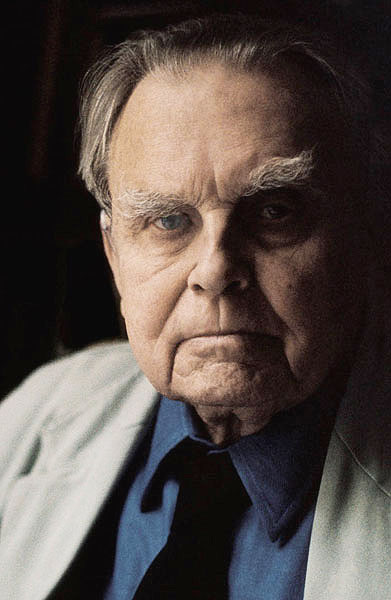
Czeslaw Milosz in Kraków, 2001
|
|
|
|
|
|
We were riding through frozen fields
in a wagon at dawn.
A red wing rose in the darkness.
And suddenly a hare ran across the road.
One of us pointed to it with his hand.
That was long ago. Today neither of them is alive,
Not the hare, nor the man who made the gesture.
O my love, where are they, where are they going
The flash of a hand, streak of movement,
rustle of pebbles.
I ask not out of sorrow, but in wonder.
--Czeslaw Milosz
|
4.07.05
The old Poles that survived WWII are dying, that whole generation is going, and listening to worldwide mourning for the Pope reminds me of my great sorrow last summer at the passing of Czeslaw Milosz. It is a small, tender mercy to feel kinship with someone you've never met. I was always comforted knowing Milosz was out there somewhere putting the world into words for me. I continue to feel a lack since his death.
I saw him twice in person: once at Linfield, and once in Poland. At Linfield, it was somewhat surreal . . . a Nobel Laureate speaking in our tiny auditorium to a tiny audience. It was the first year Creative Writing was offered as a major, and there were only two of us in the program. (The other guy, Joe, wanted to be Stephen King. And I wanted to be Milosz.) So I sat in a seat a few feet from him, and watched his face while he read his own poetry, and spent the next twenty years pondering the words "A sponge, suffering because it cannot saturate itself; a river, suffering because reflections of clouds and trees are not clouds and trees."
After he read, I went up and shook his hand, and said "thank you," and he said "You are welcome," and afterwards I thought of a thousand things I might have said after that, but didn't. And I could have, because there was nobody behind me in line waiting to talk to him.
In Poland, Wojtek and I took the train to Katowice. My landlord managed a theater there, and had given me tickets. Milosz, along with Joseph Brodsky and some others (I regret not writing it all down; it was so exciting I was sure I'd remember it forever) read and talked. This was a larger event, telecast for national television in a country that celebrates poets, and I spent the entire time slumped down in my seat hoping the camera wouldn't catch us in the audience. Wojtek was supposed to be in Kraków. I didn't go up to shake Milosz's hand then, due to the crowd and my need for anonymity, but I thought "dzien dobry, czesc, it's me, I met you almost ten years ago, I adore you" in his general direction.
Milosz's death went largely unheralded here in the States. People didn't care because they didn't know. But I remain convinced (call me Pollyanna) that if they'd known his voice, his words, they would have wept. But who reads Polish poetry in America? Who reads any poetry in America?
He was 93. I'm telling you, these old Poles, they are tough as nails. They are survivors. They shame me with their ability to just keep GOING.
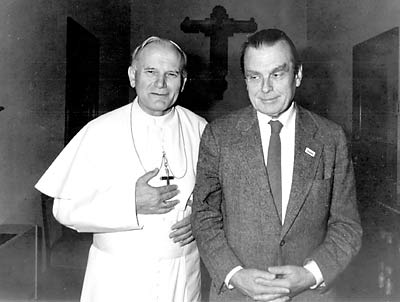
Czeslaw Milosz with Pope John Paul II, circa 1980
If you have not read Milosz and want to, I urge upon you The Captive Mind, which predated works like the Gulag Archipelago (oh, but read that, too!), all of Havel's stuff (Summer Mediations, which you should also get) (actually, get everything by Havel, the letters, essays, plays, all of it), and John Paul II's speeches against Communism.
Then dive into Milosz's poetry, and just keep reading. He was prolific, so you'll be busy for awhile, and it'll stick with you.
It's late, and I'm getting too old to have fire in my brain over poetic ideology and memories of Kraków . . . but nothing outside faith and family has impacted me more than the words of these old Poles.
Thank God Szymborska lives.
|
|
|
|
|
|