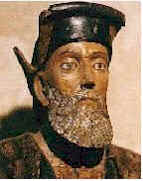
A medieval rendition of Joseph of Arimathea- 14th century, Italy.
JOSEPH OF ARIMATHEA
|
A medieval rendition of Joseph of Arimathea- 14th century, Italy. |
A short summary
Joseph of Arimathea is one of the most mysterious and enigmatic figures in the Story of Christianity. No mention is made of him during Jesus' ministry. Then he steps out of the shadows and takes centre stage at the crucial moments upon which the central mystery of Christianity is based: the trial, crucifixion and resurrection of Jesus. He commands our attention for only a few short passage in each of the Canonical Gospels and yet he is of vital importance to the Christian mythos. He is a central player in the sequence of events that result in Jesus being hailed as the Messiah of all mankind.
The four canonical Gospels recount his involvement in the Jesus story in fairly consistent ways, each gospel adding some detail about his character.
Luke implies that he defended Jesus at his trial in the Sanhedrin. And all four Gospels record that after the Crucifixion of Jesus, Joseph went to Pilate and asked for the body of Jesus. Obtaining permission he took Jesus's body down from the cross, wrapped it in a linen cloth and laid it in a tomb.
Despite his vital role in this pivotal moment of the Jesus story Joseph of Arimathea is not deemed to be an Apostle. Apostolos (Apostle) means "to send forth" or "to dispatch" in Greek. It is used to apply to the followers of Jesus who following his death were entrusted with the mission of spreading his word. However following the Crucifixion Joseph of Arimathea completely disappears from early Christian accounts.
The Acts of the Apostles is the story of those that came after Jesus to spread his name and perpetuate his ministry into a World religion. It makes no mention of Joseph of Arimathea. And neither do the Apostilistic letters.
Thus either he did actually disappear from the scene at the Crucifixion or else he continued to be active in the post- Resurrection Church but he was not considered important enough to be mentioned in the Apostilistic writings.
St. John Chrysostum in his "Homilies on the Gospel of John" takes the later view. He sees Joseph of Arimathea as probably active in the early Church but of such minor importance that he does not elicit any subsequant comment. He refers to him as "Not one of the twelve, but perhaps one of the seventy".
It is not until the early 4th Century that Joseph of Arimathea starts to appear in apocryphal texts (The Avenging of the Saviour, the Gospel of Nicodemus and the Gospel of Mary). However, these texts are late and are usually classified by historians as pseudigraphical and as partly or entirely spurious.
It is in the Middle Ages, however, that the body of legends connected to his name really flourish. During the 12th Century a myth began to crystallise. Robert de Boron's romance "Joseph d' Arimathie" and an addition to William of Malmesbury's "De Antiquitate Glastonie Ecclesie" (1129) popularised the legend that Joseph of Arimathea had fled the holy land and settled with twelve other disciples at Glastonbury in the South West of England. The legend goes that they built the first open and above ground Church in the world and introduced Christianity to Britain.
This and a series of other texts by monk historians promoting the same legend is often classified by historians and ecclesiastics as part of that great body of localised myth that is invented, wishfully, to bring celestial meaning to an environment and landscape that people know and live in.
Contemporaneously with the development of the Glastonbury legends was that of the Arthurian and Grail corpus, referred to as the Matter of Britain. This corpus associates Joseph of Arimathea with the Holy Grail and as being the ancestor of Sir Lancelot & Sir Galahad.