|
|
|
Have you thought about moving to another country? Do you want to explore another culture for the adventure of it? Are you tired of working to pay your taxes and not much else? Are you tired of lousy weather? Why not consider Mexico? First I visited Ajijic, next I'll try San Miguel de Allende, then the coast north of Puerta Vallarta. Why bother, you might ask?
Living on a fixed income, I see my options dwindle every year. I could travel to Florence, Italy and Bali, or give more to my community, if my income stretched further. What can a single white haired old lady do? It's a mindset.
June 2002, I flew to Guadalajara, bought a taxi fare to Ajijic, and proceded toward my Mexican adventure.
In High School, "hace muchos anos", I had studied Spanish for four years. More recently I had studied Italian. I thought I was prepared for basic communication. I wasn't.
The trip was long and tiring. My very cheap tickets included no food. My flight change in Phoenix ran me from one end of the airport to the other. There was no time to eat. Our American West stewardess was Chinese. She spoke neither English nor Spanish very well. My arrival time was dusk in Mexico, soon to be dark. Deplaning and walking across the asphalt, looking around, my surroundings screamed "Dorothy, you aren't in Kansas anymore". "Culture Shock" is not just words. It is real. I was tired and overwhelmed.
The manager of my B&B in Ajijic had emailed me directions in Spanish. This was my salvation. I managed, "Por favor..." and handed the taxi driver the printed instructions. He spoke no English, but he drove me straight to my door. Gratefully I tipped him more pesos than he was expecting.
Don and Jeanne, the owners of the Inn, met me at the door. Don was wearing one flip flop. Ya gotta' love this guy! (Don died the next year, but Jeanne continues. He was a brilliant true gentleman in every way.) In short order, I was installed in my room. Jeanne ordered me to take a dip in the pool, while she graciously prepared a lovely omlet supper for me. This was one of many kindnesses. The crickets chirped. The stars twinkled. The soft mountain breezes embraced me. My adventure bagan...
"A picture is worth a thousand words", they say. I took all of the pictures displayed on this page with a garage sale Kodak Star 35, point and click. Looking over these pictures makes me feel sentimental.
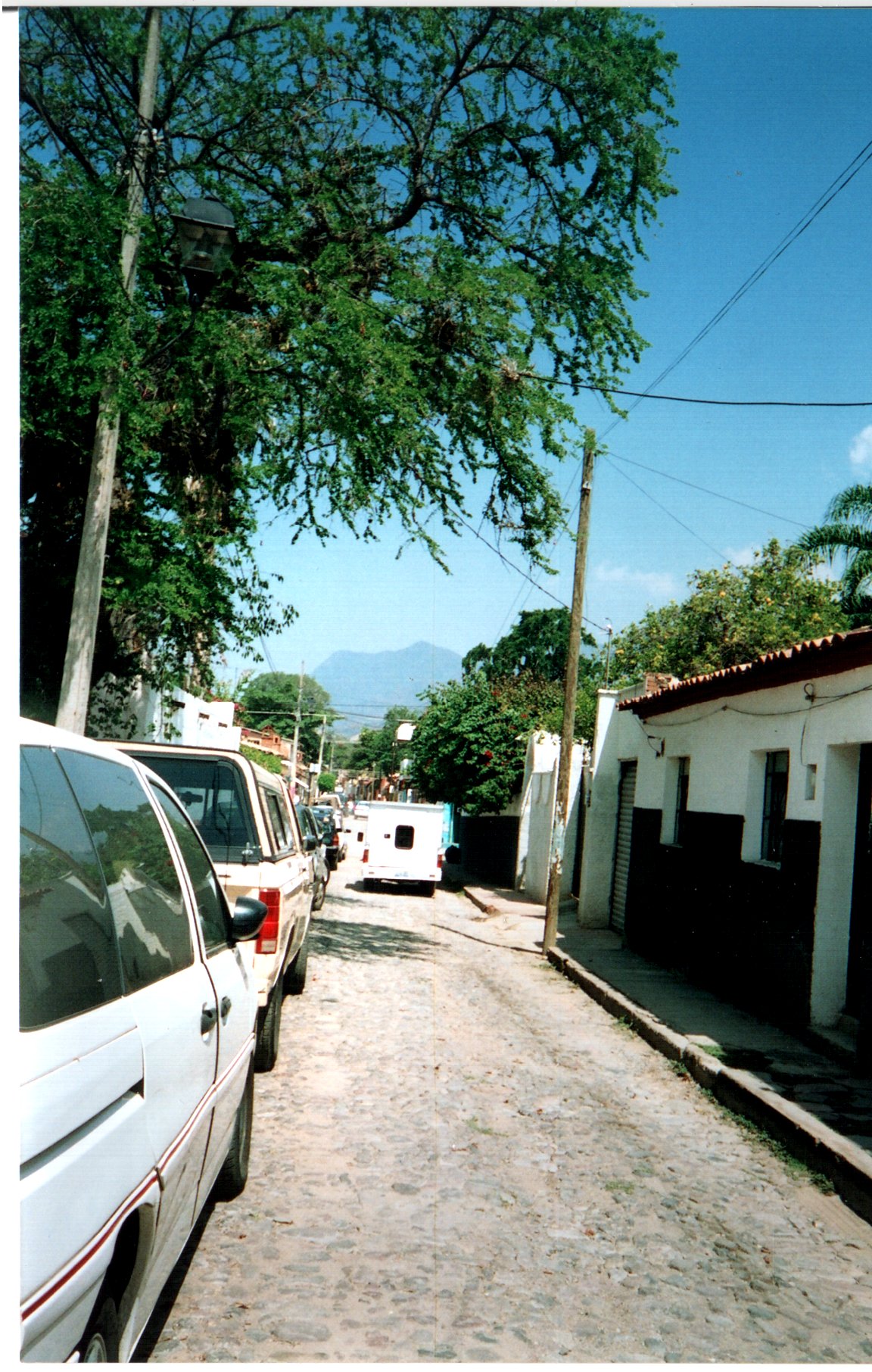
Narrow one way streets have enough room for parking on one side and one lane of traffic. Most people walk everywhere. Many of the sidewalks are renovated.
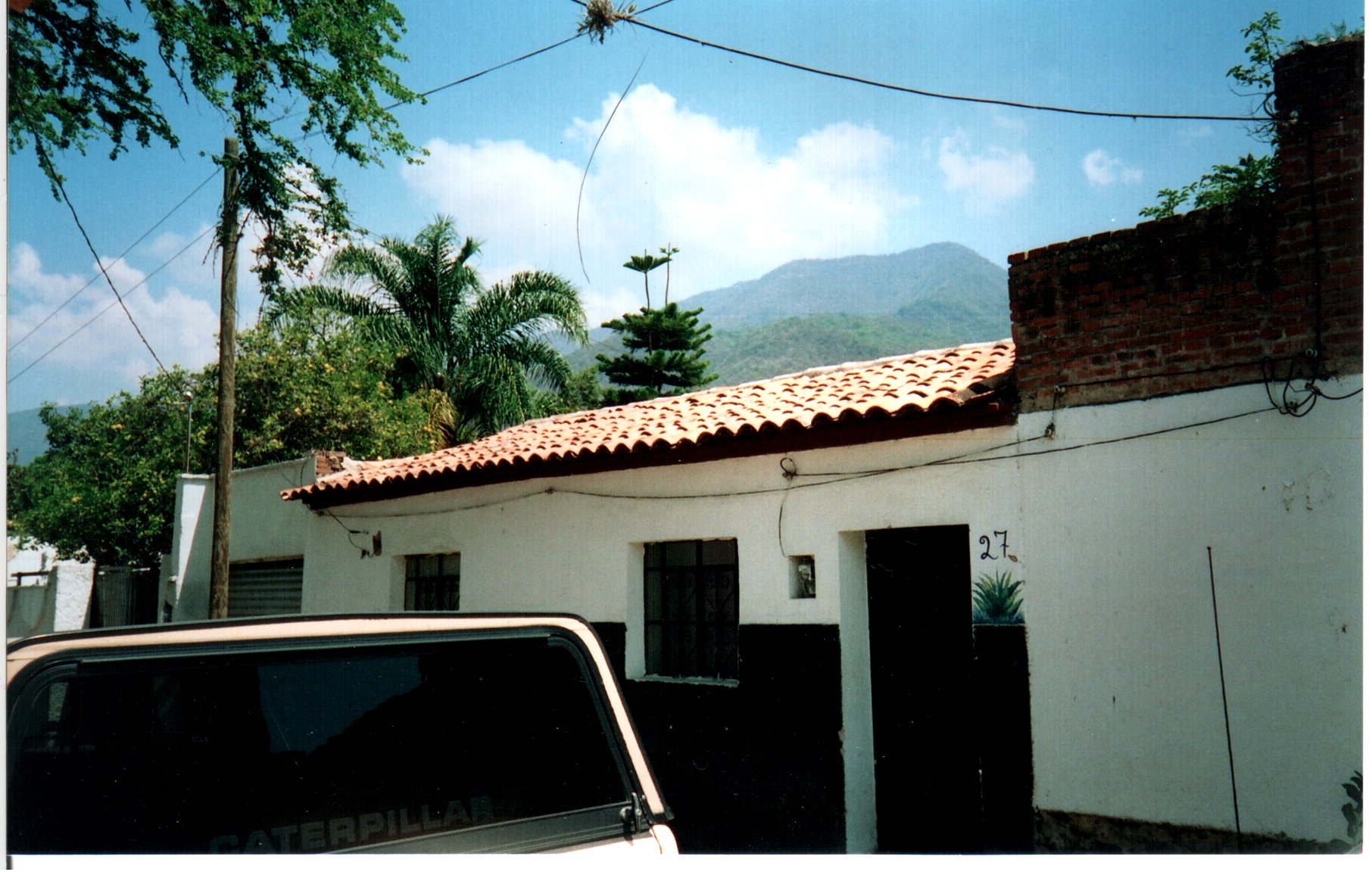
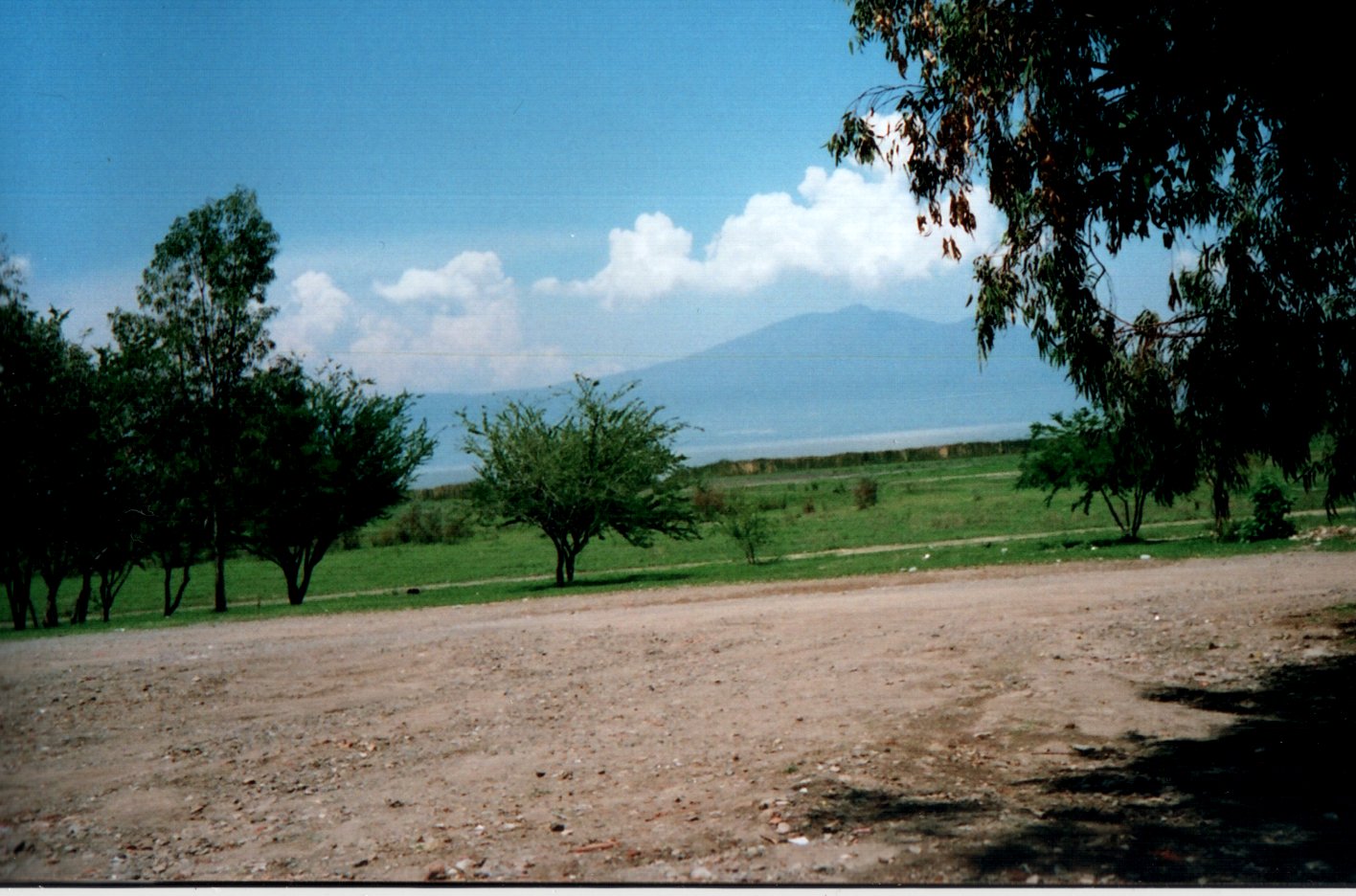
The villages are a string of pearls stretched between the lake and the mountins. The Sierra Madre mountains block the polution of Guadalajara to the north. In this picture, I was attempting to show the white wooden cross up the side of the mountain. I didn't succeed. You can walk up to it and go through "the Stations of the Cross".
To get from village to village, you can buy a ticket and take a public bus on the Carretera. The Carretera is a four lane blacktop road that runs through the north side of the villages. If there are any stop lights in a village, they are going to be on the Carretera. I don't know if there is a speed limit, unless it is "Fast". The Police tend to make up their rules on the fly. Crossing can be a challenge in the afternoon. It was worth the effort to me to walk the distance to a stop light and use the Stop button on a pole. Walk fast! You don't have much time.
The Mexicans are mestizo with the genetic heritage of both the Conquistadors and the indiginous Indians. A local joke: the only thing the French gave Mexico is great bread.
The people are beautiful. Juan, the contractor from the Inn, drove me back to the airport. We were discussing the Mexican people and how advertising influences the way people see themselves. "White" is considered "better". Juan told me that he has two girl cousins the same age. One is very light and the other is very dark. The light girl is popular and has scholarship offers. The darker cousin is not offered anything. Juan's heritage is Aztec. He has worked hard to create his business, learn English, educate himself and prosper in his very poor country. I told him not to forget to tell his children how blessed they are to have such a rich heritage. We laughed and shared our souls in the short thirty minute ride. English, Spanish and Spanglish, all mixed up. The Mexican people are modest. Flaunting wealth is considered bad manners. Some people are very rich and some people are very poor. There isn't much middle ground.
The streets of Ajijic and Chapala are narrow one way cobblestone. There are no wide freeways nearby. The freeway from the Guadalajara airport to the lakeside villages is equivalent to the freeways in the States of 50 years ago. They are not limited access and not sterile landscape. There was very little traffic. I smiled when I saw a large dead bull by the side of the road. It lay there swelling in the fading sun. I though to myself, "Manana". Mexicans don't get uptight about dead animals or excrement on footpaths. They spend their time making their homes and private gardens beautiful. They spend their time stopping to say "Hola" to their neighbors. Family comes first, always. Mexicans work long hard hours. How did they get the reputation for being lazy? I'll never know. (Interesting note, on my return trip to Guadalajara a month later, the bull was still there.)
There is seldom traffic noise in Ajijic. A car or truck passes every now and then. Sometimes a strong boy rides by on a bicycle. Occasionally you hear a donkey braying, especially early morning, carrying a load of goods for an enterprising farmer. Sometimes gentlemen on horseback ride from the dirt lake road through the cobblestone streets of the village. Several week days, a noisy truck drives by with speakers on top blaring salsa music with the driver on a PA, loudly announcing, "Gas! Gas!" or "Agua!" and sometimes, "Fruta!". This passes quickly.
The Lake Chapala Society, LCS, is a repository of valuable information and support for the Expats who move to Ajijic or the touristas who visit during the tourist season. A successful Expat village artist donated the land and buildings in the 1920s. With a small yearly membership donation of $35 a year, good stewards have made LCS an Expat treasure. With the membership, you get the updated LCS directory of local members and businesses, addresses and phone numbers. An Event Calendar of fiestas and celebrations helps the Expat find his or her niche with little effort.
Introductory classes are offered FREE. I took a Spanish pronunciation class from Sebastian, a local well ecucated young man who loved communication and teaching. He offered group conversational Spanish classes in his home for a modest fee. I signed up.
The calendar announced that Scrabble and Bridge are played in the Pavillion on certain days. When I showed up, about a dozen ladies of a certain age were gathered. They graciously set me up at a table. It was fascinating. Everyone had a different accent: English, Scottish, German, Austrailian, French and American. This was typical for LCS events. For those who waxed nostalgic, goup activities were available for the country of your choice. On the LCS grounds, English was the universal language.
Every Sunday an inspirational meeting was offered by different members. One Sunday it was held in the Pavillion, another Sunday it was held in the courtyard. One soon realized that not only were the members from all over the world, but most of them were highly educated. One talk was given by a PhD of physics who took his degrees from Cambridge in England. His new passion was poetry. His discussion topic was his experience with the Muse. To end the gathering, someone offered a prayer. Someone suggested a place to eat. Some of us had no cars - like me. Others offered transportation to the chosen restaurant. More personal conversations continued at the restaurant. Was this a dream?
Several rooms in LCS were devoted to books and video tapes. Members volunteered to keep everything organized and running smoothly. This wonderful library was offered to all. Check it out - return it - free.
In the spirit of the donation of this land, all Ajijic children were offered free art lessons. Over the years, a number of artists succeeded. Some of the local children moved to California or other states, opened businesses and returned back on retirement. One good deed does make us all richer.
Regular lectures are offered about Mexican Health Insurance, immigration laws, etc. Knowledgeable bilengual lawyers and health care providers conduct these. Once a week you can get your blood pressure checked. Hearing checks and eye exams are offered periodicly.
The Mexican postal service is hit and miss. However... The LCS has come up with a system that works well. Put a standard US stamp on your letters and drop them into a big wire basket at LCS. Within two or three days, someone will head back to the states and take the basket with them to the closest US post office at the border. I used the service several times and the letter arrived in Seattle an average of four days later.
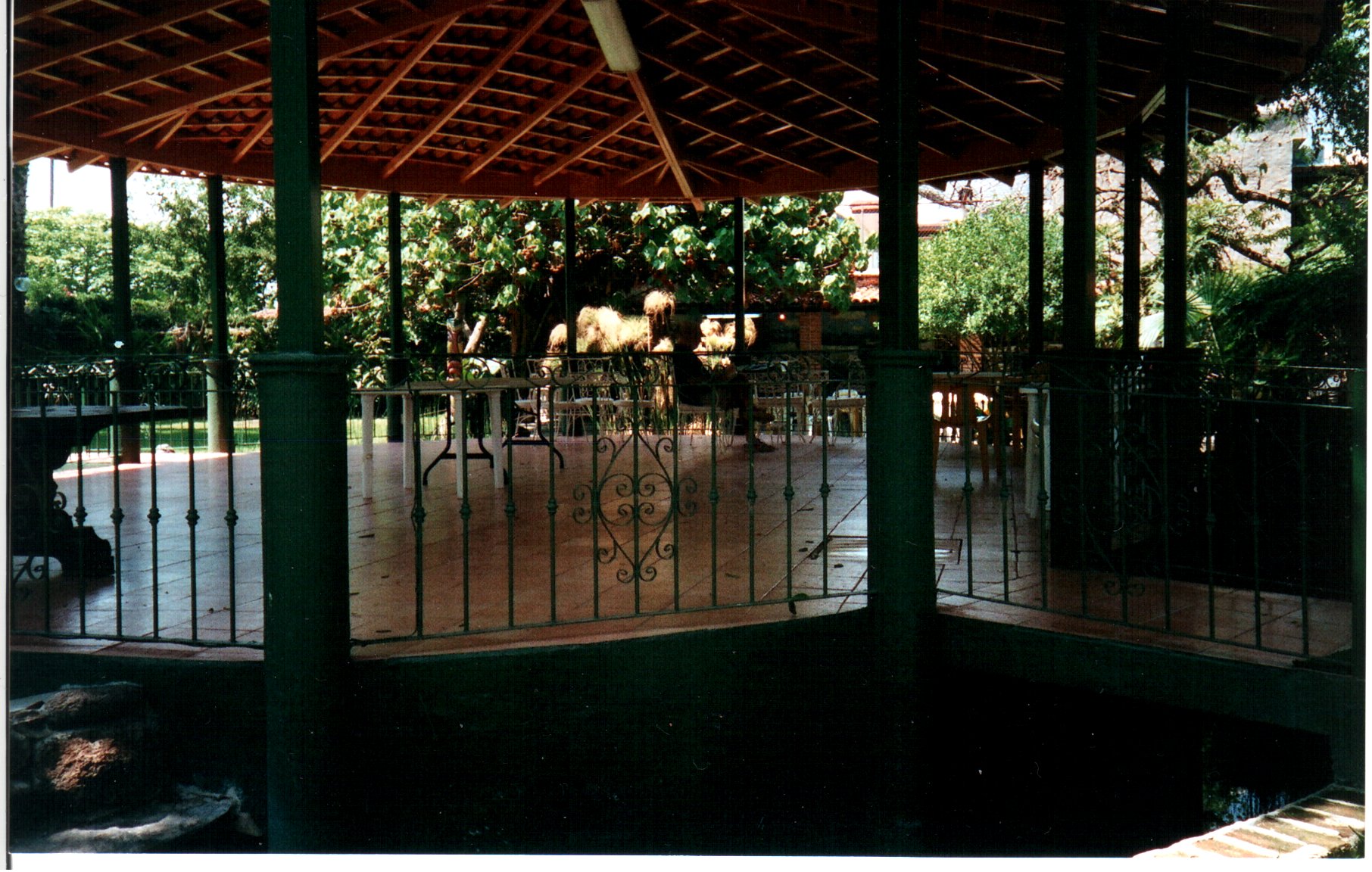
An open air pavillion on LCS grounds can be set up with card tables, folding chairs or food tables. If you look carefully, you can the dark figure of a man quietly reading a book in the shade. The LCS grounds offer a beautiful place to contemplate. Well tended flowers and gurgling fountains add to the charm.
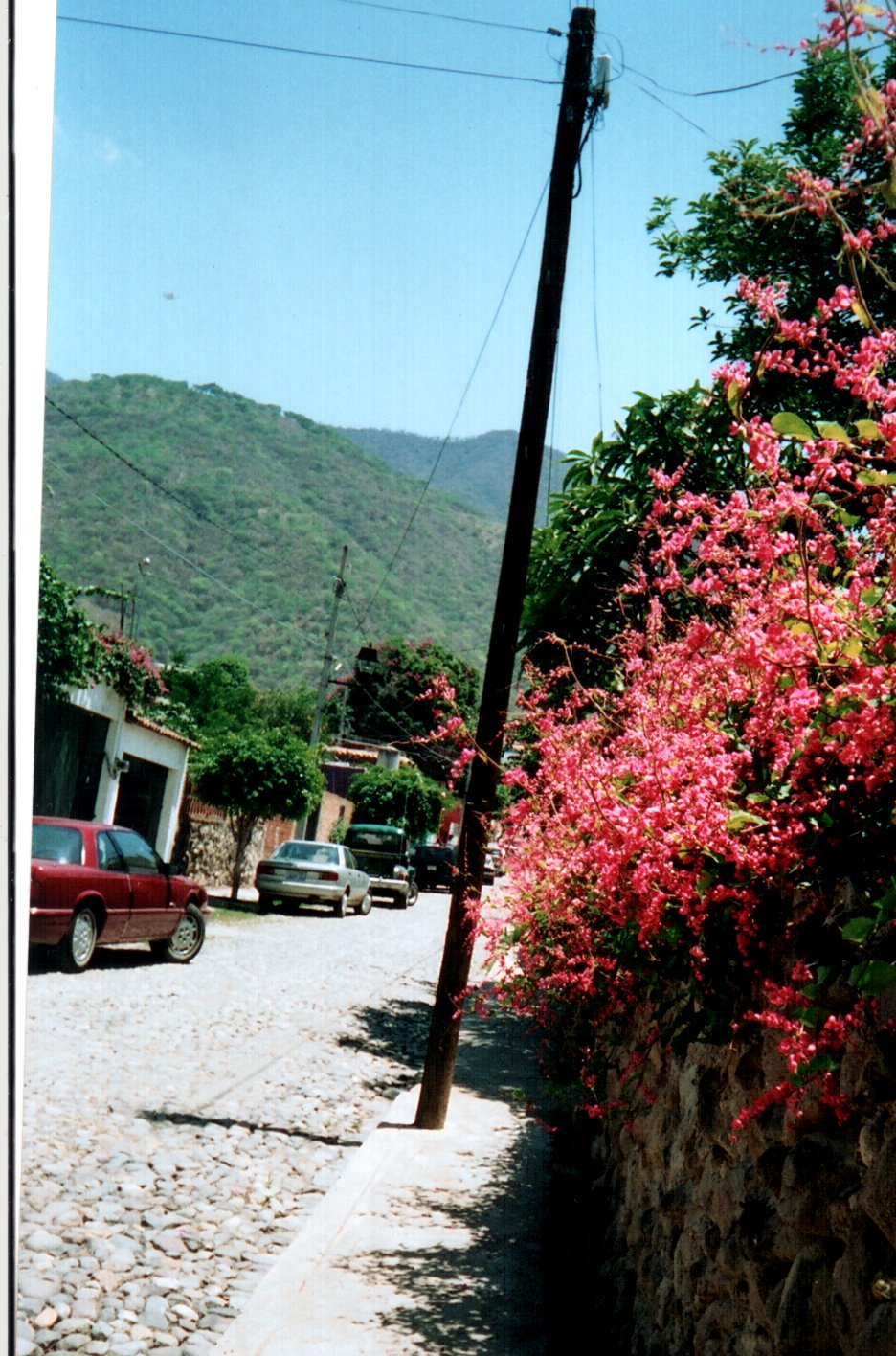
This is a wall around LCS. Bees buzz in the blossoms. The first morning there, a swarm of "Killer Bees" took residence on the wall between LCS and the Swan Inn. Someone from LCS called a bee keeper and moved the swarm.
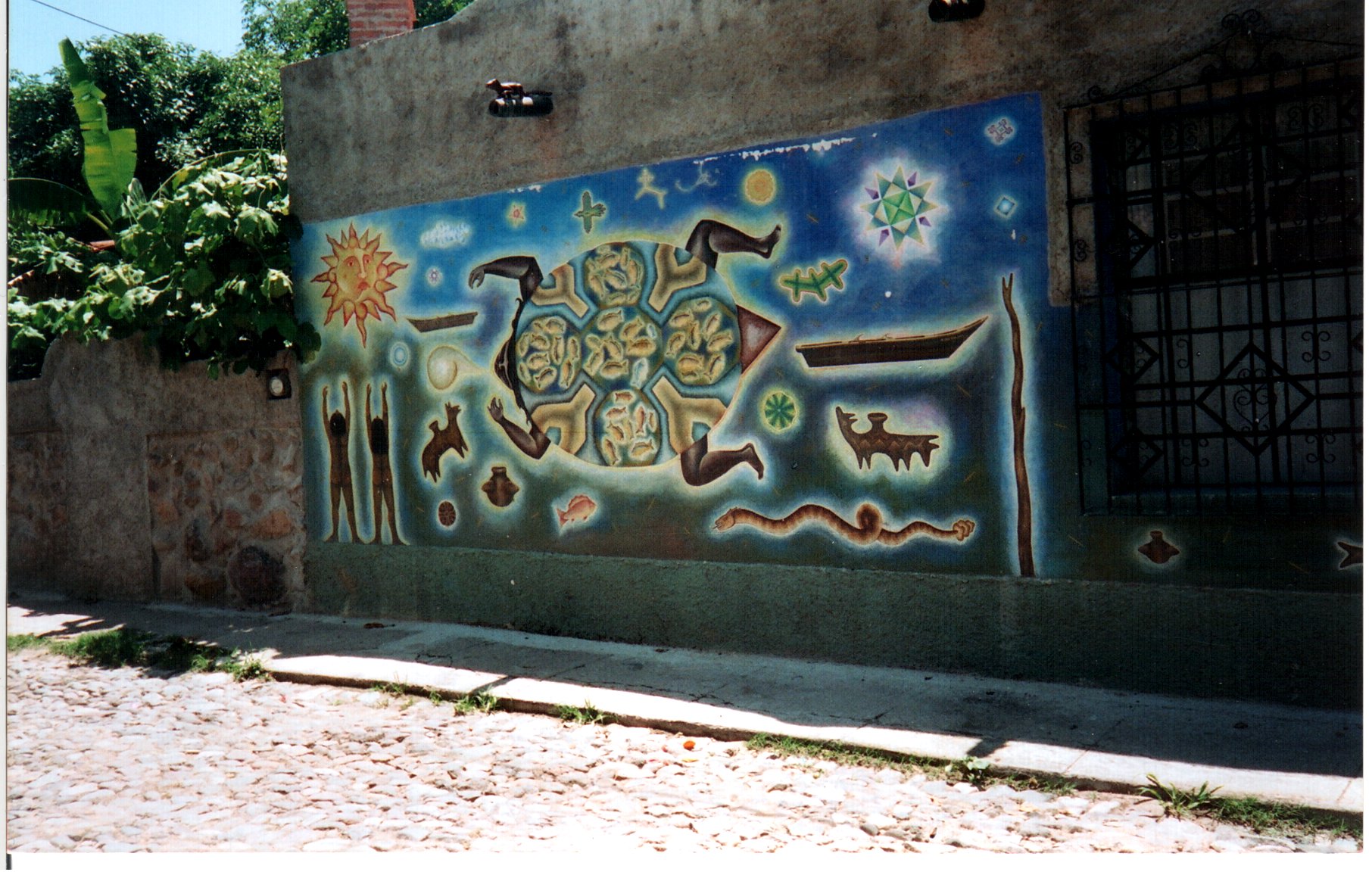
The mural on an LCS wall was rendered by local artists. It depicts an Indian Creation Myth. Murals in the village blend well with every day life.
In Ajijic, water is available, piped in from the street to homes and businesses. It isn't potable, but it is available. Considering that eight months of the year, the countryside is semi-arid, until June, this is a very nice convenience. My B&B ran all water though a water purification system and stored it in a rooftop cistern. That means that you can drink the water from any faucet and not get sick. That means that you can gulp the water in the pool or shower and not worry... brush your teeth, etc.
Most local restaurants are careful that all water is purified. Because Ajijic has a strong Expat community, the restaurants could not stay in business if the gringos got sick. If in doubt, ask a local gringo. Another clue is the ice cubes. If the ice cubes have holes in the center, they were made with purified water. If there is no hole, don't use them. I ate fresh salads, fruit, and milk products with no problems. Most people soak salad components in a solution that kills the bad bacteria. If you have no referral, pass on those foods.
Sometimes what you see on the internet has no correlation to reality. I was very fortunate. The Swan Inn was exactly what I expected, but better. Much of the MexConnect.Com web site is valid. Read the Bulletin Boards. If you sincerely want to learn practical information about Mexico, subscribe to Mexico-Insights.
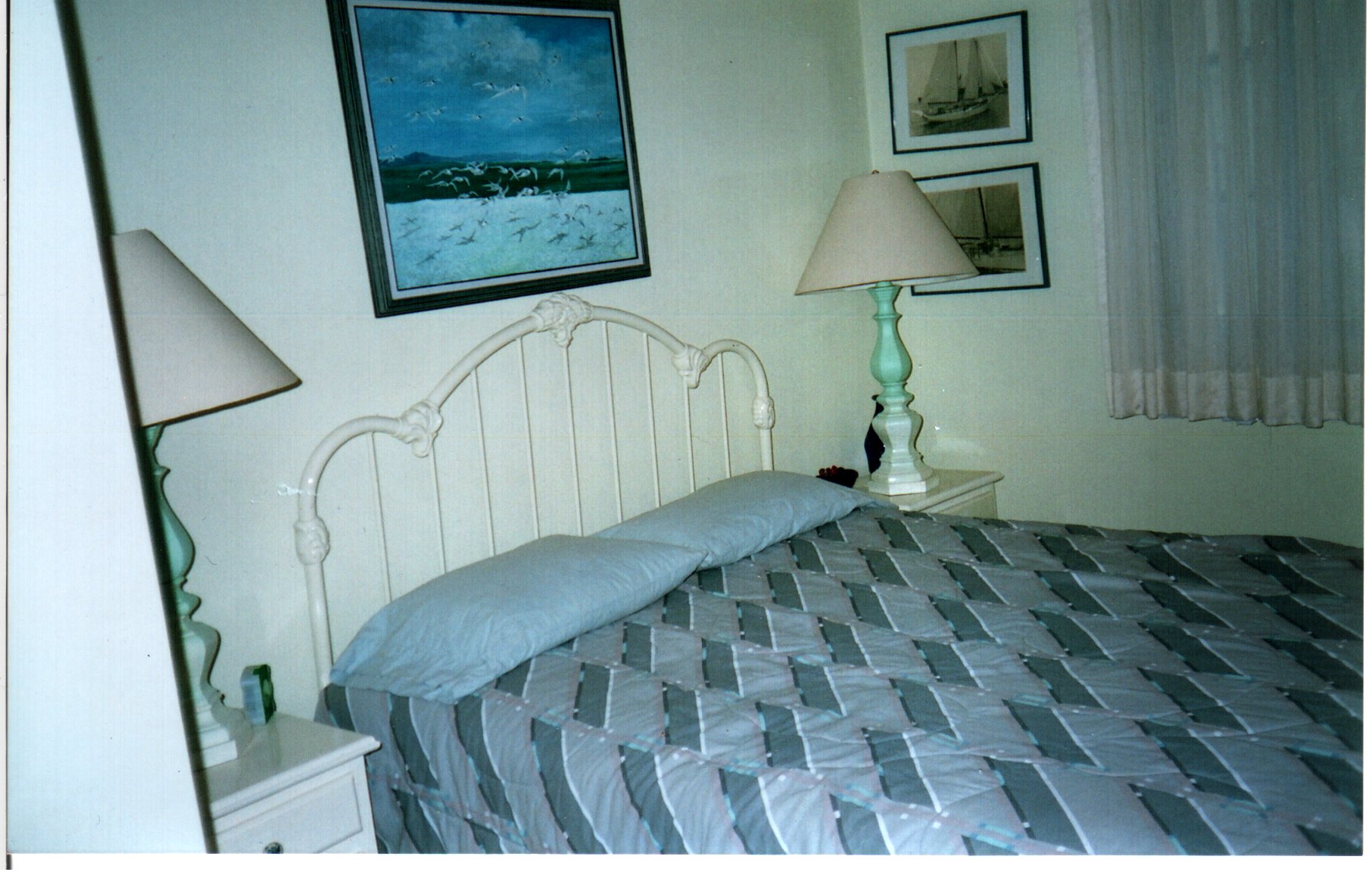
My "Nautical Room" is graced with original art work and needlepoint. A clothes closet and dresser provided a place for me to organize my things. A linen closet in the bathroom offered clean towels and storage space. A small color TV carried Mexican cable stations. I was located on the bottom floor and faced an inner courtyard that included a small Japanese garden with lime and quince trees. Just outside my window, an Avacado tree flourished, bearing fist size Avacados.
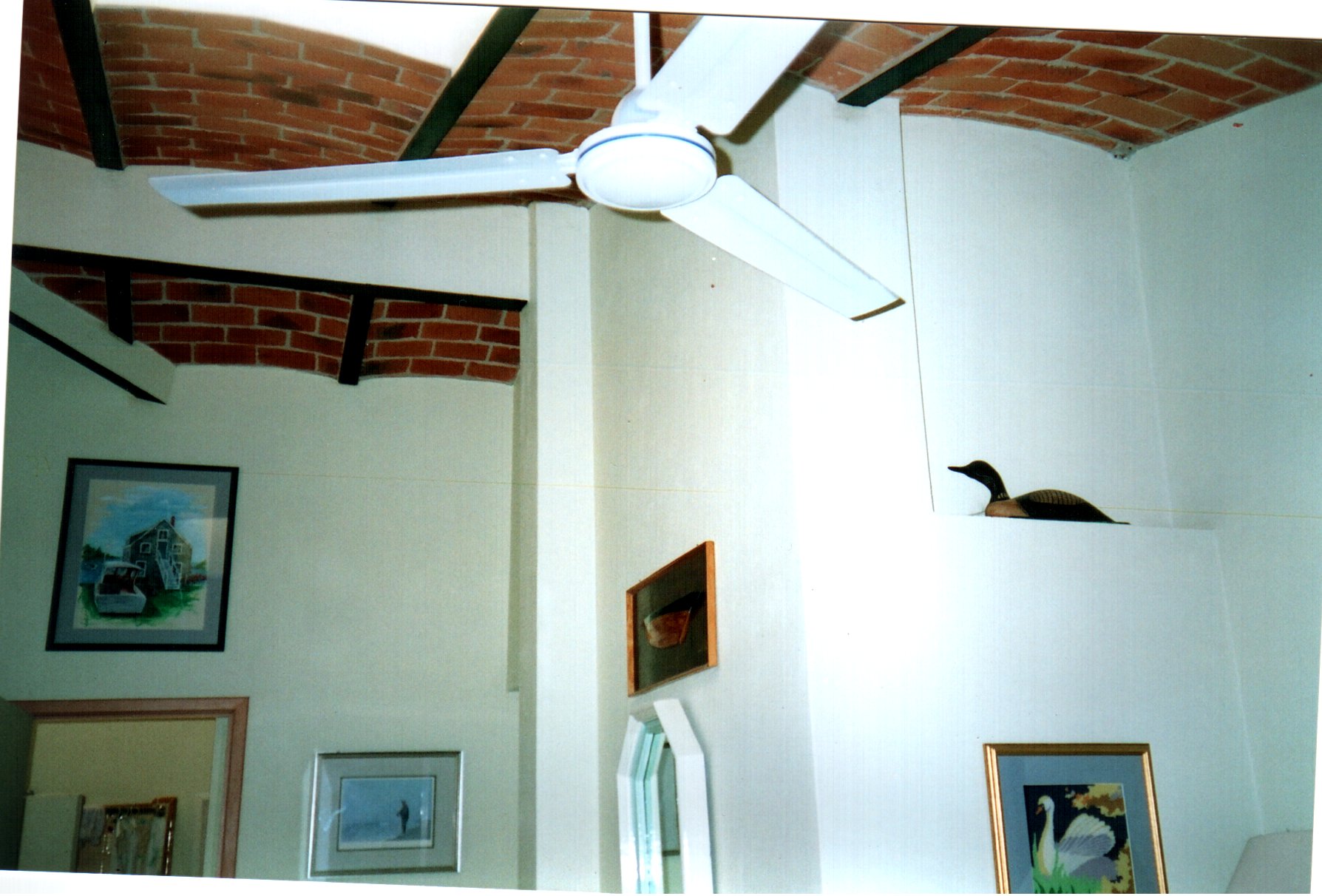
In the Boveda style ceiling you can see a large skylight and modern ceiling fan. The windows are screened to keep out the beasties. Every detail was planned with care by Jeanne.
It is common practice to use Skylights instead of electric lights. Electricity is expensive. The climate along Lake Chapala is mild. It doesn't get that hot in the late Spring, under 90F, or that cold in Winter, low 40sF. Most homes have neither air conditioning nor central heat. Instead, ceiling fans and natural radiant heat are used.
The rains came late, after the first week in June. Most nights it stormed in the middle of the night. From my bed, I could watch a wonderful light show flashing through the skylight and count the miles until the thunder. By sunrise, the sky was washed clean blue. The streets and sidewalks sparkled in bright sunlight. Within a week, the mountains changed from brown to new green.
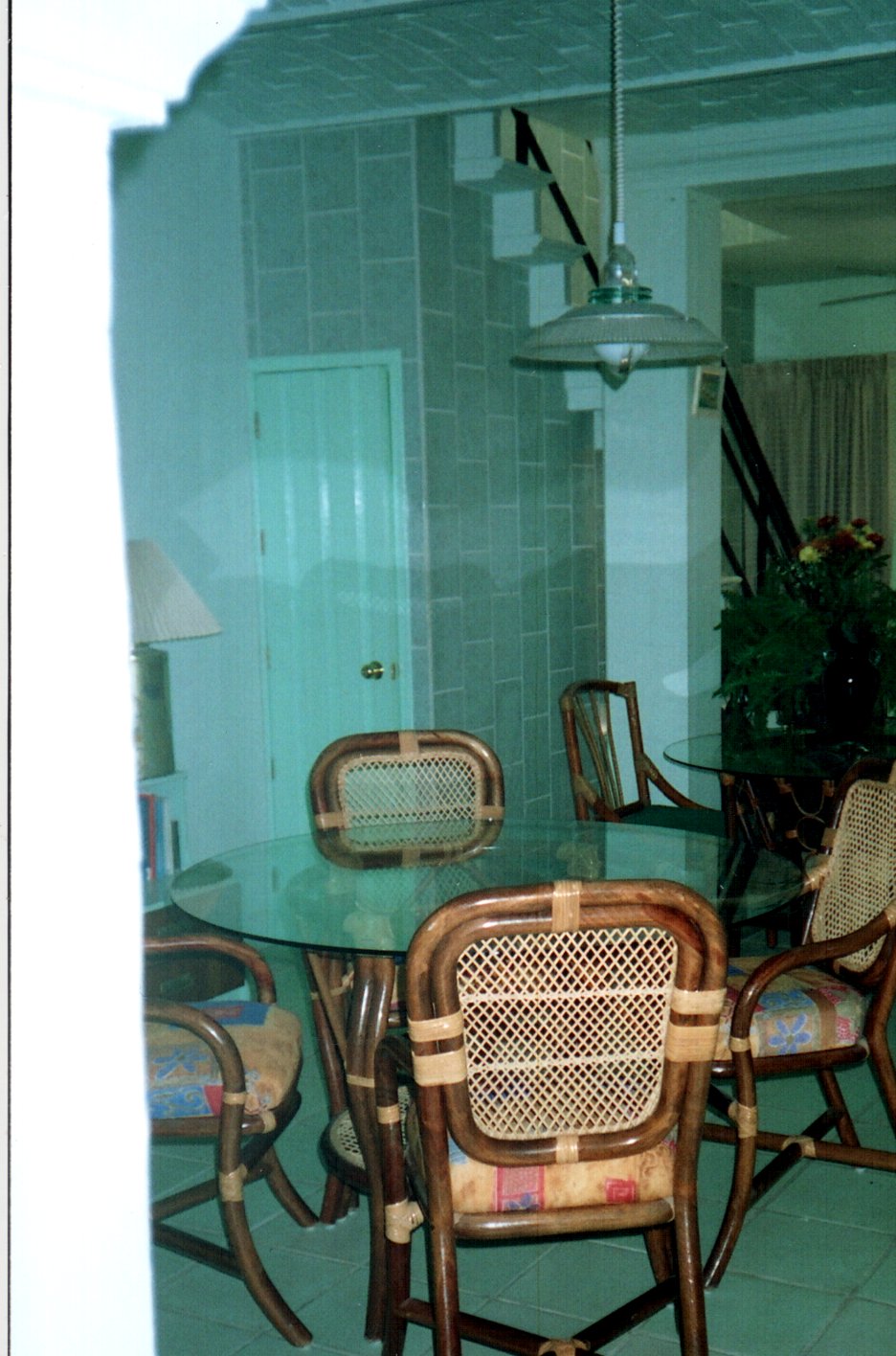
The first two mornings, I listened to the progression of sounds of the village waking up. Around 4:30 am the first set of birds began their song. Horses whinnied. Several donkies brayed. Dogs barked for breakfast. Then lazy roosters announced the day - late. By 6:30 I jumped in the shower before I took a walk along the Lake. Some gringos jogged along the dirt road. I watched the sunrise paint the mountains before breakfast. From the buffet, a standard fare was offered every early morning: a tray of fresh tree ripened fruit, homemade yogurt, dry cereal and milk, pots of hot coffee, a daily sweet bread from the bakery, jam and butter, and sometimes fresh squeezed orange juice. We dined on glass top tables. See the front door in the background. The night before, the guests are asked what time breakfast is preferred. Most of the time, 7:30 am was chosen. We straggled in and started with something from the buffet. Then the manager asked each if we wanted the daily entre. Different things were offered different days. Everything was delicious: omlets, fritatas, pancakes, etc. I ate, walked to a class, painted or explored and cooled in the pool, socializing with other guests. One night we gathered to play Mexican Train Dominoes. (Thanks Alex!)
The sitting area is on the other side of the public room. Books and magaines are available. The TV carries many Canadian and Mexican programs. A small fireplace can warm a chill.
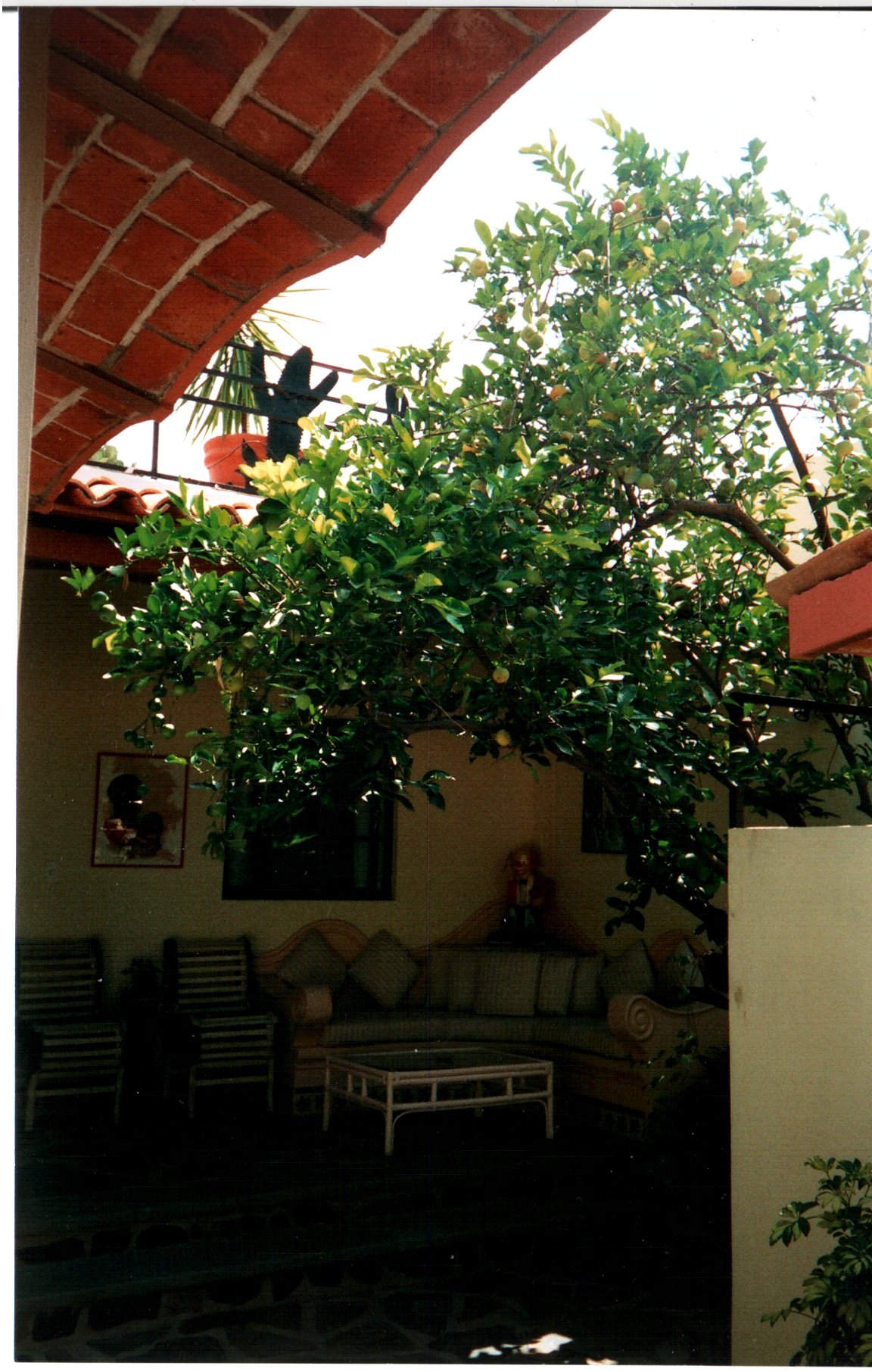
Several outside sitting areas provide comfortable places to read or daydream. See the fat lemons on the tree. The Inn has a small central kitchen available to guests with a full size refrigerator, ice trays, a sink, dishes and cutlery, a double hot plate, small microwave, electric coffee pot and shelves. Usually, I prepared a tomato and cheese sandwich for late lunch and went out for dinner. Some guests chilled beer or mixings for evening drinks. Mexican electrical outlets are the same as those in the States. No converters are needed like in Europe. If you plug in your computer, use a power strip to protect against power surges.
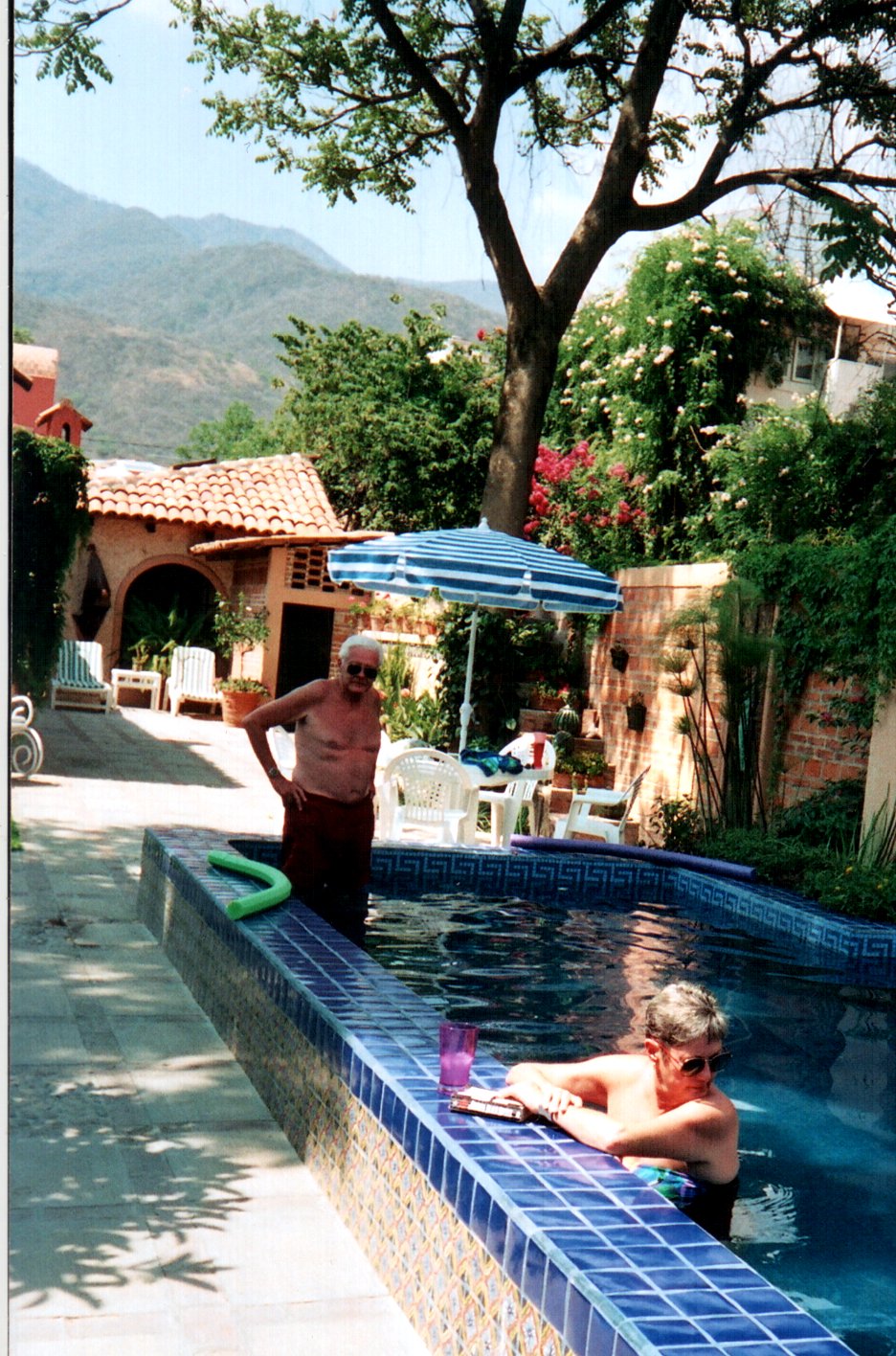
Guests share a pool to cool off and socialize in late afternoon. The couple shown here are both highly intelligent accomplished people, each in their own way. I hope they don't mind these pictures. The brown mountains in the distance soon green up when the rainy season finally begins.
Within five days I was ajusted to the altitude and time change. From Seattle to Lake Chapala, there is an altitude differential of 5,000 feet. I am convinced that it is so easy to ajust because the lack of traffic noise and the lack of air pollution is healthier. In other words, if you normally live at sea level, you will feel tired at the higher elevation for several days.
When you get a room somewhere, negotiate a daily price. When you get there, if you like the place, negotiate a long term price. If you stay for a week or a month, it is much cheaper. Maybe because I am lazy, I chose to stay at the Inn, instead of renting an apartment. Having a hearty breakfast, fresh towels with maid service daily, good conversation in English, made my days carefree. The Inn has six rooms, reserve early.
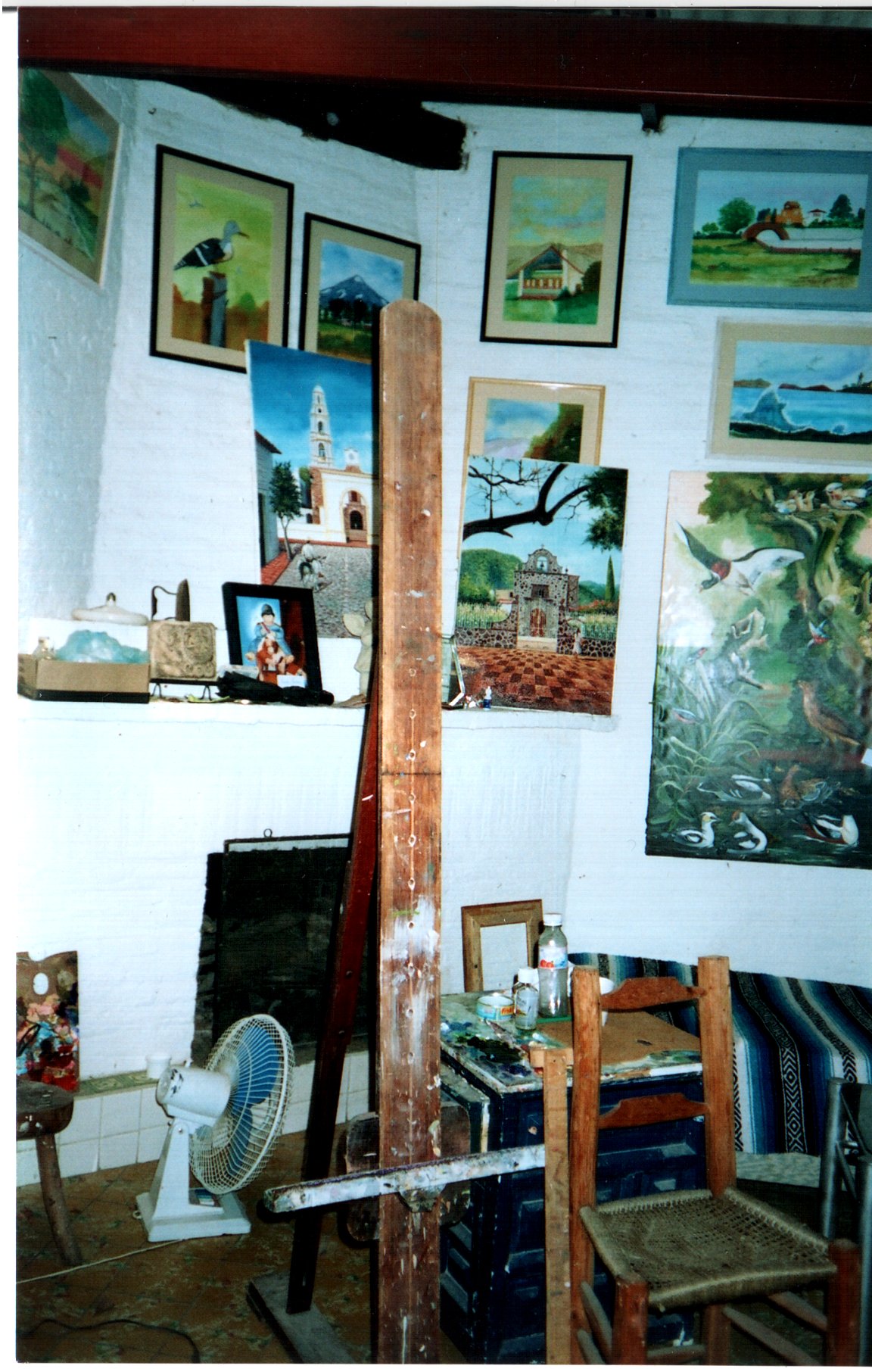
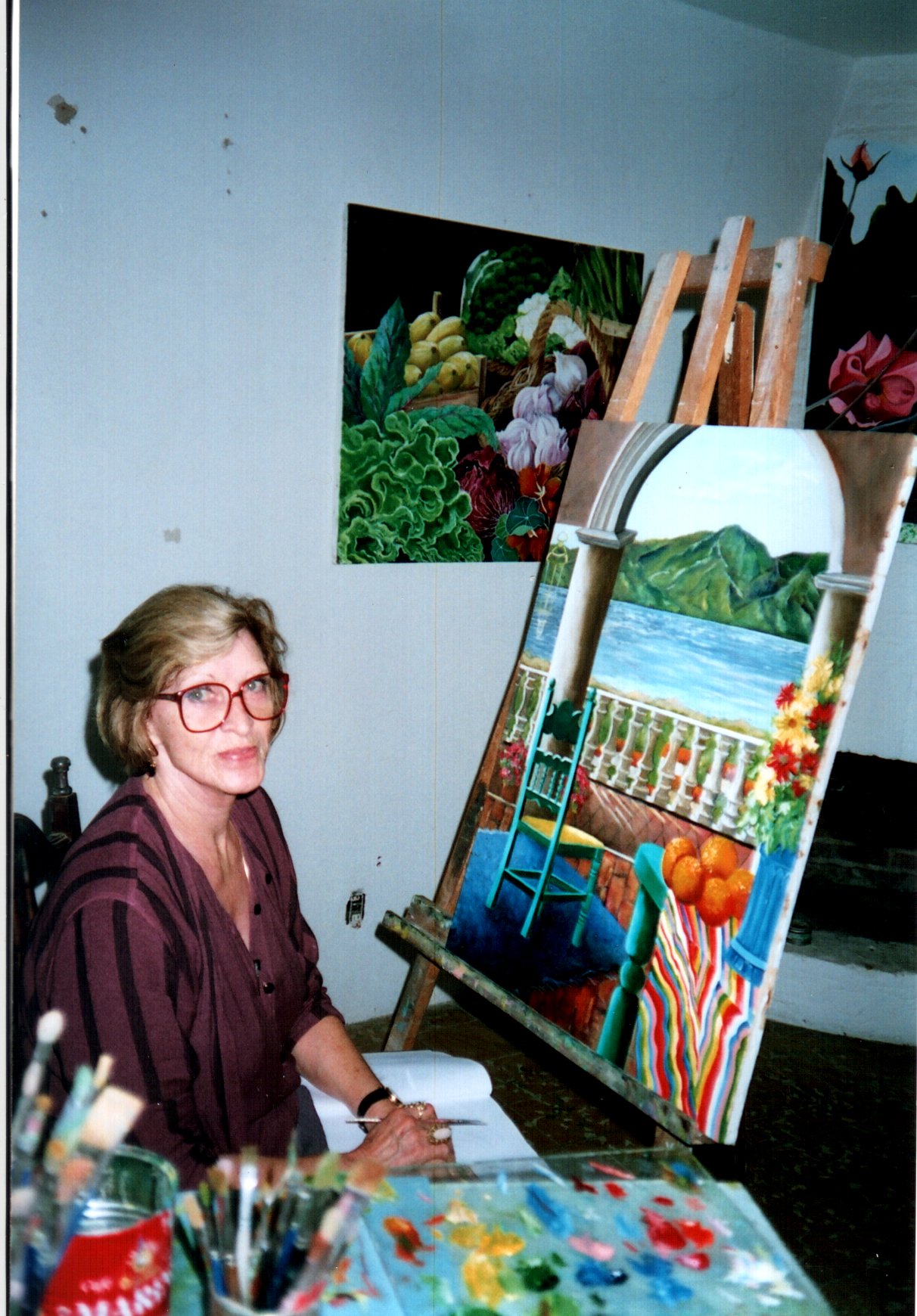
On the third day, I joined an Art workshop with Victor Romero, a skilled Mexican Artist. The other workshop members were skilled artists in their own right. Paintings lined the walls, for sale to the public. I was instructed to buy the four basic oil colors plus white, several brushes and turpenoid thinner. Don Niederlitz, the owner of my Inn, gave me a starter set. I later learned that he had been a famous artist in New York. Many of the paintings in the Inn were painted by him. An 18x20 blank canvas was given to me. The art experience was a magical deja vous surprise.
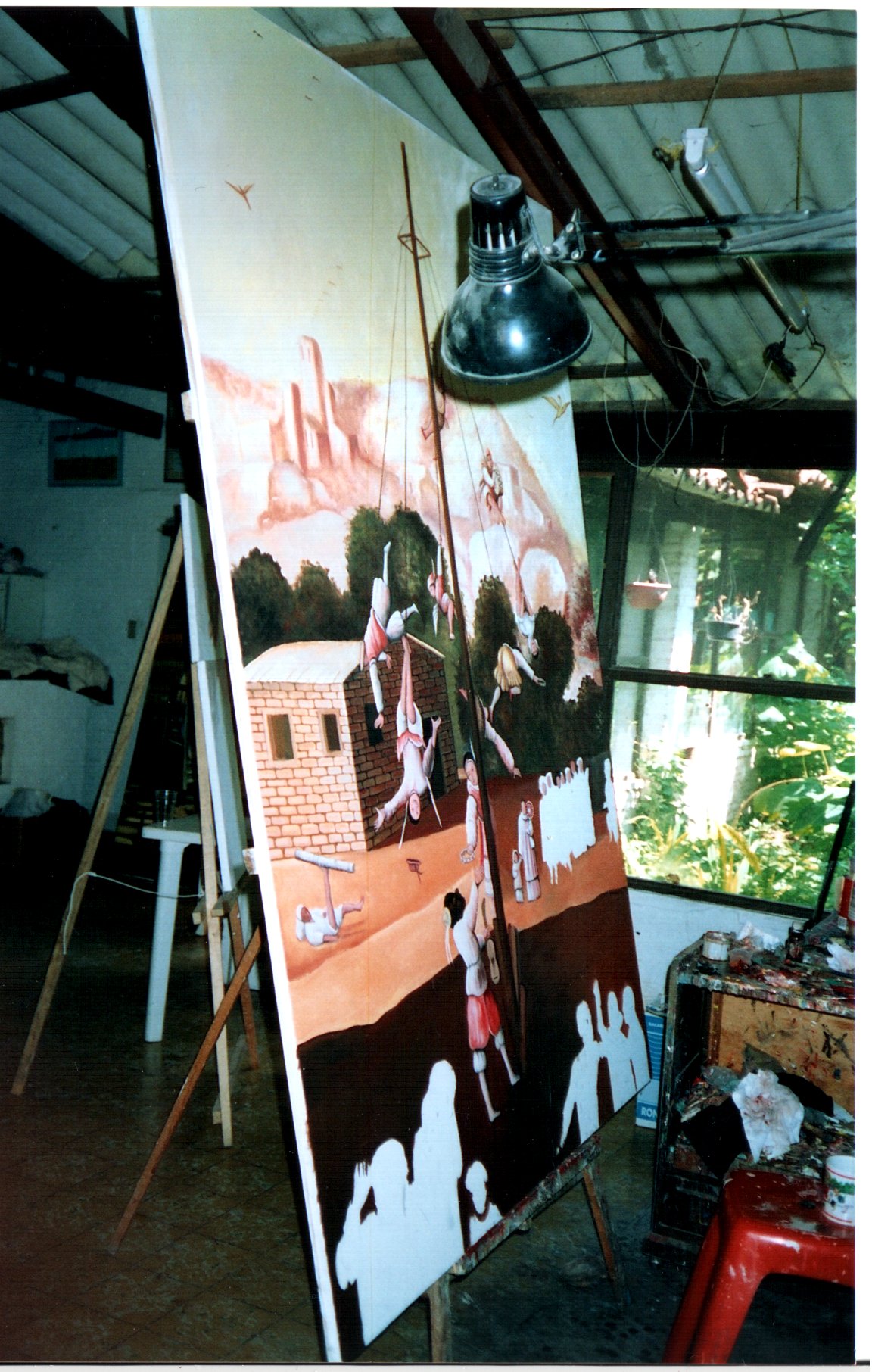
The huge paintingthat greets visitors is a work in progress by Victor Romero, a consignment painting for one of several American department stores he supports.
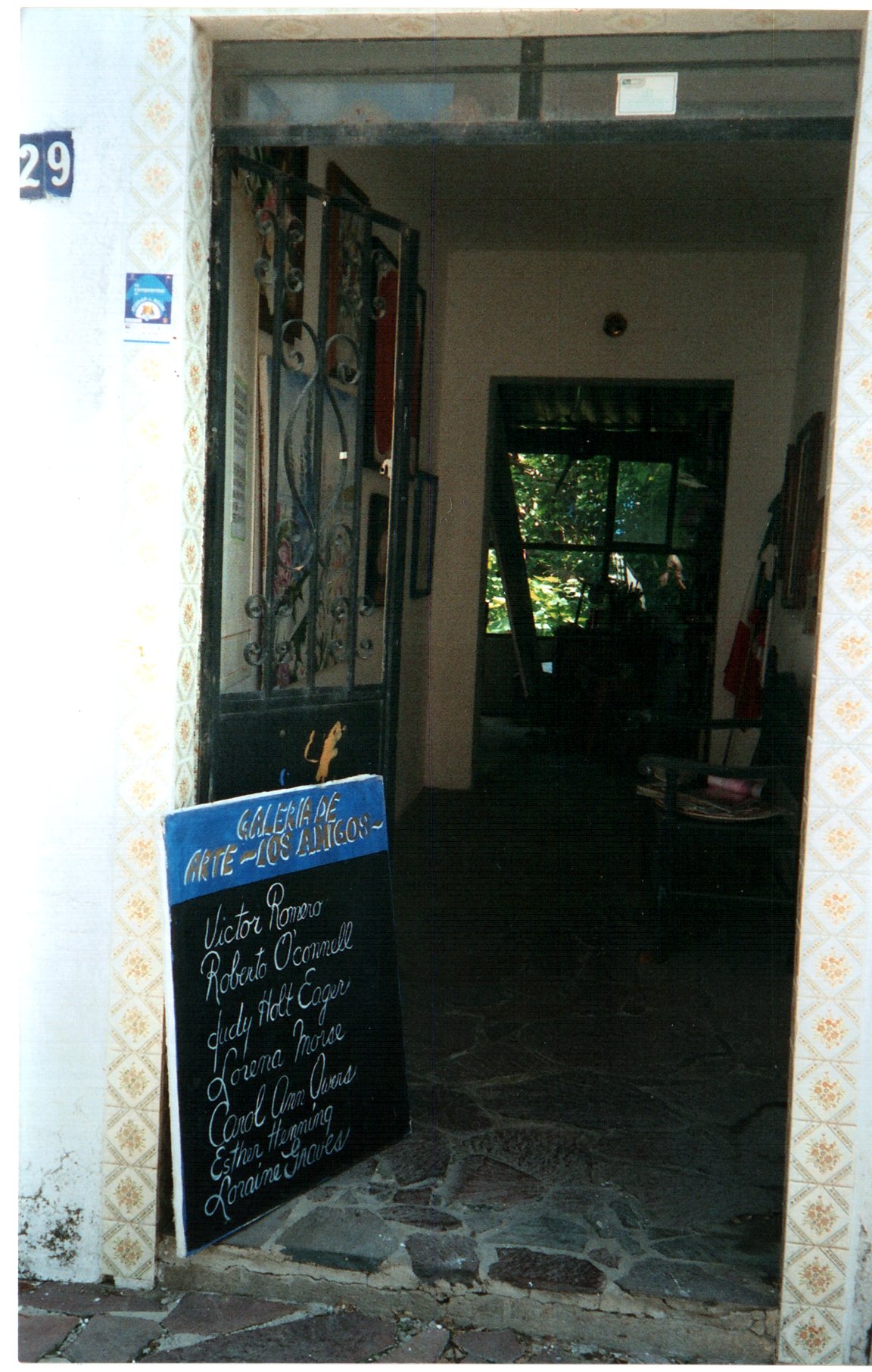
My spot in the gallery provided a place for me to learn the basics. My easel, chair and glass pallette faced a wall of completed works. During the day, tourists wandered through. In time, some of them included us in their daily rounds, to check our progress. I felt great pride to be part of this group. The group motto is, "Everything is for sale." They have since moved to Javier Mina street.
Artist Judy Eagermigrated to Mexico fron Denmark via Canada. Her still life on the wall has already sold. Her current painting is a view of Lake Chapala. Her son runs La Nueva Posada, a lovely restaurant with the best view in town. Enjoy a gourmet dinner on the patio and watch the sun slowly set on the high mountains across the lake. I recommend it. If you are in luck, Carlos, Carlos and Tom will drop by to serenade you with Mariachi music, five songs for 50 pesos. They take requests.
Victor suggested I find a subject from a stack of art magazines to copy. I chose a painting by J. Nelson, four spirit dog soldiers with spirit horses and a black crow. This is a complex picture, but I liked it very much. I still like it. I was inspired. When I covered it with tin foil and packed it in my suitcase, it traveled just fine.
Initially, I inspected the ground carefully on my walks around the lake and in my room. I had read about them on Mexconnect.Com. (This website now charges a small sum, but it is worth it.) I never saw either in Ajijic and I walked at least five miles every day. I have seen a number of scorpians in Alabama, but not Mexico. Nor did I see tarantulas, even when I walked to and from a restaurant at night. I did see several cucarachas. They can't hurt you. In the evenings, mosquitoes may bite. Bring mosquito repelent if you are sensitive. However, they are not as numerous as in New Orleans. The loud aggressive buzzing of the killer bees was initially daunting. However, I sat near the wall where they swarmed and they paid me no mind. Creepy crawly things probably exist in the more rural areas, but I didn't see them. After all, the area is lush with tropical flora and fauna.
Don't hesitate to create your own adventure. And yes, you CAN do it alone. The Mexican people are warm and wonderful. Learn some conversational Spanish. I take Spanish Conversation classes through Bellevue Commiunity College. No, Spanish is not necessary. Before I left, I spent a lot of time at web sites gathering information.
Read "Midlife Mavericks, Women reinventing their lives in Mexico" by Karen Blue. She moved to Ajiic from Silicon Valley, renovated a Mexican house, and teaches classes to gringos who wonder, "What if...". I took Blue's class in Ajijic. Blue did it... why can't I... or you?
Read "Mexico's Lake Chapala and Ajijic" by Teresa A. Kendrick. This book has practical information with pictures. I took it with me. Excellent information.
If not now, when, unless you plan to live forever?
... to be continued...