

Key Accomplishments
Region11 Soil Data Quality Specialists have had the opportunity to contribute greatly to the over all team efforts here in MLRA Region 11 for the past 4 years. They have been tremendously involved in the following activities to meet internal and external customers and partner needs in terms of soil survey information and products.
Official Series Descriptions Updated from 1996 to 2000
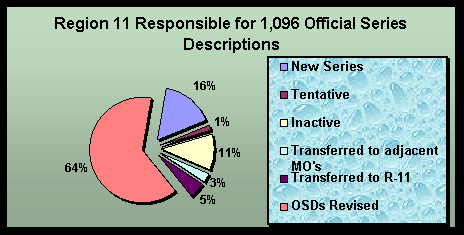
Region11 Soil Data Quality Specialists aggressively updated and revised 856 Official Series Descriptions (OSD) to assist in correlation activities and manuscript preparation. These OSD updates also supported correlation activities for MLRA Offices of Region 10, 11, 12, & 13.
In March 1996, the Indianapolis, Indiana, MLRA Region 11 Office had responsibility for 847 OSDs. As of November 13, 2000, we now have responsibility for 1,097 OSDs, of which only 20 are tentative series. In addition, there are about 150 inactive series in this region. From March 1996 to the present, 216 new series have been established in this region, 34 series have been transferred to three of the adjacent MLRA Offices, and 68 series have been transferred to this office from two of the adjacent MLRA Offices. Of the 1,097 active OSD�s that we now have responsibility for, 856 of them have been revised or updated in some form and 829 have had the taxonomic classification updated since March 1996.
Manuscript Activities
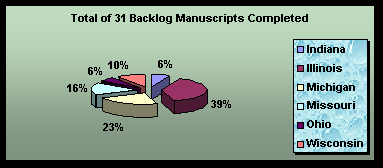
After USDA re-organization, Region 11 Soil Data Quality Specialist received a number of manuscripts from the six states and National Soil Survey Center that were in need of English edit. Region 11 Soil Data Quality Specialist organized and submitted those manuscripts and responded to the Editor comments for the following counties:
State of Illinois: Clay, Crawford, Fayette, Livingston, Marion, Mason, Moultrie, Shelby, Tazewell, Vermilion, Washington and White Counties.
State of Indiana: Tippecanoe and Newton Counties
State of Ohio: Clark and Delaware Counties
State of Michigan: Alcona, Calhoun, Crawford, Hillsdale, Mason, Oceana, and Missaukee Counties.
State of Missouri: Adair, Chariton, Clark, Pike, and Macon Counties
State of Wisconsin: Dodge, Door, and Sheboygan Counties
Region 11 Soil Data Quality Specialist completed the Technical Edits of once-over and update soil survey (from 1997-2000) for the following counties:
Once-over Counties
State of Illinois: Clinton, Cumberland, Franklin, Fulton, Hancock, Jefferson, Marshall, Pike, Schuyler, Winnebago, and Woodford Counties.
State of Michigan: Alpena, Iosco, Kalkaska, Roscommon, Montmorency and Otsego Counties.
Soil Survey Update Counties
State of Illinois: St. Clair, Adams, Edgar, McHenry, Du Page, Champaign, and Moultrie Counties.
State of Indiana: Scott, Perry, Owen, Delaware, Elkhart, Pulaski, and Fountain Counties.
State of Ohio: Paulding, Erie, Hancock, and Ross Counties.
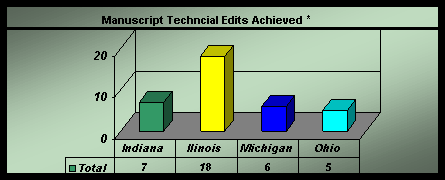
* Soil Survey Manuscript Technical Edits completed after processing the NSSC backlog manuscripts.
Correlation Activities
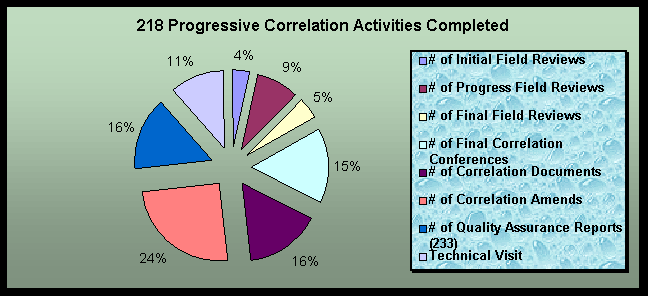
Region 11 Soil Data Quality Specialists conduct progressive correlation quality assurance for soil survey areas within the region to facilitate manuscript preparation, SSURGO Certification and NASIS database management. Correlation documents are also prepared as part of the quality assurance process.
Training Sessions (formal and informal)
Region 11 Soil Data Quality Specialists serve as instructors and provide training for courses in soil interpretation, classification and correlation to NRCS employees and employees in the conservation partnership. They spend time developing the training outlines and lesson plans for each training session. They also serve as facilitators for various meetings across the region.
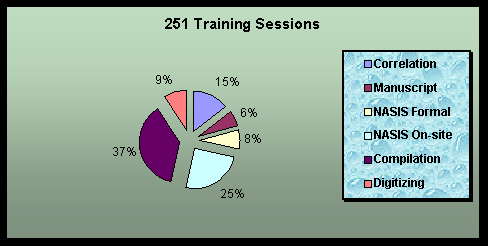
In 1998, Region 11 Soil Data Quality Specialists had the opportunity to assist the National Soil Survey Center (NSSC) and National Employee Development Center (NED) in the development of the Correlation and Management of Major Land Resource Area (MLRA) Soil Surveys training course. This course has greatly enhanced the effectiveness and efficiency of the way the National Cooperative Soil Survey conducts MLRA Soil Survey activities across the country.
Meetings and Committees
Region 11 Soil Data Quality Specialists participated in a total of 261 meetings and committees at the national, state and local levels to help facilitate and maintain quality assurance for soil survey programs within the region.
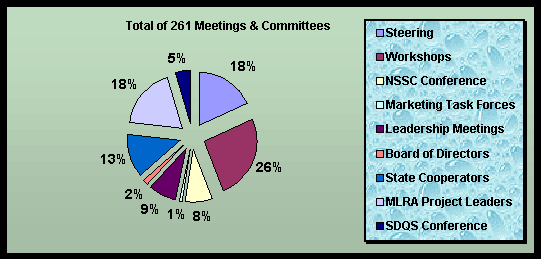
In November 1996, MLRA Region 11 hosted a region-wide work group meeting. The purpose of this work group meeting was to develop a guidance document to help strengthen the MLRA concept and uniformity as we service soil scientists and partners throughout the region. There were six work groups that completed specific assignments during this meeting. There were 95 participants at this meeting, including NRCS Soil Scientists, State Conservationists representing all 6 states, and cooperators from around the region, as well.
In October 1997, MLRA Regional offices at St. Paul, Minnesota, and Indianapolis, Indiana held a joint Soil Data Quality Specialists meeting in Madison, Wisconsin. The purpose of the meeting was to arrive at concrete proposals/decisions for the issues and concerns raised by different individuals and work groups within both regions. From the efforts of this meeting, strong coordination and communication methods were established between both regions.
SSURGO Certification
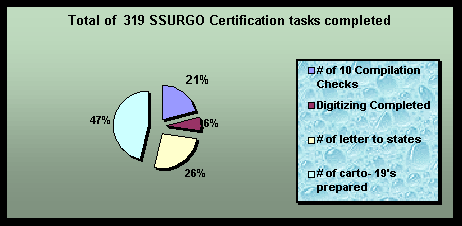
SSURGO Certification quality assurance efforts are the responsibility of the Soil Business Team. Quality assurance efforts include performing SSURGO quality reviews of recompiled soil map data for MLRA Region 11.
NASIS Implementation
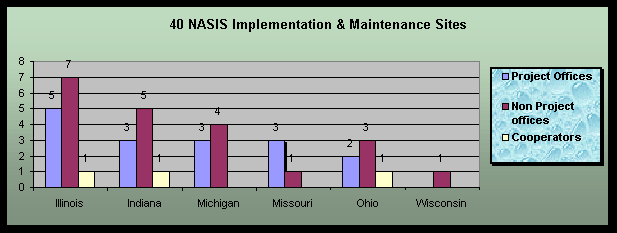
There are 40 NASIS sites that have been configured and are supported by the MLRA Region 11 Office. In addition, there are about 44,000 Data Map Unit Components being managed in Region 11.
Administrative Activities
Region 11 Soil Data Quality Specialists share the responsibility of serving as acting MLRA Team Leader/State Soil Scientist at numerous State Conservationist Leadership Meetings, workshops, soil survey cooperators work conferences, special interest groups, and other state and local groups and agencies. Upon request by the MO Leader, they are involved with issues where managerial skills are needed for making state and regional soil survey program decisions.
Region 11 Soil Data Quality Specialists have developed several MLRA guidance documents to provide consistent policy guidance to soil scientists within Region 11. These documents were distributed to all Midwest NRCS soil scientists, cooperators, and adjacent MLRA Regions. Through this effort, these documents have ensured consistency for soil scientists in implementing and carrying out National Cooperative Soil Survey standards.
Special Studies Initiated within REGION 11 MLRA Area
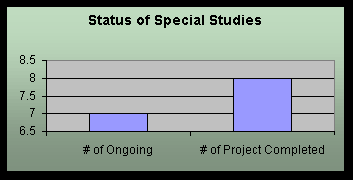
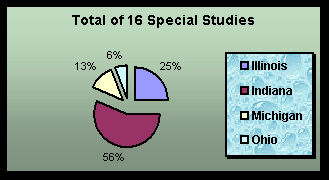
Special Studies help strengthen soil interpretations, land use planning, soil classification, and NASIS database management.
Below are special studies SDQSs have helped facilitate within the region.
Field Tours
Marketing Activities
Region 11 Soil Data Quality Specialists have been involved in assisting states with the marketing of soil survey update and maintenance efforts within the Region. They have helped in developing marketing plans and presentation targeting potential cooperators to promote the initiation, support and funding of an MLRA soil survey.
Below are some of the MLRA Soil Survey marketing sessions SDQS have been involved in.
MLRA Boundaries Revisions
As part of the National Soil Survey Center initiative, Region 11 Soil Data Quality Specialist assisted in revising MLRA boundaries and identifying MLRA subdivisions within the region. Specifically, these included MLRA Boundaries for 94A, 94B, 95B, 108A, 108B, 108C, 110, 111A, 111B, 111C, 115A, 115B, and 115C.
Memorandum of Understanding (MOU) Revisions
Of the 17 major MLRA�s in this region, only three of the seventeen MOUs have been signed. Also, three MOU�s have not been drafted of the total. There is a need to draft a Memorandum of Understanding agreement between members of the Board of Directors for an individual region-wide MLRA Office Soil Survey Area. It would be signed and implemented by the Board members and MO Leader. This would allow us to eliminate the drafting of numerous individual MLRA MOUs, which has been a very slow process. A region-wide MLRA MOU would definitely increase the facilitation of MLRA soil survey activities within the region.
