 ENGLISH CORNER
 WRITING
  POETRY
  RESEARCH
  READING
  STUDENT NEWS
|
ENGLISH CORNER |
WRITING |
POETRY |
RESEARCH |
READING |
STUDENT NEWS |
| GUIDELINES
FOR SOURCE CARDS Books, Magazines/Newspapers, Encyclopedias, Internet/Web |
| |
Instructions for Source
Cards/Works Cited Entries Once you have found the sources you intend to use, you will need to identify them for your reader.  For each Source you use, write a separate
listing on an index card.
Number each card in the upper right hand corner.
Include all of the required available information for each source according to type. Since you will use your SOURCE CARDS later to create your Works Cited page, including the required, correct punctuation is helpful.
Sources sometimes have no author. If author¹s name is missing, begin with the title of the source.
Please note that there is a wide variety of sources you may use for a research paper. This page includes instructions for those most commonly used by high school students.
If you need help with other types of sources check the links listed on the Research Page Internet/Web There are many pieces of information that may be used to document resources from the Worldwide Web. Listed below is the information that is considered essential if it is available. Again, there may not be an author. Be sure to print or save a copy of any web source you plan to use; then you will have any more information you may need. 1. THE NAME OF THE AUTHOR OR AUTHORS [if available] (followed by a period) last name, first name second author's name is not inverted 2. THE TITLE OF THE ARTICLE OR SECTION OF THE SITE in quotoation marks (followed by a period placed inside quotation marks) 3. THE TITLE OF WEB SITE in italics or underlined 4. THE NAME OR THE ORGANIZATION OR GROUP ASSOCIATED WITH OR SPONSORING THE PAGE (followed by a period) 5. THE DATE THE SITE WAS CREATED OR REVISED OR THE COPYRIGHT DATE. (followed by a period) 6. THE DATE YOU VIEWED THE SITE 7. <THE URL ADDRESS> in < > (followed by a period) |
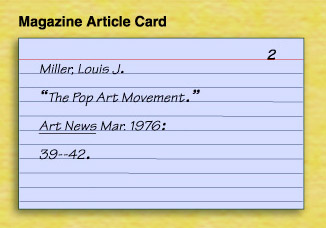
Books BOOK CARDS/WORKS CITED ENTRIES may include some or all of the information listed below. Items in capital letters are what appears on most cards. 1. THE NAME OF THE AUTHOR OR AUTHORS [if available] (followed by a period) last name, first name for first author second author's name is not inverted 2. TITLE (followed by a period) in italics or underlined 3. editor, translator, compiler, if any (followed by a period) name is not inverted 4. PLACE OF THE BOOK'S PUBLICATION (followed by a colon) 5. THE NAME OF THE BOOK'S PUBLISHER (followed by a comma) 6. DATE OF THE BOOK'S PUBLICATION (followed by a period) Magazines/Newspapers Write a separate card for each article from a MAGAZINE, NEWSPAPER, OR JOURNAL. Articles sometimes have no author. If author's name is missing, begin with the title of the article. 1. THE NAME OF THE AUTHOR OR AUTHORS [if available] (followed by a period) last name, first name second author's name is not inverted 2. THE TITLE OF THE ARTICLE (followed by a period placed inside quotation marks) in quotoation marks 3. THE TITLE OF THE PERIODICAL in italics or underlined 4. THE DATE OF THE ISSUE IN WHICH THE ARTICLE APPEARS (followed by a colon) 5. THE PAGES ON WHICH THE ARTICLE YOU ARE REFERRING TO APPEARS (followed by a period) Encyclopedias (any other alphabetically arranged reference book) General encyclopedias are good sources for background information on a topic. They are not considered strong sources for good research papers. As you become more experienced in doing research, you should rely less on this type of source. 1. THE NAME OF THE AUTHOR OR EDITORS [if available] (followed by a period) last name, first name second author's name is not inverted 2. THE TITLE OF THE PART OF THE WORK USED in quotation marks (followed by a period placed inside quotation marks) 3. THE TITLE OF THE ENCYCLOPEDIA in italics or underlined (followed by a period) 4. THE YEAR OF THE EDITION (followed by a period) |
SAMPLE SOURCE CARDS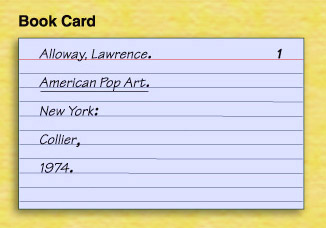
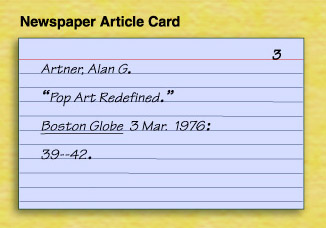
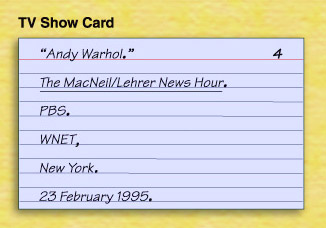
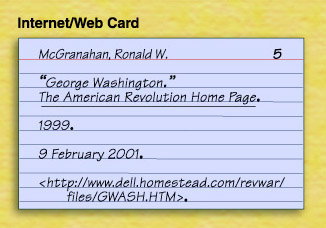
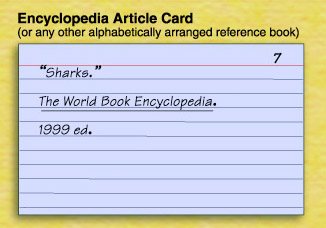
|
|