Corrales always a crowd-pleaser
Fiery Spaniard a bilingual terror but fun to watch
Athens Daily News/Banner-Herald
May 21, 1998
By Marc Lancaster
Staff Writer
Talito Corrales, struggling through a long point on Court No. 4, could hit an easy shot down the line and have a good chance at a winner...but he doesn't. He tries for a spectacular winner, one that would make NBC tennis analyst Bud Collins babble with delight. It goes wide.
Corrales turns toward the baseline and throws up his hands in dismay. He then says wistfully - to himself, but just as much to his always-captive audience - in accented English: "I try to be Picasso."
His gallery responds with quiet laughter, and Talito, having dumped the frustration from his system and given the crowd one more reason to love him, re-attaches his smile and turns to play another point.
These quick glimpses of Corrales' personality are why the junior transfer from Barcelona, by way of Texas Christian University, has become one of Georgia's most popular players.
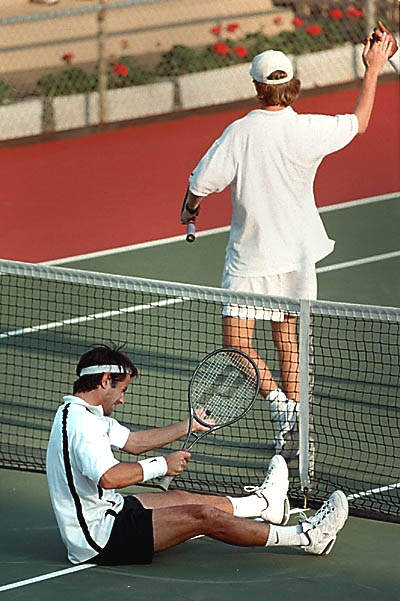
Corrales joyfully stomps on most of the quiet, reserved customs of tennis when he plays - talking to his racket, the ball, the ground, the fans, the umpire, his opponent, and mostly, to himself. He is Mark Fidrych with a Spanish accent.
"I guess what I'm thinking," he says, "is I like to have fun, and I like for everybody to have fun."
But Corrales' fun is not always for the faint of heart - the bilingual faint of heart, that is. When Talito is pleased with himself or wants to let his partisan gallery in on his thoughts, he generally speaks English on the court. But when he gets upset, it's Spanish all the way. He reverts back to his native language quickly and naturally, just like a mother using her child's full name when she scolds him.
"There is a rule that I cannot speak another language that is not English in competition, so I always get in trouble, because I try to speak English, but it is so difficult," Corrales says. "You know, when you dream, or when you get mad, that is the time you're going to use (Spanish). So it's really difficult, but I am trying. Plus, I say bad things when I'm talking in Spanish, so it's better they don't understand me."
Corrales has a point. Most of his post-mistake utterances would never end up in this or any newspaper when directly translated to English. His outbursts generally involve some reference to God: Dios santo - literally, "Dear God," or maybe Madre de Dios - "Mother of God." But there's always an extra expletive thrown in nearby.
Despite his use of words that many Americans would find somewhat offensive if translated, Corrales says it is merely a cultural difference.
"You see, in Spain, we cuss a lot, everybody - it's like in Italy," he explains. "We are all Catholics, 99 percent is Catholic, but everybody uses bad words, and it's not bad. Like over here, when you say the f-word or whatever, people kind of look at you really bad. But in Spain and Italy, it is so normal to use it that I don't realize how bad it looks.
"If you literally translate everything, it looks terrible, terrible. But that's the way we are, and when you go to a soccer match and you are 10 years old, you're going to hear these kind of comments all around - that's our culture, we are like that."
Of course, that cultural acceptance didn't stop Corrales from turning off his act altogether during one match this season, against Ole Miss. On that Sunday afternoon, Talito's parents Gonzalo and Maria were in town from Barcelona to see their son play at Georgia for the first time. Would there be any Spanish curses with Mom in the audience? No chance.
"I didn't say a word," he says. "I didn't say anything at all."
One observer of Corrales' antics who understands every word that comes out of the player's mouth is longtime tennis official Rudy Kinchen. Kinchen assigns and supervises the chair umpires at every Georgia match, and is fluent in Spanish. He notes that some of those George Carlin-esque phrases are merely Spanish expressions, part of everyday (though not dinner-table) conversation.
He has also had to tell Corrales to tone down the chatter on a few occasions, but says Corrales' laid-back disposition tends to give the player more leeway with umpires than some true yellers and screamers - like Bulldog John Roddick - receive.
"I've warned him one time, you know, don't say that again," says Kinchen. "He says, 'Nobody understands it but you,' and I said, 'That's not true, there are people who actually do understand it.'
"But he's good-natured. Most of the rules are against, say, hitting a ball in anger. The 'in anger' business is very important. He talks to his opponent - that's a no-no, you can't do that. Except he does. But nobody really cares because he's a nice guy, and he's not saying anything bad to them."
Corrales, like many college players, does congratulate his opponents if they hit a nice shot. He says that he had enough of win-at-all-costs, no-fun-allowed tennis during his very successful junior career and his two years at TCU.
He was the Horned Frogs' No. 3 singles player as a freshman, and their No. 1 player last year, reaching a No. 32 national ranking at one point. Since arriving at Georgia, Corrales has played almost exclusively at No. 4, but he doesn't mind at all. Individual satisfaction is no longer a career goal in this very individual sport.
"I had never played number four or five or six," he says. "Then I came over here, and I have such good players, Hisham (Hemeda), Steven (Baldas) and John, ahead of me. I came over here because of the team, that was my goal: the team, the team, the team. So I wouldn't mind even playing sixth, as long as the team does well.
"I know a lot of people, their goal is to play No. 1. I haven't seen it here, but on TCU and other teams. I don't have that goal at all. I'm just here for the team and I don't care about my single success or whatever."
Still, Corrales has had a good bit of success this spring, going 25-11 in singles play. Georgia coach Manuel Diaz, one person that regularly speaks Spanish with Corrales, says he sees a correlation between his protege's happiness and his play.
"When he's having fun out there, he plays great tennis," says Diaz. "It's a fine line - sometimes he crosses the line and starts getting a little too angry at himself, and that's when he starts to struggle. He's doing a tremendous job and he cares a lot about the team; he's had a sensational year."
But what about the outbursts - words Diaz probably doesn't want his three young sons to hear at a match?
"I look the other way sometimes," he says, then adds with a laugh: "But I can recall doing the same things when I was playing. He's very entertaining."
Corrales is playing at No. 3 in the Bulldogs' final regular-season match against North Carolina. He and his opponent stage a great rally, and the Tar Heel player deftly puts a drop shot just inside Corrales' side of the net.
Corrales sprints forward to keep the ball alive - an outstanding play - but in doing so, leaves basically the entire court open for his opponent to put the ball away. Corrales, nearly falling over, just can't resist saying something as his opponent lines up the easiest winner of the match.
So just as the North Carolina player strikes the ball, Corrales half-heartedly cries out, "Miss it!"
The Tar Heel doesn't, of course, but Corrales smiles his smile, giggles erupt from the crowd, and his opponent, despite an initial expression of shock at this blatant violation of the rigid tennis code of conduct, cracks a smile of his own.
Todos quieren a Talito. Everybody loves Talito.