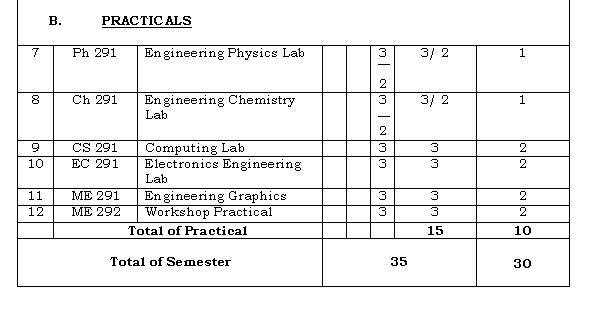
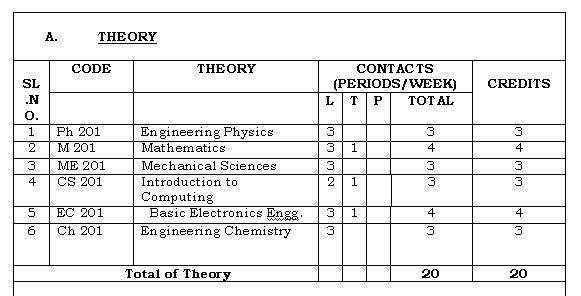
DETAILS
OF CURRICULUM
FIRST YEAR
SECOND
SEMESTER
COURSE
STRUCTURE
(
Common to All Branches of B.Tech Programme)
INTRODUCTION TO
COMPUTING
Code : CS 201
Contacts : 2L + 1T =
3
Credits :
3
Fundamentals of
Computer:
History of Computer, Generation
of Computer, Classification of Computers
2L
Basic Anatomy of Computer
System, Primary & Secondary Memory, Processing Unit, Input &
Output devices
3L
Binary & Allied number
systems representation of signed and unsigned numbers. BCD, ASII. Binary
Arithmetic & logic gates
6L
Assembly language, high level
language, compiler and assembler (basic concepts)
2L
Basic concepts of operating
systems like MS DOS, MS WINDOW, UNIX, Algorithm & flow chart
2L
C
Fundamentals:
The C character set identifiers
and keywords, data type & sizes, variable names, declaration,
statements 3L
Operators &
Expressions:
Arithmetic operators,
relational and logical operators, type, conversion, increment and
decrement operators, bit wise operators, assignment operators and
expressions, precedence and order of evaluation. Input and Output:
Standard input and output, formatted output -- printf, formatted input
scanf.
5L
Flow of
Control:
Statement and blocks, if -
else, switch, loops - while, for do while, break and continue, go to and
labels
2L
Fundamentals and Program
Structures:
Basic of functions, function
types, functions returning values, functions not returning values, auto,
external, static and register variables, scope rules, recursion, function
prototypes, C preprocessor, command line arguments.
6L
Arrays and
Pointers:
One
dimensional arrays, pointers and functions, multidimensional arrays.
6L
Structures Union and
Files:
Basic of
structures, structures and functions, arrays of structures, bit fields,
formatted and unformatted files.
5L
Recommended reference
Books:
Kerninghan, B.W.
The Elements of Programming
Style
Yourdon,
E. Techniques of Program
Structures and Design
Schied F.S.
Theory and Problems of Computers
and Programming
Kerninghan B.W. & Ritchie
D.M. The C Programming
Language
Rajaraman V.
Fundamental of
Computers
Balaguruswamy
Programming in C
Kanetkar Y.
Let us C
BASIC ELECTRONICS
ENGINEERING
Code : EC 201
Contacts : 3L + 1T =
4
Credits :
4
Introduction:
Crystalline material:
mechanical properties, energy band theory, Fermi levels
2L
Conductors, Semiconductors and
Insulators: electrical properties, band diagrams. Semiconductors:
intrinsic and extrinsic, energy band diagram, electrical conduction
phenomenon, P-type and N-type semiconductors, drift and diffusion
carriers, mass action law and continuity equation (statement only)
6L
Formation of P-N junction,
energy band diagram, built-in-potential forward and reverse biased P-N
junction, formation of depletion zone, V-I characteristics, Zener
breakdown, Avalanche breakdown and its reverse characteristics, junction
capacitance and varactor diode.
6L
Simple diode circuits, load
line, linear piecewise model; rectifiers: half wave, full wave, its PIV,
DC voltage and current, ripple factor, efficiency Clipper and Clamper
circuits
5L
Introduction to
Transistors:
Formation of PNP / NPN
junctions, energy band diagram; transistor mechanism and principle of
transistors, CE, CB, CC configuration, Ebers-Moll model of transistor;
transistor characteristics: cut-off active and saturation mode, early
effect.
4L
Biasing and Bias stability:
calculation of stability factor with variation of Ico Different operating
modes; CE, CB, CC and their properties; small signal low frequency
operation of transistors; equivalent circuits h parameters as a two port
network.
4L
Transistors as amplifier:
expression of voltage gain, current gain, input impedance and output
impedance, frequency response for CE amplifier with and without source
impedance (qualitative)
4L
Introduction to Field Effect
Transistor:
Construction and
characteristics of JFET (N channel only), Transfer characteristics;
construction and characteristics of MOSFET (N channel only), depletion and
enhancement type; CS, CG, CD configuration
5L
Feed Back
Amplifier:
Concept (Block diagram),
properties, positive and negative feed back, loop gain, open loop gain,
feed back factors; topologies of feed back amplifier; effect of feed back
on gain, output impedance, input impedance, sensitivities (qualitative),
bandwidth stability; effect of positive feed back: instability and
oscillation, condition of oscillation, Barkhausion criteria.
5L
Operational
Amplifier:
Introduction to integrated
circuits, operational amplified and its terminal properties, specification
of M741
2L
Application of operational
amplified: concept of virtual earth, inverting and non-inverting mode of
operation, voltage summing, difference, constant gain multiplier, voltage
follower, comparator, integrator, differentiator.
3L
Special Semiconductor
devices:
Silicon Controlled Rectifier
(SCR): constructional features, physical operation, characteristics,
simple application (Saw tooth generator); concept of TRIAC, DIAC and UJT;
insulated gate bipolar transistor (IGBT)
4L
Cathode Ray
Oscilloscope:
Construction features of
cathode ray tube, concept of dual beam CRO; application of CRO for
different electrical measurements: amplitude frequency and phase of sine
wave, Lissajous figure.
3L
Recommended reference
Books:
Millman & Halkias
Basic Electronic
Principle
Millman & Halkias
Integrated
Electronics
Mottershed
Electronics Devices &
Circuits
Millman & Grabal
Microelectronics
Schilling & Belove
Electronics &
Circuits
Mukherjee M. K.
Foundation of Electronics,
Devices & Circuits
Rakshit & Chattopadhyay
Foundation of
Electronics
Storey
Electronics
MECHANICAL
SCIENCES
Code : ME 201
Contacts : 3L =
3
Credits :
3
Thermodynamics:
Introduction; first law for
closed and open systems; flow processes and control volume; analysis of
difference non-flow and flow processes: limitations of first law of
thermodynamics; perpetual motion machine (PMM) of the first kind.
6L
Power producing and power
absorbing devices; second law of thermodynamics; introduction of Carnot
cycle; practical thermodynamic cycles; PMM II, Corollaries of second law.
4L
Clausius inequality,
reversibility, entropy and disorder, basic concept of avalability;
temperature entropy diagram, properties of vapour of saturated steam.
3L
Use of Mollier Chart and Steam
Tables; Ranking cycle, reheat and regenerative cycles; Airline cycles.
5L
Fluid
Mechanics:
.Properties of Fluid,
Classifications; ideal fluid, Newtonian and non-Newtonian fluids, Inviscid
fluid; Newton's law of viscosity.
3L
Fluid Statics; fluid pressure
and its variation within fluid at rest; measurement of fluid pressure
4L
Fluid Kinetics; principles of
fluid flow; rate of flow, average velocity, steady and unsteady flow; One,
two and three dimensional flow; laminar and turbulent flow.
3L
Fluid dynamics: one dimensional
equation of motion; integration of equation of motion; Bernoulli's
equation; application of Bernoulli's equation.
4L
Dynamic Fluid Pressure:
conservation of linear momentum and its application; study of viscous
flow; laminar and turbulent flow through circular and non-circular
conduits.
6L
Flow through open channel:
Chezy's equation; compressible fluid; compressibility factor; stagnation
enthalpy, temperature, pressure & density.
4L
Recommended reference
Books:
Nag P.
K. Engineering
Thermodynamics
Van Wylen G. J. & Sentag R.
E. Fundamentals of Classical
Thermodynamics
Arora C. P.
Thermodynamics
Streeter U.L. and Wylie E. B.
Fluid Mechanics
Roy D. N.
Fluid Mechanics
Bansal R. K.
Fluid Mechanics and Hydraulic
Machines
ENGINEERING
CHEMISTRY
Code : Ch 201
Contacts : 3L =
3
Credits :
3
Chemical
Thermodynamics:
Concept of Thermodynamic
System: diathermal wall, adiabatic wall, isolated system, closed system,
open system, extensive property, intensive property
Introduction to first law of
thermodynamics: different statements, mathematical form; internal energy:
physical significance, mathematical expression (ideal and real gas),
Enthalpy: physical significance, mathematical expression
3L
Cp and Cv: definition and
relation; adiabatic changes; reversible and irreversible processes;
application of first law of thermodynamics to chemical processes:
exothermic, endothermic processes, law of Lovoisier and Laplace, Hess's
law of constant heat summation, Kirchoff's law
3L
Second law thermodynamics;
Joule Thomson and throttling processes; inversion temperature; evaluation
of entropy: characteristics and expression, entropy change in irreversible
process, entropy change for irreversible isothermal expression of an ideal
gas, entropy change of a mixture of gases
2L
Work function and free energy:
physical significance, mathematical expression for ideal and real gases
obeying Vander Waals' equation, Gibbs Helmholtz equation
2L
Condition of spontaneity and
equilibrium; non ideal systems, activity and activity coefficient, partial
molar properties, chemical potential to multicomponent systems, Gibbs
Duhem relation; application of thermodynamics to phase transition
4L
Atoms and
Molecules:
Homonuclear and heteronuclear
diatomics, covalent bonds, ionic bonds and electronegativity concepts,
hybridzation and shapes of molecules, non-covalent interaction (Vander
Waals and hydrogen bonding).
3L
Solid State
Chemistry:
Introduction to stoichiometric
defects (Schottky & Frenkel) and non-stoichiometric defects (Metal
excess and metal deficiency); role of silicon and germanium in the field
of semiconductor, transistors, rectifier and photovoltaic cells; the
process for preparing microminiaturized semiconductor devices: integrated
circuits
5L
Instrumental Methods of
Analysis:
Introduction to instrumental
metals such as IR, UV,-Vis, NMR and Mass spectrometry.
1L
Reaction
Dynamics:
Reaction laws: rate and order;
molecularity; first and second order kinetics; mechanism and theories of
reaction rates (Transition state theory, Arrhenius equation)
2L
Transition and Metal
Chemistry:
Structures of coordination
compounds corresponding to coordination number 6; types of ligands;
isomerism (geometrical, optical, ionization, linkage and coordination).
2L
Structure and Reactivity of
Organic Molecule:
Inductive effect; resonance;
hyperconjugatin; electromeric effect; carbanion and free radicals; brief
study of some addition, elimination and substitution reactions
4L
Polymerization:
Concepts, classifications and
industrial applications; polymerization processes, degree of
polymerization (addition and condensation polymerization); preparation,
structure and use of some common polymers: plastic (PE, PP, PVC bakelite),
rubber (natural rubber, SBR, NBR), fibre (nylon 6,6, polyester);
conducting and semiconducting
polymers 6L
Industrial
Chemistry:
Solid, liquid and gaseous
fuels; constituents of coal, carbonization of coal, coal analysis,
proximate and ultimate analysis; classification of coal
Petroleum, gasoline, octane
number, aviation fuel, diesel, cetane number; natural gas, water gas.
5L
Electrochemistry:
Conductance of electrolytic
solutions, specific conductance, equivalent conductance, molar conductance
and ion conductance; effect of temperature and concentration; basic ideas
and inter ionic attractions; transport numbers and hydration ions,
electrochemicals cells; cell emf and its thermodynamic significance;
single electrode potentials and its applications; hydrogen half cell and
calomel half cell; conductometric titrations: SA vs SB & SA vs WB;
precipitation titration KCL vs AgNO3
5L
Recommended reference
Books:
Rakshit
P. C. Physical
Chemistry
Dutta
R. L. Inorganic
Chemistry
Finar
I. L. Organic
Chemistry
Sarkar Samir
Fuels and
Combustion
Glasston Samuel
Text Book of Physical
Chemistry
Lee
J. D. Concise Inorganic
Chemistry
Ghosh
P. Polymer Science and
Technology of Plastics & Rubbers
ENGINEERING
PHYSICS
Code : Ph 201
Contacts : 3L
Credits : 3
Vector
Analysis:
Scalar and Vector fields,
Gradient of a scalar field, curvilinear co-ordinates in connection with
grad, divergence and curl of a vector field, line integral of a vector
field, gauss-divergence theorem Stoke's theorem.
3L
Electromagnetism:
Quantization & Conservation
of charge, Coulomb's law (vectorial from) and superposition principle,
concept of electric lines, flux of E-field, Gauss's law, electric
potential energy and potential (problems on spherical and cylindrical
symmetry), conductors, capacitors (parallel plates, spherical and
cylindrical symmetry) and dielectric materials (frequency dependence of
such materials), magnetic field, force on a moving charge in a magnetic
field, force on current element, torque on current loop, Biot Savart's Law
(concept of B and vector potential A), Ampere's law, electromagnetic
induction and Faraday's law, magnetism in materials (relation among B, H
and M), Maxwell's equation in differential and integral form,
electromagnetic waves.
10L
Thermoelectricity:
Seebeck effect, law of
successive temperatures, law of intermediate metals, peltier effect,
Thomson effect, thermoelectric power.
3L
Modern Physics:
Limitations of classical
physics and its failure, blackbody radiation, photoelectric effect,
compton effect (derivation of wave length shift), X-ray diffraction and
Bragg's law, wave particle duality, Davisson-Germer experiment,
Heisenberg's uncertainty relation (Thought experiment y-ray experiment,
elementry proof), Schrodinger's equation (time dependent and time
independent), wave function and its normalisation, probability density and
expectation values, operators in quantum mechanics (brief introduction),
particle in a box (one dimensional (infinite square well potential) three
dimensional also to be discussed), hydrogen atom problem-transformation of
Schrodinger equation to spherical polar to-ordinate, discussion of the
solution of the equation in polar coordinates, space quantisation, orbital
& spin angular momentum, normal zeeman effect, exclusion principle.
14L
Thermal
Physics:
Introduction to Statistical
Physics, Maxwell-Boltzmann distribution, application to ideal gas
molecules, distribution of molecular speeds, mean, rms and most probable
velocity, law of equipartition of energy, Fermi-Dirac statistics,
calculation of total number of free electrons in a metal, evaluation of
Fermi energy of electrons in a metal at absolute zero temperature (short
derivation), Bose-Einstin statistics, Plans's radiation law, Wien's
displacement law and Stefan-Boltzmann law.
10L
Solid State
Physics:
Crystal class and their
symmetries, Bravais lattice, unit cell fcc, bcc, hcp crystal, Miller
indices and applications, Band theory of solids, conductor, semiconductor
and insulators, Brillouin zones.
6L
Nuclear
Physics:
Nuclear binding energies,
nuclear forces and their short range character, balance of mass and energy
in nuclear reactions-Q-value of reaction, threshold energy in endothermic
reactions, nuclear fission and fusion: fundamentals, nuclear reactors.
6L
Recommended reference
Books:
Speigal M.
Vector Algebra
Fewkes & Yarwood
Electricity and Magnetism (Vol.
I)
Ghoshal S.
N. Introduction to Quantum
Mechanics
Eisberg & Resnick
Quantum Physics
Wehr, Richards & Adair
Physics of the
Atom
Brijlal
& Subrahmanyam Thermal and
Statistical Physics
Dekker A. J.
Solid State
Physics
Kaplan
I. Nuclear
Physics
Fewkes
& Yarwood Atomic Physics
(Vol II)
Gupta
A. B & Ghosh D. Atomic &
Nuclear Physics
MATHEMATICS
Code : M 201
Contacts : 3L + 1T =
4
Credits :
4
Linear Algebra:
Vector Spaces: definition of
vector spaces over the field of real numbers; definition of south face of
a vector space and a criterion for a sub space; definition of linear
combination, linear independence and linear dependence of vectors with
examples. Definition of basis and dimension of vector space; example of
vector space which has more than one basis.
3L
Introduction to the idea of a
matrix; equality of matrices; special matrices. Algebraic operations of
matrices: commutative property, associative property and distributive
property. Transpose of matrix (properties (At)t = A, (A+B)t = At +
Bt , (cA)t = cAt, (AB)t = BtAt to be stated (without proof) and verified
by simple examples. Symmetric and skew symmetric matrices.
2L
Properties of determinant
(statement only); minus, co-factors and Laplace expansion of determinant;
Cramer's rule and its application in solving system of linear equations.
2L
Singular and non-singular
matrices; adjoint matri; inverse of a matrix [(AB)-1 = B-1A-1 to be stated
and verified by example. Elementary row and column operations on
matrices; definition of rank of a matrix; determination of rank of (2x2)
matrix using definition; determination of rank of a rectangular matrix.
2L
Systems of linear equations:
consistency and inconsistency.
1L
Eigen values and Eigen vectors
of a matrix; diagonalization of a matrix; Gauss elimination process for
solving a system of linear equations.
2L
Linear transformation:
definition of kernel and image of a linear transformation; kernel and
images of a linear transformation forming sub-spaces; nullity and rank of
a linear transformation; Dimker T + Dim lm T = Dim V; definition of inner
product space, norm of a vector, orthogonal and ortho-normal set of
vectors.
1L
Ordinary Differential
Equations:
Definition of order and degree;
ODE of the first order: first order first degree (equation solvable by
separation and variables, homogeneous equations, non-homogeneous equations
that can be reduced to homogeneous equations, exact equations; definition
and use of integrating factors; linear equation and Bernoulis' equation
ODE of first order but not of
first degree, simple problems
3L
General ODE of nth order:
operator method for solving equations with constant coefficients, method
of variation of parameters and method of undetermined coefficients for
solving equations with variable coefficients; Cauchy-Euler homogeneous
linear equations.
4L
Solution of simple simultaneous
linear equations; Legendre and Bessel' functions and their properties
2L
Laplace
Transforms:
Definition; existence of LT; LT
of elementary functions; first and second shifting properties; change of
scale property; L.T. of derivatives
4L
Corresponding theorems for
multiplication by t" and division by t; L.T. of periodic functions; unit
step functions
Inverse L.T.; solution of ODE's
using L.T. 4L
Numerical
Methods:
Estimation of error; difference
operator (forward, backward, central, sift and average operators);
Newton's forward and backward interpolation; Lagrange interpolation and
corresponding error formulae.
5L
Newton's forward formula,
Newton's backward formula and Lagrange formula; numerical integration
(Trapezoidal rule and Simpson's rule);
4L
Recommended reference
Books:
Kreyszig E.
Advance Engineering
Mathematics
Krishnamurthy V., Mainra V.P.
and Arora J.L. An Introduction
to Linear Algebra
Boyce and Diprima
Elementary Differential
Equations and
Boundary Value
Problems
Grewal
B.S. Engineering
Mathematics
ENGINEERING PHYSICS
LABORATORY
Code: Ph 291
Contacts: 3/2 P
Credits: 1
1.
To determine the thermal
conductivity of a bad conductor by Lee’s method.
2.
To determine the thermal
conductivity of a good conductor by Searl’s method.
3.
Measurement of thermo emf
between different types of thermocouples as a function of temperature
between the junctions, measurement of an unknown
temperature.
4.
Verification of Hooke’s law and
determination of Young’s modulus.
5.
Determination of Bending Moment
and Shear Force of beam by Travelling Microscope.
6.
Determination of rigidity
modulus.
7.
Determination of Spring Constant
of a Spiral Spring & helical spring.
8.
To determine the dielectric
constant of a given dielectric material
9.
To determine the Rydberg
Constant by studying Hydrozen Spectrum
10.
To find the Lande'g-factor with
Electron-Spin Resonence Spectrometer
11.
Study the
current-Voltage,poweroutput vs. load, areal characteristics,and Spectral
Response of the Photovoltaic Solar cell.
ENGINEERING CHEMISTRY
LABORATORY
Code : Ch
291
Contacts :
3/2 P
Credits:
1
Suggested List of
Experiments
1.
Acid –base titration (
estimation of commercial caustic soda)
2.
Redox titration (estimation of
iron using permanganometry)
3.
Complexometric titration (
estimation of hardness of water using EDTA titration)
4.
Preparation and analysis of a
metal complex ( for example thiourea / copper sulfate or nickel
chloride / ammonia complexes)
5.
Chemical Kinetics (determination
of relative rates of reaction of iodide with H2O2 at room temperature
(clock reaction)
6.
Heterogeneous equilibrium
(determination of partition coefficient of acetic acid between n-butanol
and water)
7.
Photochemical
oxidation-reduction (study of photochemical reduction of ferric
salt)
8.
Viscosity of solutions
(determination of percentage composition of sugar solution from
viscosity)
9.
Conductometric titration for
determination of the strength of a given HCl solution by titration against
a standard NaOH solution
10.
pH- metric titration for
determination of strength of a given HCl solution against a standard NaOH
solution.
COMPUTING LAB
Code: CS
291
Contacts:
3 P
Credits:
2
Exercises should include but
not limited to:
1.
DOS System commands and Editors
( Preliminaries)
2.
UNIX system commands and vi (
Preliminaries)
3.
Simple Programs: simple and
compound interest. To check whether a given number is a palindrome or not,
evaluate summation series, factorial of a number , generate Pascal’s
triangle, find roots of a quadratic equation
4.
Programs to demonstrate control
structure : text processing, use of break and continue,
etc.
5.
Programs involving functions and
recursion
6.
Programs involving the use of
arrays with subscripts and pointers
7.
Programs using structures and
files.
BASIC ELECTRONICS ENGINEERING
LAB
Code: EC
291
Contacts:
3P
Credits:
2
1.
Familiarization with Electronic
components such as Resistors, Capacitors, Diodes, Transistors
etc.
2.
Familiarization with electrical
devices and measuring equipment like DC power supply, Multimeter, Trainer
kit etc.
3.
Familiarization with measuring
and testing equipment like CRO, Signal generator.
4.
Study on V-I characteristics of
Junction Diode.
5.
Study on V-I characteristics of
Zener Diode.
6.
Study on Half Wave and Full Wave
rectifiers.
7.
Study on characteristics of
Field Effect Transistors.
8.
Determination of Input offset
voltage, Input Bias current, Slew rate of Op-Amp.
9.
Determination of Common Mode
Rejection Ratio, Bandwidth, Offset null of Op-Amp.
10.
Characteristics Curve for common
base emmitor & common collector transducers
11.
Study of working of data
acquisition system.
ENGINEERING
GRAPHICS
Code: ME
291
Contacts:
3 P
Credits:
2
ISOMETRIC VIEW AND ISOMETRIC
PROJECTION
2L
+ 4 Sessionals
Class sessional work
2 PROBS
Home assignment
2 PROBS
SECTIONAL VIEW, TRUE SHAPE OF A
SECTION
2L
+ 4 Sessionals
Class sessional work
1
PROB EACH
Home assignment
1
PROB EACH
RIVET HEADS, RIVETED JOINTS
2L
+ 4 Sessionals
Class sessional work
Rivet
heads, types, lap-joint, butt joint (single cover)
Home assignment
Remaining
heads butt-joint (Double cover)
THREADS, NUT-BOLT KEY AND
COTTER JOINT
Class sessional work:
Home-work-threads-2types, hexagonal bolt, fitted with a SQ. nut-plan and
elevation. Home-work –two views each- 2 probs
Home assignment: Remaining
threads. SQ. Head bolt and Hexagonal head nut. – 2 probs
DEVELOPMENT
1L
+ 3 Sessionals
Class sessional work
Two
PROBS
Home assignment
Two
PROBS
INTERPENETRATION
2L
+ 3 Sessionals
Class sessional : From
orthographic view- plan , elevation and side view-1 PROB.
Home assignment : 1
PROB
MACHINE PARTS
1L
+ 5 Sessionals
Home assignment: 1
PROB
BUILDING DRAWING (CIVIL –
R.C.C.) 1 L + 5
Sessionals
Class sessional
work
Front line plan to draw
plan-elevation .A Brick Foundation showing all components.
Home assignment: 2
probs
Computer Aided Drafting
3L
+ 3 Sessionals
Introduction .Cartesian and
Polar Co-ordinate system, Absolute and Relative
Co-ordinates;
Basic Editing Commands : Line,
Point, Trace, Rectangle, Polygon, Circle, Arc, Ellipse, Polyline; Basic
Editing Commands : Basic Object Selection Methods, Window and Crossing
Window, Erase, Move, Copy, Offset, fillet, Chamfer, Trim, Extend, Mirror;
Display Commands : Zoom, Pan, Redraw, Regenerate; Simple dimensioning and
text. Simple exercises and practice problems.