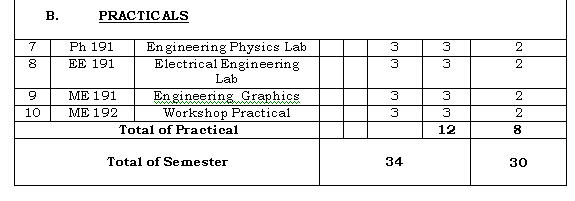
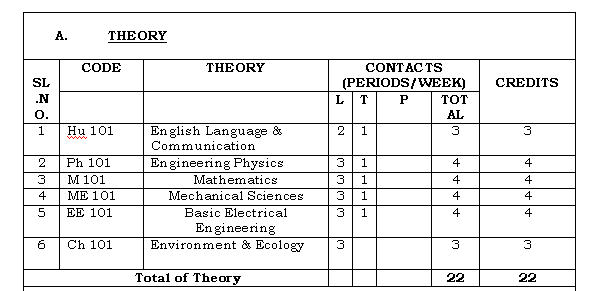
DETAILS
OF CURRICULUM
FIRST YEAR
FIRST SEMESTER
COURSE
STRUCTURE
(
Common to All Branches of B.Tech Programme)
ENGLISH LANGUAGE &
COMMUNICATION
Code : Hu 101
Contact
: 2L + I T = 3
Credits:
3
Guidelines for Course
Execution
Objective of the
Course
To impart basic skills of
communication in English through intensive practice to the first year UG
students of Engineering so as to enable them to function confidently and
effectively in that language in the professional sphere of their
life.
Desired Entry
Behaviour
The student must have some
basic command of English that is must be able to :
1.
Write reasonably
grammatically
2.
Understand ( if not use ) at
least some 2500 general purpose words of English to express himself in
writing and 1500 words to talk about day-to-day events and experiences of
life.
3.
Understand slowly-delivered
spoken material in Standard Indian English , and
4.
Speak reasonably clearly ( if
not fluently ) on routine matters with his fellow
students.
Strategies for Course
Execution
·
The topics must be conveyed
through plenty of examples. Lecture classes must be conducted as
lecture-cum-tutorial classes.
·
It is a course that aims to
develop skills. It is therefore “practical” in orientation. Plenty of
exercises of various kinds must be done by the students both inside and
outside the classroom.
·
The teacher must not depend on a
single or a set of two or three text books. He must choose his materials
from diverse sources.
·
Keeping in view the requirements
of his students , the teacher may have to prepare some teaching and
exercise material.
·
For practice in listening , good
tape recorders can be used if the more advanced facilities ( for example ,
language laboratory ) are not available. In fact they can be used very
fruitfully.
·
The teacher must function as a
creative monitor in the class-room.
·
Minimum time should be spent in
teaching phonetic symbols , stress , intonation , etc. The aim should be
to enable the students to find out for himself the correct pronunciation
of a word from a learner’s dictionary. In teaching speaking, emphasis
should be on clarity , intelligibility and reasonable fluency rather than
on “ correct “ pronunciation of words. Classroom presentation and group
discussion sessions should be used to teach speaking.
End Results from the
Course
Some Key
Concepts
Communication as sharing;
context of communication; the speaker / writer and the listener /
reader; medium of communication; barriers to communication; brevity,
clarity and appropriateness in communication.
Writing
Selecting material for
expository, descriptive , and argumentative pieces, business letters;
formal report; summarizing and abstracting ; expressing ideas within a
restricted word limit; paragraph division; the introduction and the
conclusion; listing reference material; use of charts, graphs and tables ;
punctuation and spelling; semantics of connectives, modifiers and modals;
variety in sentences and paragraphs.
Reading
Comprehension
Reading at various speeds (
slow , fast , very fast ) ; reading different kinds of texts for different
purposes (for example , for relaxation , for information , for discussion
at a later stage , etc.) ; reading between the lines.
Speaking
Achieving desired clarity and
fluency ; manipulating paralinguistic features of speaking ( voice quality
, pitch , tone , etc. ) pausing for effectiveness while speaking ;
task-oriented , interpersonal , informal and semiformal speaking ;
task-oriented, interpersonal , informal and semiformal speaking; making a
short , classroom presentation.
Group
Discussion
Use of persuasive strategies
including some rhetorical devices ( for emphasizing , for instance; being
polite and firm; handling questions and taking in criticism of self;
turn-taking strategies and effective intervention ; use of body
language.
Telephonic
Conversation.
Listening
Comprehension
Achieving ability to comprehend
material delivered at relatively fast speed; comprehending spoken material
in Standard Indian English, British English and American English ;
intelligent listening in institutions such as an interview in which one is
a candidate.
Syllabus
Details:
Grammar – Correction of
sentence, Vocabulory / word formation, Single word for a group of words,
Fill in the blank, transformation of sentences, Structure of sentences –
Active / Passive Voice – Direct / Indirect Narration
(
5 lectures)
Essay – Descriptive –
Comparative – Argumentative – Thesis statement- Structure of opening /
concluding paragraphs – Body of the essay
(
7 lectures)
Reading Comprehension – Global
– Contextual – Inferential – Select passages from recommended text
(
8 lectures)
Business Correspondence –
Letter Writing – Formal. Drafting. Biodata- Resume¢- Curriculum Vitae
(
7 lectures)
Report Writing – Structure ,
Types of report – Practice Writing
(
8 lectures)
Communication / Public Speaking
skills , Features of effective speech, verbal-nonverbal
(
7 lectures)
Group discussion – principle –
practice
(
6 lectures)
Distribution of
marks:
Examination
Letters including official
10
Precis
10
Comprehension (chart / graph)
10
Report writing including
technical/scientific
10
Essay
10
Grammar
20
70
Assessment
Class tests
10
Unit Tests
Reading ability
5
Speaking ability
5
Group Discussion
5
Formal conversation
5
30
References /
Books:
1.
Mark MaCormack :
“Communication”
2.
John Metchell “ How to write
reports”
3.
S R Inthira & V Saraswathi “
Enrich your English – a) Communication skills b) Academic skills “
Publisher CIEFL & OUP
4.
R.C. Sharma and K.Mohan ,
“Business Correspondence and Report Writing “ , Tata McGraw Hill , New
Delhi , 1994
5.
L.Gartside , “Model Business
Letters” , Pitman , London , 1992
6.
Longman , “Longman Dictionary of
Contemporary English” ( or ‘Oxford Advanced Learner’s Dictionary of
Current English’ , OUP , 1998.
7.
Maxwell Nurnberg and Rosenblum
Morris , “All About Words” , General Book Depot, New Delhi ,
1995
8.
A Text Book for English foe
Engineers & Technologists
9.
Written Communication in English
by Sara-Freeman – Orient Longman
10.
English skills for Technical
Students by British Council
11.
The Young Writer’s TheraurusS by
A.J.Koutsoukis – Orient Longman
12.
Communicating at Work by Alder
& Elmhorst – McGraw-Hills International
13.
Students Companion by Wilred
D’Best – Harper Collins
ENGINEERING
PHYSICS
Code : Ph
101
Contacts:
3L + 1 T = 4
Credits :
4
Total lecture & theoretical
classes needed = 43
Theory of Relativity
7L
Galilean transformation ,
Inertial frame of reference , Non inertial frames and fictitious forces
(Centrifugal and Coriolis forces – deviation of the path of a freely
falling body) , Outline of Relativity (shortcomings of Newtonian
Relativity), Michelson-Morley experiment, Postulates of Special
Theory of Relativity, Lorentz transformation of space and time , length
contraction , variation of mass with velocity , addition of velocities,
equivalence of mass and energy.
Geometrical Optics
5L
Introduction to Matrix Algebra,
Combination of thin lenses , cardinal points of coaxial system of thin
lenses , thick lenses, location and properties of cardinal points
.
Matrix method
in paraxial rays - introduction, effect of translation and refraction.
Imaging by a spherical Refracting surface, Imaging by a co-axial optical
system (thick lens & lens formulae), unit planes, Nodal
planes
Physical Optics
Interference
5L
Huygen’s Principle, relation
between phase and path difference, Secondary waves, Coherence (Spatial
& Temporal) Analytical treatment of interference , Intensity
distribution of fringe system , Coherent and non-coherent sources ,
Fundamental conditions of interference , Fresnel’s biprism , Displacement
of fringes , Wedge shaped films , Newton’s rings
Diffraction
4L
Concept of diffraction,
classification of diffraction (Fraunhofer and Fresnel class),
Single slit and Double slit diffraction, diffraction grating ,reflection
(introduction) and transmission (detailed theory)), resolution (Rayleigh
criterion), Limit of resolution , resolving power of grating
.
Polarisation
7L
Concept of polarization,
Brewster’s law , double refraction , geometry of calcite crystal , optic
axis, Nicol prism, circularly and elliptically polarized light ,
retardation plates (half wave and quarter wave) , analytical treatment of
production of polaristaion, polarimeter.
Laser:
4L
Spontaneous, absorption and
stimulated emission of radiation – Einstein A,B coefficients, Population
Inversion – He Ne Laser, Ruby Laser –application,
Basic principle and application
of optical fibres.
Acoustics
7L
Simple Harmonic motion – free,
damped vibration (analogy with electric circuits), Damped Harmonic motion,
Forced vibration Amplitude resonance, velocity resonance and energy
intake. Transverse vibrations and longitudinal vibrations, wave
equation, sound absorption and reverberation, Sabine's formula. Production
and applications of Ultrasonics , Acoustics of buildings.
Dynamics of Fluids
4L
Elementary treatment (no vector
method used),Continuity equation , Bernoulli’s theorem and its
applications, Torcelli’s theorem, Viscosity, flow of liquid through a
capillary tube, capillaries in series and parallel, Poiseullie's
formula, Stoke’s formula, rotation viscometer.
References /
Books
1.
Jenkins and White , “Optics,
McGraw-Hill Book Company
2.
Mechanics by
D.S.Mathur
3.
A treatise on heat by Saha and
Srivastava
4.
Physics of Oscillations and
Waves by R.B.Singh
5.
Optics by
A.K.Ghatak
6.
Introduction to special
Realtivity by Robert Resnick
7.
Optics by
P.K.Cahkraborty
8.
Optics (Teach yourself Physics)
by A.Yadav (Bharati Bhawan)
9.
Acoustics by D.P.Roy
Chowdhury
MATHEMATICS
Code: M
101
Contacts:
3L + 1 T = 4
Credits:
4
Calculus of Functions of One
Variable
Review of limit and continuity
and differentiability.
1L
Successive differentiation,
Libnitz’s theorem ( without proof but with problems of the type of
recurrence relations in derivatives of different orders and also to find
(yn)n ):
3L
Rolle’s theorem (statement
only), Mean Value Theorem (Lagrange & Cauchy), Taylor’s theorem
(without proof and problems in respect of direct use and applications of
the theorem only),Maclaurin’s expansion in infinite series of the
functions: log(1+x)n , ex , sinx/cosx, (a+x)n , n being a negative integer
or a fraction.
5L
Newton’s method for approximate
solution – This is included in the Numerical Analysis in 2nd Sem (M 201)
and so should be extended from M101 and instead of this we may teach
L’Hospital Rule.
1L
Fundamental theorems of
integral calculus (Statement and related problems)
1L
Elementary Reduction Formulae
for Integrals.(Problems of the type
π/2
π/2
∫ secn xdx, ∫ tann xdx,
Integral 0 cosn xdx , Integral 0
cosn xdx )
2L
Applications.
Calculation of length (assuming
formulae for Cartesian only) Moment of Inertia and C.G. Volume and surface
of revolution.
5L
Infinite
Series:
Concepts of Sequence,
Convergence and Divergence of Infinite series – and typical examples
of convergent and divergent series.
1L
Comparison test and related
problems (statement only)
1L
Ratio test and related problems
(statement only)
1L
Cauchy’s root test , Cauchy’s
integral test and related problems( statements only)
1L
Alternating series, Leibnitz’s
theorem (without proof), absolute and conditional convergence and related
problems.
2L
Expansions of functions into
Taylor and Maclaurin series.
1L
Calculus of Functions of
Several Variables
Introduction of Function of
several variables and examples.
2L
Knowledge of limit and
continuity.
Partial derivative &
related problems.
Euler’s Theorem & Problems
upto 3 variables.
1L
Chain rules and related
problems.
1L
Differentiation of implicit
functions & related problems.
Total differentials and related
problems.
2L
Jacobian – Definition and
related problems for two variables.
Tangent planes and normals and
related problems.
1L
Maxima , minima and saddle
points – definition , condition of extrema & problems for two
variables. Lagrange’s multiplier method – problems related to three
variables. 2L
Double Integrals, Triple
Integral – Discussion w.r.t. different type of limits and
problems.
3L
Transformations, applications
to areas and volumes, surface area of revolution.
2L
Vector Calculus
Scalar and vector fields –
Definition (terminologies, products: dot,cross,box,vector triple product)
1L
Gradient , directional
derivative,divergence , curl. (with problems).
2L
Lines and Surface
integrals with examples.
2L
Green’s theorem
with problems
Divergence theorem
do
4L
Stoke’s theorem
do
TOTAL = 48L
References /
Books:
1.
G.B.Thomas and R.L. Finney ,
“Calculus and Analytic Geometry”, 6th edition, Addison Wesley / Narosa,
1985.
2.
Piskunov, “Differential and
Integral Calculus”, Vol-I & II , Mir Publishers , Moscow ,
1979
3.
B.S. Grewal “Engineering
Mathematics”, S. Chand & Co., New Delhi.
4.
Integral Calculus , Das &
Mukherjee
5.
An Introduction to Real
Analysis- S.K.Mapa
6.
Higher Algebra – Lahiri &
Roy
7.
Higher Algebra , Ghosh &
Chakraborty
8.
Higher Algebra, Bernard &
Child
9.
Differential Calculus, Maity
& Ghosh
10.
Integral Calculus , Maity &
Ghosh
11.
Engineering Mathematics,
Prof.T.Majumdar
12.
An Introduction to Analysis ,
Mallick & Arora
13.
Thomas &
Finney
MECHANICAL
SCIENCES
Code: ME
101
Contacts:
3L + 1 T = 4
Credits:
4
Force systems &
Equilibrium: Types of forces- concurrent, coplanar, distributed, spatial,
resultant of a force about an axis, concept of equilibrium.
1L
Moment and couple, Principles
of Transmissibility.
1L
Lamis and Varignon’s theorem
1L
+ 1T
Resultant of a coplanar force
system into a single force and a couple.
1L
Computation of centroids,
centre of gravity
2L
+ 1T
Moment of inertia of areas and
masses
2L
Concepts of friction. Laws of
coulomb
Problems- applications to
wedges- square threaded screws and bolts.
3L
Applications of Simple
Structures
2L
+ 1T
Analysis
of plane pin joints, trusses and frames, Methods of joints, sections and
members.
Virtual works- Principle of
virtual work
1
½ L
Simple applications to
machines, mechanical efficiency
2L
+ 1T
Potential energy and
equilibrium.
1
½ L
Total : 18L +
4T
Mechanics of
Materials
Concepts of stress and strains-
Internal and external forces
1L
Stress-normal, shearing and
bearing
Deformations
1L
Strain-Normal, shearing and
bearing
Stress-strain
diagram
Elastic and plastic behaviour,
elastic constants and their mutual relations
2L
St.Venaut’s
principle
Thermal
stresses
Shearing force and bending
moments
2L
+ 2T
Shear and Bending moment
diagrams and their applications
Deflections of beams.
1
½ L
(Double
Integration Method)
Principal stresses, graphical
representation by Mohr’s circle (two dimensional)
1L
Computations of stress and
strain in simple structure and thin walled pressure vessels, Principle of
strain energy.
Hoop stress
1
½ L + 1T
Total : 10L +
3T
Kinematics and
Kinetics
Rectilinear and curvilinear
motion of particles
2L
Translation and rotation of
rigid bodies
1L
General plane motions,
equations of motions in non-inertial frames of reference
1L
Inertia force, D’Alembert’s
principle
1L
+ 1T
Principle of work and energy,
application to plane motion of particles and rigid bodies, conservation of
energy, power, efficiency.
2L
+ 1T
Principle of impulses and
momentum, application to plane motion of particles and rigid bodies.
1L
Mechanical vibrations:
Introduction to free forced and damped vibrations.
2L
+ 1T
Total = 38L +
10T
References /
Books:
1.
Beer , F.P. and Johnston. F.R. ,
“Mechanics for Engineering “, McGraw Hill
2.
Shames I.H., “Engineering
Mechanics”, Prentice Hall of India.
3.
Meriam , J.L., “Statics”, John
Wiley
4.
Meriam , J.L., “Dynamics”, John
Wiley
5.
K.L.Kumar-“Engineering
Mechanics”-Tata McGraw Hill, New Delhi
6.
Timoshenko & Young-
“Engineering Mechanics”- McGraw Hill, 4th Ed.
7.
Ferdinand, P.Beer & E.
Russel Johnston Jr.-“Mechanics for Engineers (statics)”- McGraw Hill Book
Co.
8.
Ferdinand, P.Beer & E.
Russel Johnston Jr.-“Mechanics for engineers(dynamics)”- McGraw
Hill
9.
Ferdinand, P.Beer & E.
Russel Johnston Jr.-“Mechanics of Materials”- McGraw Hill Book
Co.
10.
Irvin L. Shames-“Engineering
Machines”-Printice Hall of India
BASIC ELECTRICAL
ENGINEERING
Code: EE
101
Contacts:
3L + 1T = 4
Credits:
4
Coulomb’s law, Gauss’s theorem
(proof), capacitance calculation for plates, concentric spheres and
co-axial cylinders, dielectrics, stored energy, electrostatic
precipitator, electrostatic photocopying ( Xerox ).
6L
Ohm’s law, Kirchhoff’s laws,
mesh current and node voltage methods, Delta-star and star-Delta
conversion, superposition theorem; Thevenin’s and Norton’s theorems (with
independent sources), Maximum power transfer theorem (with proof)
5L
Magnetism as a Relativistic
effect; Biot-savart law, Ampere’s circuital law, magnetic field due to
long straight conductors, coils and solenoids; magnetic forces : Lorentz
/Ampere force, force production in simple systems (as in PMMC)
5(4)
L
B-H characteristics of
ferromagnetic materials, Magnetic circuits, Faraday’s law, self and mutual
inductance, Energy stored in a magnetic field, lifting power of
electromagnet, Hysteresis and Eddy current losses.
3L
D.C. Machines: Construction ,
Characteristics of D.C.generators and D.C. motors( qualitative and only
for shunt & series machines), starting (by 3-point starter) and speed
control of D.C. machines (armature voltage and field current control)
5(4)
L
D.C. transients in R-L, R-C and
R-L-C circuits
3(2)
L
A.C.
generation ,waveforms, average and RMS values, peak-factor, R-L, R-C and
R-L-C circuits, symbolic notations, j-operator, complex representation of
impedances, power factor, active and reactive power, series, parallel and
series parallel circuits, series and parallel resonance, Q-factor ;
application of circuit theorems.Maximum power transfer theorem in A.C.
circuits.
7(6)
L
Three phase power supplies,
Delta and star connection, line and phase quantities, solution of 3-phase
circuits for balanced voltage and balanced loads, phasor diagrams, 3
phase, 4 wire circuits, power measurement by two wattmeter method. General
structure of electrical power systems, Power transmission &
distribution through overhead lines & underground cables.(single line
diagram only)
5L
Single phase Transformers :
Core and shell type construction, EMF equation, no load and on load
operation, open and short circuit tests, equivalent circuit, regulation
and efficiency calculations.
3L
3 Phase Induction Motors:
Construction, Production of rotating field, principle of
operation ratings. Torque –speed characteristics ( qualitative
only).Starters for squirrel cage and wound rotor Induction motors. Speed
Control (only voltage control and frequency control)
References /
books:
1.
Edward Hughes ( revised by Ian
McKenzie Smith) , “Electrical Technology “ , Seventh Ed. , English
Language Book Society Publication with Longman , 1995.
2.
Vincent Del Torro , “Electrical
Engineering Technology “ , Second Edition, Prentice Hall of India Pvt.
Ltd. , 1994
3.
H.Cotton , “Advanced Electrical
Technology “ , Issac Pitman , London
4.
Theodore Wildi, “Electrical
Machines, Drives and Power Systems”, Second Ed. , Prentice Hall,
1996.
5.
J.R. Cogdell , “ Foundations of
Electrical Engineering “ , Second Ed. , Prentice Hall,
1996
6.
Cotton H – “Electrical
Technology”- Wheeler, 1989.
7.
Nagrath I J – “Basic Electrical
Engineering” Tata McGraw Hill Pub. Co.
8.
Kamaleshaiah and Naidu –
“Introduction to Electrical Engineering” Tata McGraw Hill Pub. Co
1995.
9.
Parker Smith S – Problems in
Electrical Engineering , CBS, 9th Edn, ‘81
10.
JR Cogdell, Foundations of
Electrical Engineering . PHI
11.
McGraw Hill Encyclopedai of
Science & Technology , Vol.6 & 13
12.
Berkley Physics course, Vol.2,
TMH
ENVIRONMENT &
ECOLOGY
Code: Ch
101
Contacts:
3L = 3
Credits:
3
General
Basic ideas of environment,
basic concepts related to environmental perspective, man, society and
environment, their inter relationship.
1L
Mathematics of population
growth and associated problems, definition of resource, types of resource,
renewable, nonrenewable, potentially renewable, effect of excessive use
vis-à-vis population growth, definition of pollutant and contaminant.
Environmental impact assessment.
2L
Environmental
degradation:
Acid rain, toxic element,
particulates, noise pollution , air pollution and its effect on
man.
1L
Overall methods for pollution
prevention, environmental problems and sustainable development ,
components of environment
1L
Ecology
Elements of Ecology
:
System, open
system, closed system, definition of ecology, species, population,
community, definition of ecosystem, biotic and abiotic
components.
Ecological balance and
consequence of change:
Effect of abiotic factor on
population, flow chart of different cycles with only elementary reaction
[oxygen, nitrogen, phosphate, sulphur], food chain [definition and one
example of each food chain]
3L
Air Pollution and
Control
Atmospheric Composition:
Troposphere,
stratosphere, mesosphere, thermosphere, tropopause, stratopause and
mesopause
1L
Energy Balance:
Conductive and convective heat
transfer, radiation heat transfer, simple global temperature modal [Earth
as a black body, earth albedo]), problems.
3L
Green-house
effects:
Definition, impact of
greenhouse gases on the global climate and consequently on sea water
level, agriculture and marine food.
1L
Climate ,
weather:
Difference between climate and
weather
Global warming and its
consequence:
2L
Adiabatic lapse rate,
atmospheric stability, temperature inversion, radiation
inversion
Atmospheric
dispersion:
Maximum mixing depth,
ventilation coefficient, smokestack plumes and atmospheric lapse rate.
1L
The point-source Gaussian plume
model excluded.
Source and effect of
pollutants:
Toxic chemicals in the
environment , toxic chemicals in air , suspended particulate matter,
carbon dioxide, sulphur dioxide, nitric oxide, lead, carbon monoxide.
2L
Primary and secondary
pollutants:
Emission standard, criteria
pollutant, oxides of carbon, oxide of nitrogen, oxide of sulphur,
particulate, PAN
Depletion Ozone
layer:
CFC,
destruction of ozone lair by CFC, impact of other greenhouse gases, effect
of ozone modification.
1L
Standards and control
measures:
Industrial, commercial and
residential air quality air quality standard, Control measure (ESP,
Cyclone separator, bag house, catalytic converter, scrubber (ventury).
Statement with brief reference)
1L
Water Pollution and
Control
Hydrosphere:
Hydrological cycle
1L
Natural water
Pollutants : their origin and
effects :
Oxygen demanding wastes,
pathogens, nutrients, salts, thermal application, heavy metals,
pesticides, volatile organic compounds
1L
River / lake / ground water
pollution
River
DO, 5day BOD test, BOD reaction
rate constants, temperature dependents of BOD, effect of oxygen demanding
wastes on river [Deoxygenation, reaeration], COD , Oil, Grease,
pH.
2L
Lake
Eutrophication [Definition,
source and effect]
1L
Ground Water:
Aquifers, hydraulic gradient,
ground water flow. (Definition only)
1L
Standard and
control:
Waste
water standard [BOD,COD,Oil, Grease], Water treatment system [coagulation
and
flocculation, sedimentation and
filtration, disinfection, hardness and alkalinity,
softening],
wastewater treatment, primary
treatment , secondary treatmens [Trickling filters, rotating biological
contractor, activated sludge, sludge treatment, oxidation ponds], tertiary
treatment definition.
3L
Arsenic pollution
:
Biochemical
effect, contamination, speciation
2L
Land Pollution
Lithosphere
Composition
Pollutants
Municipal, industrial,
commercial, agricultural, hazardous solid wastes
1L
Recovery and conversion method
2L
Waste and waste
management
Land
filling, incineration, composting
Noise Pollution
2L
Sources,
effects
Definition of noise, effect of
noise pollution , noise classification, transport noise, occupational
noise, neighbourhood noise, definition of noise intensity, noise threshold
limit value.
References /
Books:
1.
Masters , G.M., “Introduction to
Environmental Engineering and Science”, Prentice –Hall of India Pvt. Ltd.
, 1991
2.
Nebel , B.J., “Environmental
Science”, Prentice –Hall Inc., 1987
3.
Odum , E.P., “Ecology: The Link
between the natural and social sciences” , IBH Publishing Com. ,
Delhi
4.
Fundamentals of environmental
studies by D.K.Sinha, & A.D.Mukherjee
5.
Introduction to Environmental
Engineering Sc. by G.Mmasters
6.
Environmental Chemistry by
A.K.De
ENGINEERING PHYSICS
LABORATORY
Code: Ph 191
Contacts: 3P
Credits: 2
Suggested List of
Experiments
1.
To determine the coefficient of
viscosity of water by capillary flow
2.
To determine the wave length of
light by Newton’s ring method.
3.
To determine the wave length of
light by Fresnel’s biprism.
4.
To determine the dispersive
coefficient of the given material of the prism.
5.
To determine the focal length of
combination of two thin lenses by nodal slide assembly and its
verification.
6.
Determination of e/m by
J.J.Thomson’s method.
7.
Use of Carry Foster
bridge
8.
Study of electromagnetic
induction
9.
Study of electromagnetic damping
and determination of terminal velocity reached by a magnet falling
in a metallic tube
10.
Laser
Diffraction
11.
Determination of Plank’s
Constant using photocells.
12.
Determination of Hall
Co-efficient of Semiconductors.
13.
Determination of
band-gap
14.
Determination of resistance of a
ballistic galvanometer and study the variation of logarithmic decrement
with resistance.
BASIC ELECTRICAL ENGINEERING
LABORATORY
Code: EE
191
Contacts:
3 P
Credits:
2
Suggested List of
Experiments
1.
To measure the armature and
field resistance of a DC machine.
2.
To calibrate a test ( moving
iron) ammeter and a ( dynamometer) wattmeter with respect to standard ( DC
PMMC) ammeter and voltmeters.
3.
Verification of circuit theorems
, Thevenin’s and Superposition theorems ( with DC sources
only).
4.
Voltage-current characteristics
of incandescent lamps and fusing time-current characteristics of fuse
wire.
5.
Measurement of current, voltages
and power in R-L-C series circuit excited by ( single phase) AC
supply.
6.
Open circuit and short circuit
tests on a single phase transformer.
7.
Connection and starting of a
three phase induction motor using direct on line ( DOL) , or star delta
starter.
8.
Connection and measurement of
power consumption of a fluorescent lamp.
9.
Determination of open circuit
characteristics ( OCC ) of a DC machine.
10.
Starting and speed control of a
DC shunt motor.
11.
Connection and testing of a
single phase energy meter ( unity power factor load only)
12.
Two wattmeter method of
measuring power in three phase circuit ( resistive load
only)
13.
Measurement of thermo emf
between different types of thermocouples as a function of temperature
difference between the junction , measurement of an unknown
temperature.
14.
Design and use of
potentiometer
15.
Study of LCR circuits with AC
current.
ENGINEERING
GRAPHICS
Code: ME
191
Contacts:
3 P
Credits:
2
1.
LINE LETTERING DIMENSIONING,
COPYING FIG
1L
+ 2 Sessionals
Class sessional work
:
Different
type of lines lettering, Dimensioning, Copying, Different
figures
Home assignment
Rest of lettering both (5:4,
7:4, Mechanical type)
Dimensioning (One-aligned
system, one-unidrectional system) copying two figures.
2.
SCALE
1L
+ 1 Sessionals
Class sessional
work:
Plain
scale, Diagonal scale, Comparative scale, Vernier scale
Home assignment
Plain scale-One PROB. Diagonal
scale-Two PROBS. Comparative scale-One PROB. Vernier One
PROB
3.
CURVES
1L
+ 2 Sessionals
CLASS SESSIONAL
WORK
Parabolla,
Hyperbolla, ellipse, Rectangular hyperbolla, Cycloid, Involute,
Archemedian spiral, Logerithm spiral, Hellix
HOME ASSIGNMENT
Hyperbolla, Ellipse-Two
methods, Two problems. Involute-One PROBLEM. Hellix –One
PROBLEM.
4.
PROJECT OF POINTS, LINES,
SURFACES
1L
+ 3 Sessionals
Class sessional
work
Home
assignment
Projection of lines including
H.T & V.T – Two PROBS.
Projection of lines including
sideview – Two PROBS
Projection of surfaces
–
i)
Pentagon-One
PROB.
ii)
Hexagon-One
PROB.
5.
PROJECTION OF SOLIDS
1L
+ 2 Sessionals
Home assignment
Cube-One problem involving
solid diagonal
Pyramid-One
PROBLEM,
Prism-One PROB.
References /
Books:
1.
Narayana, K.L. and Kannaiah, P.
“Engineering Graphics” , Tata McGraw Hill , New Delhi,
1988
2.
Bhatt , N.D. “Elementary
Engineering Drawing” , Charotar Book Stall , Anand, 1998
3.
Lakshminarayanan, V. and Vaish
Wanar , R.S., “Engineering Graphics” , Jain Brothers, New Delhi,
1998
4.
Chandra , A.M. and Chandra
Satish, “Engineering Graphics” , Narosa, 1998
WORKSHOP
PRACTICAL
Code: ME 192 and ME
292
Contacts:
3P for Semester I and 3P for Semester II
Credits: 2
for Semester I and 2 for Semester II
Carpentry
Timber , definition,
Engineering applications , seasoning and preservation, plywood and
plyboards
Metal Joining
Definitions of welding ,
brazing and soldering processes , and their applications. Oxy-acetylene
glass welding process, equipment and techniques, types of flames and their
applications. Manual metal arc welding technique and equipment, AC
and DC welding, electrodes, constituents and functions of electrode
coating. Welding positions. Types of weld joint. Common welding defects
such as cracks , undercutting , slag inclusion, porosity.
Metal Cutting
Introduction to machining and
common machining operations. Cutting tool materials. Definition of machine
tools , specification and block diagram of lathe, shaper,milling, drilling
machine and grinder. Common lathe operations such as turning , parting ,
chamfering and facing. Quick return mechanism of shaper. Difference
between drilling and boring. Files-material and
classification.
List of Jobs to be Made in the
Workshop
Group A
T-Lap joint and Bridle joint
(
Carpentry shop)
4
hrs
Group B
1)
a)
Gas welding practice by students
on mild steel flat
2
hrs
b)
Lap joint by Gas
welding
2)
a)
MMA welding practice by students
2
hrs
b)
Square butt joint by MMA
Welding
3)
a)
Lap joint by MMA Welding
1
hr
b)
Demonstration of brazing
1
hr
4)
Tin smithy for making mechanical
joints and soldering of joints
2
hrs
Group C
1)
Job on lathe with one step
turning and chamfering operations
2
hrs.
2)
Job on shaper and milling
machine for finishing two sides of a job
2
hrs.
3)
a)
Drilling two holes of size 5 and
12 mm diameter on job used / to be used for shaping
b)
Grinding a corner of above job
on bench grinder
2
hrs.
4)
Finishing of two sides of a
square piece by filing.
References /
Books:
1.
M.L. Begeman and B.H. Amstead ,
“Manufacturing Process”, John Wiley , 1968
2.
W.A.J. Chapman and E.Arnold ,
“Workshop Technology “, Vol. I & III, Viva Low Priced Student Ed. ,
1998
3.
B.S. Raghuwanshi, “Workshop
Technology “, Vol. I & II, Dhanpat Rai and Sons , 1998
4.
Hajra Choudhary , “Elements of
Workshop Technology “, Media Promoters & Publishers,
1997
5.
Khanna , O.P. “Workshop
Technology “,Dhanpat Rai Publications , 1998
6.
S.Crawford, “Basic Engineering
Processes”, Hodder & Stoughton, 1985