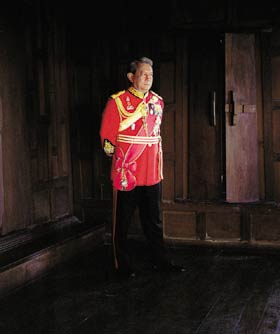
Surayud
Chulanont
A soldier who answered to the people
By Robert Horn
In the late 1960s, when Surayud Chulanont was leading a platoon of
Thai soldiers against communist insurgents in the country's northeastern
provinces, he was plagued by a recurring vision in which he encountered
a band of guerrillas at close range. In it, after a spell of bloody
fighting the rebels fled into the forest. Surayud gave chase, but
paused over a body sprawled face down in a pool of blood. He turned
over the corpse and realized he'd killed his own father.
Payom Chulanont, the father, was
a former soldier who had left the army and his family to become
a rebel leader. Surayud, now 59, was a teenager in cadet training
school the last time his father had visited the family home. It
was a strained reunion, during which Payom explained that he had
lost faith in the army because he believed it was more concerned
with enriching itself and cementing its influence than protecting
the weak and powerless. Though they were later adversaries, Surayud
credits his father with providing a foundation for his own beliefs
about what it means to be a soldier and what role the military should
play in Thailand. "He taught me how to be a good officer,"
Surayud says. "He taught me how to be a good citizen of this
country." Those lessons drove Surayud to become perhaps the
most important Thai military figure of the modern era. No man has
done more to modernize and professionalize the Thai army and, despite
significant—and lasting—resistance, infuse it with the ideals he
learned from Payom.
During the insurgency, and for decades
afterward, the military was notorious for interfering in elections,
staging coups and abusing human rights with impunity. Reports of
involvement in drug, weapon, timber and people smuggling were common.
Surayud managed to maintain a spit-shined reputation, but his journey
was not without controversy. On May 17, 1992, soldiers fired on
a crowd of pro-democracy protesters in Bangkok, killing 52 and wounding
more than 100. Surayud was then commander of the ?lite special forces.
He had been lobbying his superiors to resolve the situation without
using force, but his men had also been seen dragging protesters
through the lobby of the Royal Hotel. Days later he told a national
television audience that he deplored the loss of life and that he
had not given any orders to shoot, an account that was never disputed.
Still, the realization that he couldn't prevent the carnage crystallized
decidedly contrarian views that had been gelling since he last saw
his father: "It convinced me that the army should never be
involved in politics."
By 1997, however, he had been assigned
a desk job with few duties and was considering retirement. But the
then Prime Minister Chuan Leekpai, who wanted to reform Thailand's
army, asked Surayud to become commander in chief. Surayud accepted
and immediately targeted what he calls the "military Mafia,"
transferring corrupt soldiers out of positions of influence or forcing
them out of the service altogether. "I've made enemies,"
he acknowledges, "but I believe in the rule of law." While
the task is far from over, even critics recognize his impact.
On the tactical front, he created
rapid-response units to deal with threats along Thailand's borders,
using them to fend off incursions by Burmese troops and ethnic Wa
guerrillas seeking to attack refugee camps in Thailand or flood
the country with drugs. He acted swiftly and harshly against armed
infiltrators who harmed Thai citizens. But he also ended a policy
of pushing refugees, especially ethnic Karens, back into Burma and
into the jaws of the Burmese army. "He's been a friend to us,"
says Pastor Robert Htway of the Karen Refugee Committee. Surayud
has also sought in several instances to resolve potential bloodbaths
with negotiated surrenders, such as in a 2001 standoff with the
so-called God's Army during which Thai forces surrounded rebels
who had killed six Thai citizens, cut off their supplies and waited
for them to give up.
Under his term the army joined the
U.N. peacekeeping effort in East Timor, the first time Thai soldiers
had ever taken part in such a mission (they're performing similar
duties in Aceh and will soon be dispatched to Afghanistan). Though
Surayud regrets he was never able to win salary increases for his
soldiers, he says he's proud that he managed to procure better rations,
housing and equipment for them. For Thailand, his biggest accomplishment
was the near-wholesale refurbishment of the military's public image.
"He made people trust and believe in the army," says Adul
Khiewboriboon, who has every reason not to. His son was killed during
the crackdown on the 1992 demonstrations, but now he says, "Because
of Surayud, we no longer fear our own soldiers."
Such plaudits did not translate
into job security, however. Surayud clashed with Prime Minister
Thaksin Shinawatra due to the latter's promotion of a looser, more
business-friendly approach to Burma's military junta. Last August
the PM named Surayud supreme commander—a loftier but less influential
post—and installed loyalists into the army's top ranks. The move,
says Sunai Phasuk of Forum Asia, was "a major setback for political
reform and the move to separate the armed forces from politics."
Officers Surayud had sidelined for suspected misconduct were recalled,
but he refused to criticize Thaksin—to do so would constitute military
meddling in politics.
This October, Surayud faces mandatory
retirement. Despite the unfinished business, he'll take with him
praise from an uncommon coalition of fellow soldiers, human-rights
activists, editorialists and defense analysts. There are periodic
calls for the man who tried to remove the military from politics
to enter the political arena himself. Surayud doesn't rule it out,
but for now he plans to trade in his fatigues for saffron robes
and become a Buddhist monk. After so many battles, he wants to seek
peace.
from : http://www.time.com
|
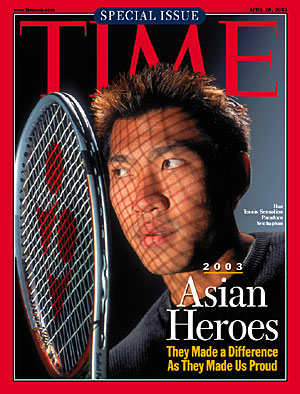
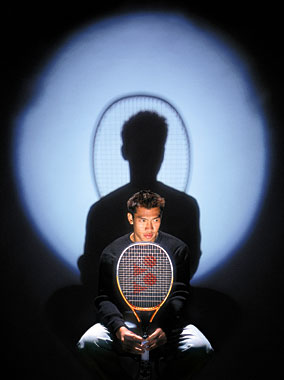
Paradorn Srichaphan
A rising Thai tennis star wins—and smiles—big
By Bryan Walsh
Pro tennis players are too often a combination
of natural talent and unnaturally bad temper. Not Thai star Paradorn
Srichaphan. You won't see Paradorn protesting a line call by smashing
his racquet into graphite shards or by questioning the parentage of
the chair umpire. Whatever the outcome of his matches, his manners
remain, well, courtly. He unfailingly thanks the fans by performing
the wai—the traditional Thai bow—to the four corners of the stadium.
That
pleasant hard-court demeanor does not mean he lacks killer instincts.
Indeed, Paradorn is from the Land of Smiles. So he smiles when he
blows a 210-km/h serve by you. He smiles as he cheerfully rips a
forehand down the line. And he smiles as he ascends the ladder of
the world's best tennis players, rising a head-spinning 110 spots
in 2002 to end the year at No. 16 in the Association of Tennis Professionals'
(ATP) tour rankings—becoming the first Asian male to breach the
top 20 since 1980. "He's fast becoming one of the best players
in the international campaign," says ATP's CEO Mark Miles.
But perhaps more importantly, Paradorn, who lives in Bangkok, is
proving to his countrymen that he can succeed without sacrificing
his essential Thai-ness.
In
Thailand, which as a sporting nation is best known for kickboxing
and transvestite volleyball, being a rising superstar in a global
game confers instant fame. "Paradorn is our first international
icon with mass appeal," says Pana Janviroj, editor of the Bangkok
newspaper the Nation, which named the tennis player as 2002's "Thai
of the Year."
After
returning home to Bangkok at the end of last season, he was so inundated
by attention that he wasn't able to touch a racquet for two weeks.
When Paradorn and Thai PM Thaksin Shinawatra led a public aerobics
session outside Bangkok's Grand Palace last November, a world record
47,000 people showed up in the heavy rain. Paradorn even scored
a private royal audience with King Bhumibol Adulyadej, an experience
Paradorn, being a good Thai, rates as his highest honor.
In
some respects Paradorn's ascent was as unlikely as it was sudden.
At an un-Thai-like 1.85 m and 81 kg, Paradorn, 23, was strong enough
to hit overhead smashes like cruise missiles, but control problems
left him languishing in the ATP's rankings. Working with his father,
who is also his coach, he has more recently learned to control his
game for greater consistency and fewer unforced errors. He's since
beaten Andre Agassi at Wimbledon, won three ATP tournaments and
opened this year's Australian Open at center court and was, at press
time, set to break into the top 10.
If
he continues his white-hot success, Paradorn has the chance to do
for tennis in Asia what half-Thai Tiger Woods did for golf in America:
open a once ?litist sport up to a new group of recreational and
professional players. Interest in tennis has spiked over the past
year in Thailand, and Bangkok will host its first ATP tournament
in September.
The
burden of national expectations continues to weigh on Paradorn's
broad shoulders, but he takes it in stride. "The recognition,"
he says, "keeps me motivated." He'll be getting plenty
of motivation from fans such as Pirakij Siributwong, a promising
13-year-old Thai tennis player. "I want to be just like him
because he's showed that Asians can be among the best in the world,"
says Pirakij. "And he's still polite, too."
from : http://www.time.com |