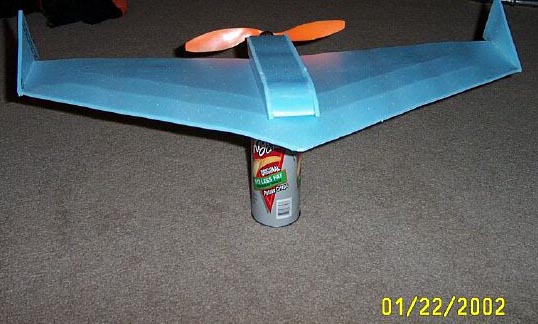
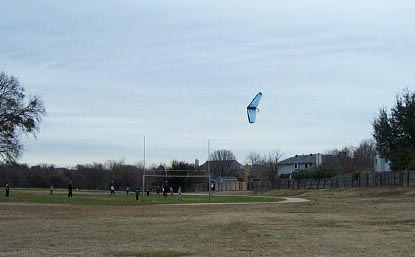
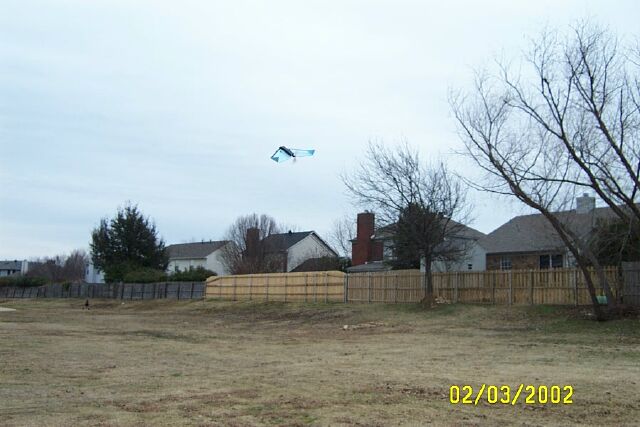
My next scratch built bluecor foam plane is a bit of a departure from the norm. This time, I decided to go for an ultra-light delta wing parkflyer along the lines of the popular zagi models. Now to the details:
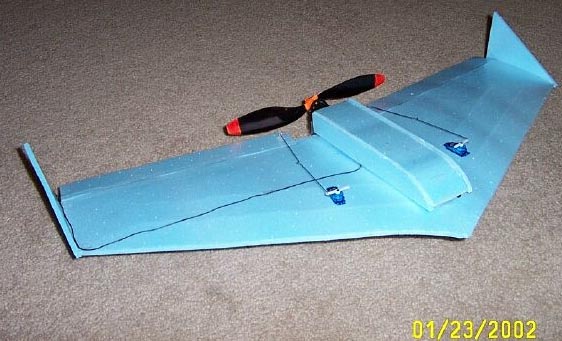
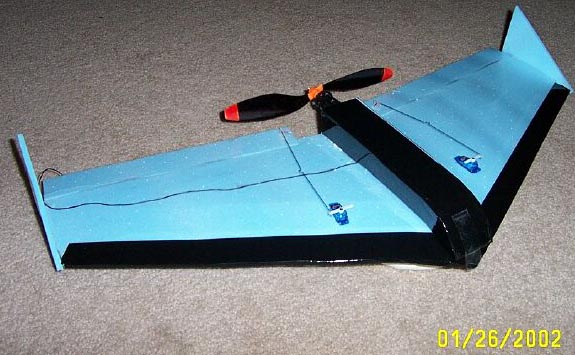
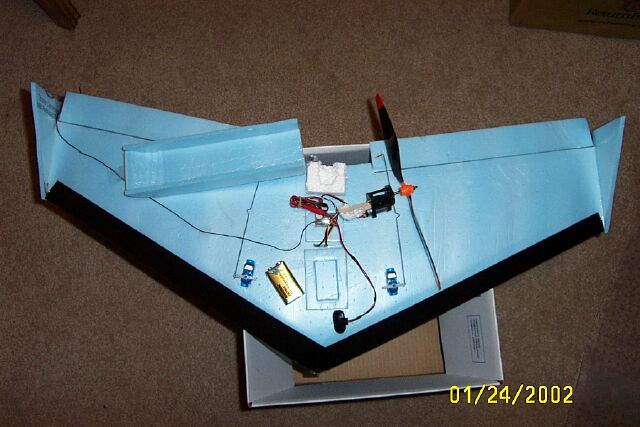
The mini-z is a small and light single layer 1/4 inch bluecor foam plane with a small equipment pod resting on the main wing surface. The wingspan is approximately 28" and overall length is 12" from the nose to the prop. The equipment pod is 8 1/2" x 2 1/2 x1 1/2". Wingtip triangles are 5" long by 3" high.The airfoil is formed by hand bending the bluecor to get thte desired shape. A piece of foam was cut to the same basic airfoil shape and glued under the airfoil running from the leading edge back 6". The skid was about 6" long and tapered from 4" at the back to 0" at the nose. It serves two purposes. One is to help hold the airfoil and the other is to help guard the bottom of the plane from landing damage. Clear or colored packaging tape is highly recommended to help stiffen the airframe and protect during rough landings.
5-minute epoxy was used throughout the construction. Although heavier than other glues, it sets really fast and since not much is needed, the added weight should be negligable. Controls are handled by 1 1/2" x 12" elevons. A pair of Hitec hs-55 servos are used to drive the elevons. Servo mounts are nothing more than slightly undersized holes cut into the wing. Servos are press fit into the hole and secured with tape from underneath. Light music wire is used to attach to small plastic horns in the elevons.
For a receiver, a GWS 4-channel was used along with a 2-amp ESC. Power comes from a Rayovac 9volt nimh pack. It was chosen because it is light and cheap. Larger cells will probably work as well or better. The motor is a stock lite stik motor (DX-A). The motor was mounted to a basswood stick glued into a 2" x 2" x 1" piece of foam. A 10x4.7 is shown in the pictures but a 10x8 or 9x6APC is used for flight testing.The APC props are very tough and perform very well. A simple silicon tubing spacer allows their use in the GWS motor shaft.
update:In flight testing, the mini-z has proven itself a good flyer. It is able to handle winds up to 10 mph. Not fast as a zagi but faster than a tigermoth or other common parkflyers.Try it, I think you'll like it.
|