 Satellites
Satellites
Satellites
When we talk about how Earth and the other planets travel around the Sun, we say they orbit the Sun. Likewise, the moon orbits Earth. Many artificial satellites also orbit Earth. When it comes to satellites, space engineers have different types of orbits to choose from.
They can pick an orbit that goes around Earth's equator, or one that goes over Earth's North and South Poles . . . or anything in between. They can pick a low-altitude orbit of just a few hundred miles above Earth's surface or one that is thousands of miles out in space.
It all depends on what job the satellite is sent up there to do.
Weather satellites keep an eye on the weather.
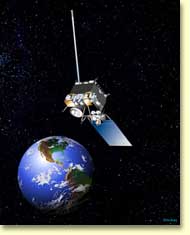
The two GOES* weather satellites, for example, have the job of keeping an eye on the weather over North America. They need to "never take their eyes off" any developing situation, such as tropical storms brewing in the Atlantic Ocean, or storm fronts moving across the Pacific Ocean toward the west coast of the U.S. Therefore, they are "parked" in what is called a geostationary orbit. They orbit exactly over Earth's equator and make one orbit per day. Thus, since Earth rotates once on its axis per day, the GOES satellite seems to hover over the same spot on Earth all the time.
