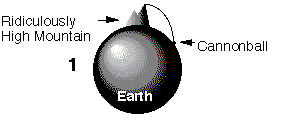
The drawings below simplify the physics of orbiting Earth.
We see Earth with a
huge, tall mountain rising from it. The mountain, as Isaac Newton
first envisioned, has a cannon at the top. When the cannon is
fired, the cannonball follows its ballistic arc, falling as a
result of Earth's gravity, and it hits Earth some distance away
from the mountain (drawing no.1).
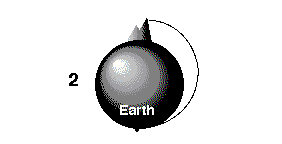
If we put more gunpowder in the cannon, the next time it's fired, the cannonball goes halfway around the planet before it hits the ground (drawing no.2).
With still more gunpowder, the cannonball goes so far that it never touches down at all. It falls completely around Earth. It has achieved orbit (drawing no.3).
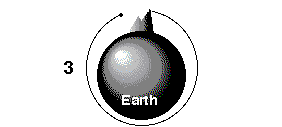
If you were riding along with the cannonball, you would feel as if you were falling. The condition is called free fall. You'd find yourself falling at the same rate as the cannonball, which would appear to be floating there (falling) beside you. You'd never hit the ground. Notice that the cannonball has not escaped Earth's gravity, which is very much present -- it is causing the mass to fall. It just happens to be balanced out by the speed provided by the cannon.
The cannonball provides us with a pretty good analogy. It makes it clear that to get a spacecraft into orbit you need to