|
| NASA's
first seven astronauts |
Astronauts |
| The word astronaut means "star sailor" in Latin. |
| The Astronaut Selection Board looks for people who have experience and potential, people who are motivated and have the ability to work as part of a team, and people who can communicate well to work as astronauts. Applicants must be adaptable and understand the tremendous workload that is involved in becoming an astronaut. Many candidates withdraw their application after they realize the time and danger involved in being an astronaut. |
|
|
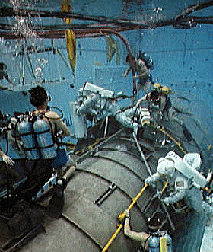
ASTRONAUT TRAININGThe novice astronauts are trained in aircraft safety which includes ejection, parachute, and survival instruction. Mission specialists and pilots are trained in a T-38 jet in order for them to gain experience in a high-performance aircraft. A Gulfstream II aircraft, which has been modified to simulate the handling of a Shuttle, is also used to train pilot astronauts. The astronauts are given a range of basic science, math, and technology courses. The astronauts receive training in a mock-up of the Space Shuttle. Each astronaut must also learn to function in weightless environments, and possibly even learn to perform a space walk. Advanced training follows the basic training program. The advanced training program consists of sixteen different courses covering all Shuttle-related crew training requirements. The advanced training continues even after a crew has been given a flight assignment. Starting at about ten weeks before a mission, the astronaut team starts to simulate the mission with the Earth-bound flight control team who will assist them in their flight. |
Often the commander is also the pilot of the Shuttle. Commanders are responsible for the vehicle, the crew, mission success, and safety.
|
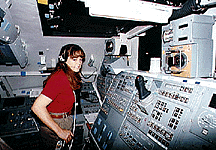
PilotThe Shuttle pilot is second in command. The pilot's primary responsibility is to control and operate the Shuttle. Pilots assist the Shuttle commander as necessary. Shuttle pilots must be United States citizens. |
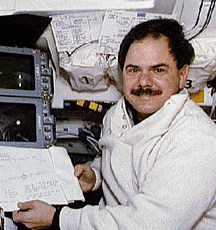
Mission SpecialistMission specialists are responsible for coordinating all on-board operations. Mission specialists perform on-board experiments, space walks, and handle the payload. Mission specialists must be United States citizens. |
|
|
Payload SpecialistPayload specialists are professionals from the physical or life sciences field, or they are highly skilled technicians who can operate the Shuttle payload equipment. Payload specialists are chosen by the payload sponsor or customer. Training for a payload specialist may begin as much as two years ahead of the scheduled flight, depending on the task the specialist must perform. |