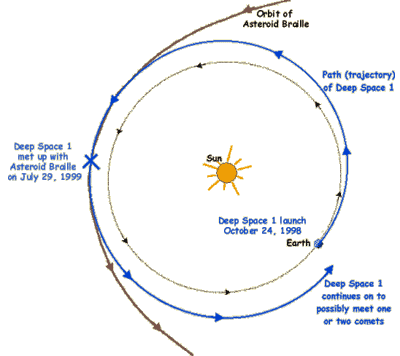
¡@

Rockets

¡@

 Nothing in space stands still. Everything either orbits around something else, or moves toward or away from something else. So how do space engineers aim a spacecraft so it lands on Mars or meets up with a particular comet or asteroid? How does a rocket launches as the planet spins?

Timing is everything!

In picking a time to launch, space engineers and scientists have to consider quite a number of things. Most of them have to do with getting the biggest boost possible from the big launch pad called planet Earth!
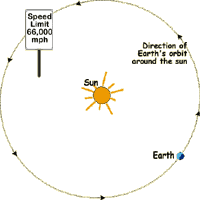
Earth orbits the SunEarth goes around the sun at a brisk 107,000 kilometers per hour (66,000 miles per hour)! If our interplanetary spacecraft is aimed in the same direction Earth is already going, it will get a big head start.


Also, Earth rotates eastward on its axis, one complete turn each day. At the equator, Earth's surface is rotating at 1675 kilometers per hour (1041 miles per hour)!

So if we launch the rocket toward the east, it will get another big boost from Earth's rotational motion.
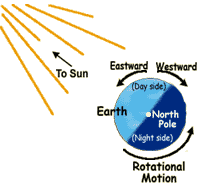
Earth rotates toward the east
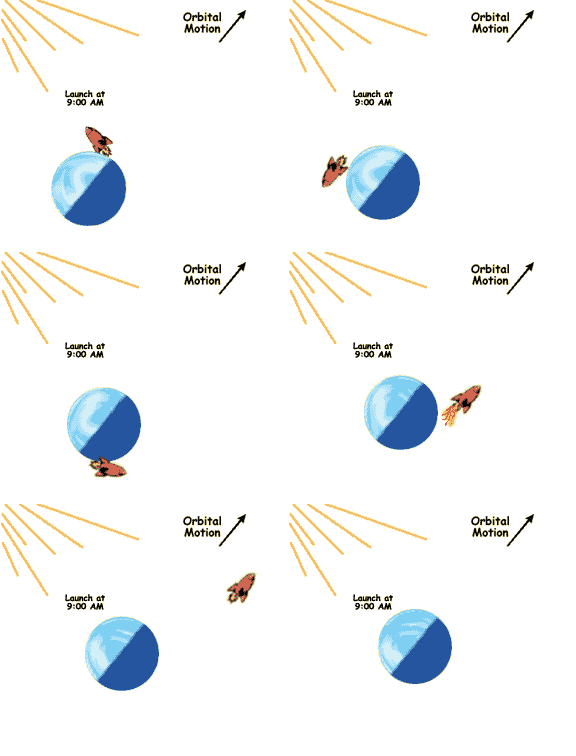
Rocket launched in same direction as Earth orbit and rotation Now, we launch eastward. We pick the time of launch (in Deep Space 1's case, early morning) to give the rocket time to accelerate as it goes partway around Earth. Then, when the spacecraft is headed in the same direction as Earth's orbital motion around the sun, the rocket gives it a final boost out of Earth orbit and on its way.

¡@

Using both the rotational motion of Earth on its axis and the orbital motion of Earth around the Sun, we can save a lot of fuel and a lot of time in getting to our far distant destination!

Ready . . . Aim . . . Blast off!

Deep Space 1 rendezvous'd with an asteroid

The best times to launch the rocket are called "launch windows."

Usually, engineers will try for the beginning of the first launch window. However, several things can delay a launch. For example, the weather might be bad. Or something might suddenly look a little funny with the spacecraft or the rocket or the ground communications. Or a boat or airplane might appear, even though they've been warned to keep their distance. Any of these could cause a delay until the next launch window or later in the same launch window.

Hosted by www.Geocities.ws

1