Our
Solar System
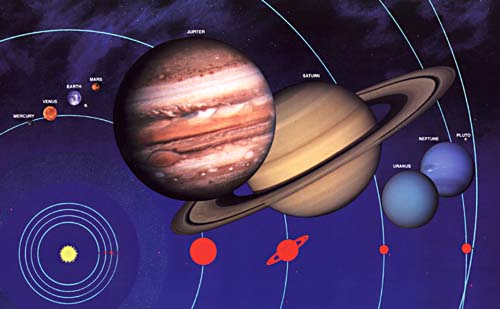
Our Solar System consists of the
Sun, a family of planets, more than sixty moons orbiting the
planets, millions of asteroids, and billions of comets. Our Solar
System is an oasis of light, heat, and life. Read here to learn
more about our Solar System and planets.
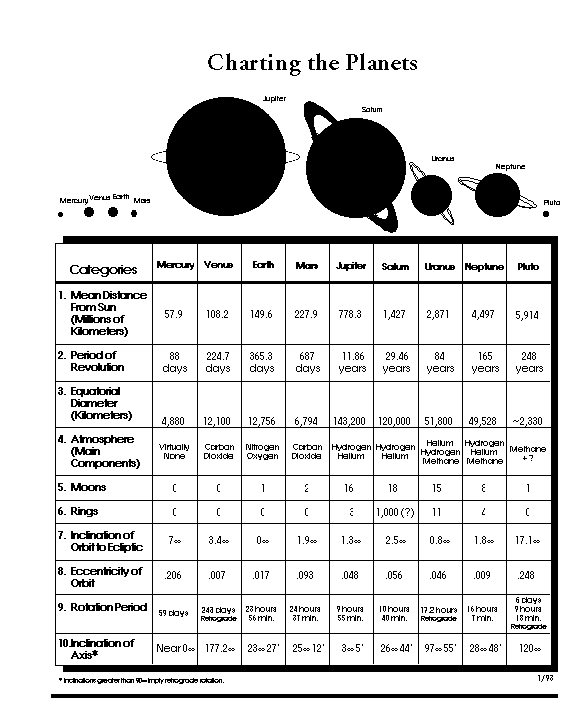
Classification
The nine bodies conventionally
referred to as planets are often further classified in several
ways:
by composition:
- terrestrial or rocky planets:
Mercury, Venus, Earth, and Mars:
The
terrestrial planet sare composed primarily of rock and
metal and have relatively high densities, slow rotation,
solid surfaces, no rings and few satellites.
- jovian or gas planets:
Jupiter, Saturn, Uranus, and Neptune:
The gas
planets are composed primarily of hydrogen and helium and
generally have low densities, rapid rotation, deep
atmospheres, rings and lots of satellites.
by size:
- small planets: Mercury, Venus,
Earth, Mars and Pluto.
- The small planets have
diameters less than 13000 km.
- giant planets: Jupiter,
Saturn, Uranus and Neptune.
- The giant planets have
diameters greater than 48000 km.
- [Mercury and Pluto are
sometimes referred to as lesser planets (not to be
confused with minor planets which is the official term
for asteroids).
- The giant planets are
sometimes also referred to as gas giants.]
by position relative to the
Sun:
- inner planets: Mercury, Venus,
Earth and Mars.
- outer planets: Jupiter,
Saturn, Uranus, Neptune and Pluto.
The asteroid belt between Mars and
Jupiter forms the boundary between the inner solar system and the
outer solar system.
by position relative to
Earth:
- inferior planets: Mercury and
Venus.
- Closer to the Sun than Earth.
- The inferior planets show
phases like the Moon's when viewed from Earth.
- superior planets: Mars thru
Pluto.
- Farther from the Sun than
Earth.
- The superior planets always
appear full or nearly so.
by history:
- classical planets: Mercury,
Venus, Mars, Jupiter, and Saturn.
- Known since prehistorical
times.
- Visible to the unaided eye.
- modern planets: Uranus,
Neptune, Pluto.
- Discovered in modern times.
- Visible only with telescopes.