It's good to know that things don't really change. Even when they do.
The fog still hangs on the coast for days at a time, and the farmers wonder
if the sun will come out long enough for them to bale hay or harvest grain.
Some days they'll snatch a few hours with the haypress or the combine at
midday, if the sun comes out. There will always be fields of barley. There
will always be men like Joe and Manuel, urging those behemoths, the
self-leveling
combines, across the sidehills, reels glinting in the sun. The up-to-date
will truck in bulk trailers in which to dump the grain instead of sacking
it the old fashioned way. But Joe will still tow the rusty old sacker into
the field. And a few local folks like you and me and Old Man Delucchi will
come to sack barley the old way.
One day in September, after the kids have gone back to school, a warm east wind will push out the fog, and summer will really begin on the coast. Joe and Manuel will have to forget about deer season and hope that the sickle is still sharp from last year and the header holds up and the feederhouse doesn't jam. There is nothing like coast barley, sweet and plump, although darkened by fog and dust. Looks aren't everything.
When we pull through the wire-gap into the field, Old Man Delucchi will be there, standing by the sacker, arguing with Joe about the price. While another generation runs the ranch, Old Man Delucchi spends his days tending a few pigs and chickens and harassing his housekeeper on the old Delucchi place. He'll scoop up a handful of grain from the ground where it has scattered because Sadie Waxworth, who just left with a dozen sacks in her new pickup, wasn't too conscientious about closing the sliding door on the hopper when her sacks were full.
Stabbing a horny finger at the barleycorns in his palm, Old Man Delucchi will complain, "Look, at this! It's beardy as hell!"
Joe will remove his cowboy hat and smooth back his thinning hair. He'll look up at the rusting red and yellow combine. He'll say, "That's just a little left in the bottom from yesterday. It was too damp. I'm augering in some good stuff now. It's really clean." He'll replace his hat and turn to you and me. He may not remember your name, but if you're a woman he will always make you feel that he knows you when he looks at you.
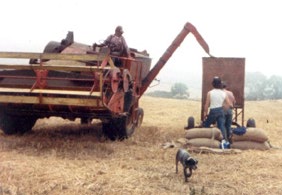
Joe will shake hands with me and then tip his hat to you. I'll be talking to Joe while the grain augers into the hopper, while Old Man Delucchi is filling his sack. He'll release the hooks and manhandle the sack over to the two full sacks he uses for a seat. Every year we'll share the hopper with Old Man Delucchi or Sadie Waxworth or one of the Smiths from down at Pigeon Point. We'll work out of this same old rusty red sacker, a hopper on legs with a trap door in front and a rack with hooks to hold open an empty sack below the door. We'll get out our musty burlap sacks. I'll spread a tarp under the hopper door to catch the stray grain. I'll get out the battered old feed tub in case I have to scoop out excess barley from an over-full sack. I'll hook on a sack and slide up the door and barley will pour into the sack with a hiss and I'll tamp it into the farthest reaches of the sack with a smooth old pick handle.
Joe will still be standing by, waiting for the load to auger into the sacker from the combine. He'll be talking crops or weather or hunting. When the sack is full, I'll walk it over to you, tipping it from side to side. Seeing that you've forgotten how to sew sacks since last year, Joe will show you how to hold the twine and needle, how to take up an ear on the end of the sack and throw a half-hitch over it with one fluid motion. He'll show you how to push the needle with the heel of your hand, folding the open edges of the sack neatly under clear across, and how to half-hitch another ear on the other end and break the twine on the cutter with a backwards jerk of the needle. Joe will stand behind you, guiding you, while you fumble and giggle and manage a clumsy imitation of his taut, trim sewing job.
Then, when the auger rattles hollowly, Joe will swing aboard the combine,
raise the auger and circle back into the field with a roar. He'll lower
the reel and the combine will gobble the tawny barley, spewing out a drift
of straw behind. For hours, Joe and Manny will circle, up and across the
rolling field, running over to the bulk trailer to discharge their load.
When Joe thinks we need more, he will make his way across the stubble and
auger barley into our sacker, stepping down to shout gossip over the
tickety-tickety-ticket
of barley rushing into the hopper. The air will smell of grain and dust,
crushed hedge nettle and tarweed.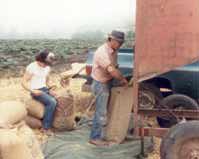
Old Man Delucchi's son and daughter and their sons and daughters run the Delucchi place now, up one of the canyons, south of town. They raise hay and grain and pumpkins. The family owns their place outright and unencumbered. They could sell out any time: cut the place into ranchettes for wanna-be organic farmers or horse or llama breeders. They could sell out and move to Oregon or Washington or Idaho where they could continue farming.
But Old Man Delucchi isn't buying barley from his family. As he magically ties the ear on the sack and loops the needle and twine through the burlap with a graceful one-two-three-pull movement, he will nod and grin, showing tobacco stained teeth. He will have on those dirty frayed overalls and an old suit jacket and his face will be bristly with several day's stubble, like a dusty harvested field. He'll pause in his work several times to hobble to his old truck to drink out of a plastic container. You'll spot him dumping a gallon can of barley into a ten gallon cream can in the back of the truck. You'll notice that the pockets of his suit coat are sagging with weight when he goes for a drink. When he comes back to the sacker his coat will flap in the breeze.
Finally, Old Man Delucchi will say, "Well, I think ten sacks should do her!" He'll try to catch my eye as he grabs the ears of the sack closest to the tailgate of his truck and he'll grunt loudly.
I'll shut the feed door on the sacker. "Here, I'll help you," I'll say. I'll sling the sacks into Old Man Delucchi's truck and he'll slowly place them, puffing hard. I'll notice that they're big sacks, sacks for oats, not barley. He'll say, "Whew, I'm not as young as I used to be!"
I'll place the last sack as Old Man Delucchi climbs down to gather up his needle and twine. He'll empty the full gallon can of barley into the cream can in back of his truck and casually fill his pockets from our tub. As an afterthought he'll pick up a holey old sack that someone has left here a quarter full, and haul it after himself into the cab of the truck, covering it with a frayed canvas. The engine will roar to life. He'll stick his grizzled head out and yell, "Tell Joe I'll straighten up with him next week! Tell him I got ten sacks!" He'll back around and roar away in a cloud of dust.
Next year, or the year after, this field may not be a field anymore; it will be a ranchette or a carefully sculpted golf course or a brushy sidehill you will see as you drive by on the coast highway. But somewhere on the plains, the steppes or the savanahs, the llanos or the pampas, when the grain is golden and dry enough to harvest, somewhere, Sasha or Mei Lin or Deepak will be winnowing or reaping or combining. Old Man Salemi will be sewing sacks and stowing barley in his pockets. And maybe by then, José will remember your name and he won't have to show you how to sew sacks, and you can do it right, all by yourself, the first time.
© 1994 Maria das Neves