hOPe YoU eNjOY hAnGiNg ArOuNd
Japanimation- refers to the tradition of Japanese animation that is recognized by its artistic quality and the artistic conventions animé artist use. Though commonly known as "Animè" the media is actually a conglomeration of the manga (comic book) industry, the animé (Animated video and film) industry, and the video game (e.g. Nintendo and Sony Playstation) industry; they are tied together by their reliance on a characteristic art style.
The word "animé" (pronounced "Annie may"), contrary to popular belief, is not the Japanese word for animation. Though the word is used in Japan to describe animation, it is actually derived from a French word. Animè in the U.S. refers specifically to Japanese animation, which in and of itself is a unique style of story telling and filmmaking
JAPANIME VS. AMERICAN CARTOONS
In the United States, animation
and film are separate mediums. In Japan they are one and the
same. The cinematography and further elements of professional
filmmaking are all used in the animated films that are created in
Japan. Unlike in the U.S. and most parts of the world where there
is a rampant belief and public perception that animation is for
children. Animè in Japan is made for all types of audiences
including children, adolescents, and adults. Unlike the U.S.,
Japan produces a large variety of animated series and movies
aimed at a wide spectrum of ages and audiences. They run the
gamete from the saccharine Hello Kitty (The Barney of the Pacific
Rim) to very hardcore adult animation known as Hentai or
H-animè. But the biggest difference between animation in the
U.S. and other parts of the world from that of Japan is that
while we dismiss it as "kid's stuff" and one of the
lowest forms of popular art, the Japanese consider it a true art
and pay great respect to the artist and creators, who produce
animé. The Manga-kA (manga writers) and Seiyu (voice actors) are
popular stars with all the admiration of Hollywood actors. Many
of them have fun clubs, concerts, and books written about them.
Animè is distinct from American cartoons in their depth of
characterization and plot (among other things). For the most
part, the quality of animation in animé far surpasses that of
American cartoons. Animè spans many genres, from silly romantic
comedies (Marmalade Boy) to fantasy adventures (Vision of
Escaflowne and Fushigi Yuugi); high-tech science fiction (Macross
Plus), and much more. The most distinctive quality of Animè is
the subject manner; much of Animè deals with
"real-life" topics that most foreign animators wouldn't
touch with a 30-foot pole. For instance, the death of major
characters is common in Animè, as are complex relationships
between characters.
 the tick versus
 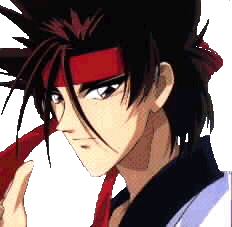 who do you think's gonna win??? ^_^
Some artistic conventions of Animè are big eyes. Japanese animation style used the motif of big eyes to represent youth in character designs. This is common in many Animè characters, but there exist a large contingent of Animè characters, which do not have big eyes. It has been said that large eyes of these characters came from the influence of early American cartoons like Betty Boop, for most Japanese the large eyes is considered very attractive, kind and welcoming in a way that it invites viewers and fans. American cartoons had a difficult time entering Japanese Market because of the small eyes of the characters. Small eyes are considered cruel, cold and unwelcoming. Another convention is the colored hair of characters. The colored hair or the outrageous hairstyles that defies even the law of physics are employed to distinguish characters from another. Another context is characters that are white but speak Japanese. Animè characters have races relative to context, not necessarily white. The reason why characters speak Japanese is because Animè comes from Japan. Likewise, why are the characters yellow in the Simpson's, yet speaking English. Another interesting feature of Animè is that all characters of school age wear uniforms. This is because uniforms are required at most schools. The last thing is that most women in Animès have high pitched voices. This is supposedly to increase femininity.
Closely related to Animè is manga, which can be roughly translated to "irresponsible pictures" and is used to describe what we would call comic books. As with Animè, there are manga for just about anyone. It is not uncommon to see a Japanese businessman reading a business manga or a housewife reading a cooking or romance manga. Many successful manga go on to become Animè television shows, original video animations (OVA); and theatrical movies. One major difference between Japanese manga and general superhero comics like DC comics or Marvel comics aside from the black and white nature of manga, is that manga are usually the vision of a single writer at most two, generally. Unlike the general superhero type where many writers tend to do difficult plots and stories, manga are more like novels, complete and detailed words that are the vision of a single author. The characters remain consistent, and they are allowed to grow and develop. On a related topic, manga also tend to be drawn for a weekly or biweekly publication containing numerous other comics by other authors.
Perhaps one of the best
examples of the romantic Animè production is Final Fantasy
III, originally released as Final Fantasy VI in Japan. Final
Fantasy III is a video game (a super Nintendo game) that contains
the classic elements of Japanese "romance" aspects that
are echoed throughout other works again and again.
One of Final Fantasy III's most striking feature is its music.
Music plays a key part in the game, each major character has his
or her own theme song. Most of the tunes are melancholy
reflecting the tragic histories of their characters. Visually,
too, Final Fantasy III distinguishes itself. At a small level,
even characters --- as small as they are on screen --- somehow
manage to display surprise, joy and sadness. The scenery too,
builds up a tangible atmosphere. The story itself is romantic.
The setting is that of a fantasy world, where magic and
technology are existing together. Final Fantasy V & VI are
now available in the Sony Playstation console.
Another much trumpeted game is Final Fantasy VII (for the Sony
Playstation). It contains some stereotypical elements: action,
combat, mecha and even large-chested woman. Yet to just focus on
those elements would be an insult to the entire game. The game
events revolve around the character of the hero, Cloud, his
relationship with others, and his thoughts, desires, fears and
his growth. He starts of outreadly a cold, almost heartless young
man - yet inwardly small and frightened. We don't see it at first
but his worst failures are largely a result of his own hypocrisy
and fear. But with the progression of the game - through the help
of his friends and his help to them - he grows into what he
really wanted to be - a hero. This type of plots is what
basically makes this type of Japanimè products click. The
intricate plots and storylines, wide variety of topics and
styles, the emotions and great artwork are what make Japanimè
fans came back for more.
Video games are presently a very popular form of entertainment
media. Most games trace their origins from manga or Animè like
Dragon Ball Z, Sailor Moon and Samurai X video games. While other
games like Final Fantasy III spawn their own animated
features.Currently Im trying to work my way through Final Fantasy
IX. Any of you folks want to give me tips? ^-^
Japanime is an art form that deserves respect and notice and that as a popular and well-known media. Its influence on society, art and the marketing general is great and deserves consideration and careful study. The large following for animé particularly animation features is caused and directly attributed to the quality of story telling and level of understanding from which the story develops as well as to the beautifully drawn characters and interestin yet largely realistc plots.