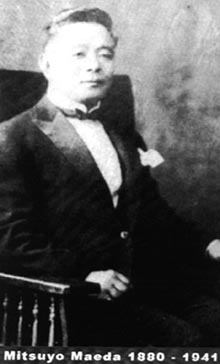
In 1914, Japanese jiu-jitsu champions Esai Maeda and Inomata arrived in Brazil to help establish a Japanese immigration colony in that developing country. He was aided by Gastao Gracie, a Brazilian scholar and politician of Scottish decent.to show his gratitude he tought his son carlos the secret fighting style of jiu jitsu.
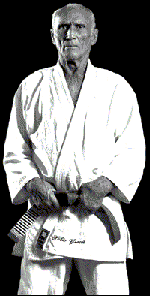
Carlos taught Maeda's techniques to his brothers: Oswaldo, Gastao, Jorge and Helio and in 1925 they opened the first jiu-jitsu Academy in Botafogo, a district of Rio de Janeiro, Brazil.
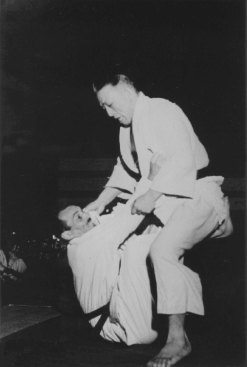
Helio went a step further than his teachers by introducing techniques that required less strength than the Japanese style. Led by him, the brothers were driven by a constant determination to find effective ways to deal with the very possible aspect of a real fight. Daring to break away from the traditional Japanese style, they began experimenting, modifying and perfecting simple techniques that would be effective regardless of stature. That is how the Gracie family developed this style of Jiu-Jitsu. Though this martial art descended from the ancient Japanese style, the differences are quite apparent. Many of the Japanese facets of the art which depended on physical prowess and stiff motion were tossed aside, leaving pure technique. |