Making modifications to your vehicle may make your vehicle less reliable and potentially more dangerous. The Mitsubishi Four Wheel Drive Club of North America is not liable for any effects caused by these modifications. Owners attempting these modifications do so at their own risk.
A: First... Only 3.0L or 3.5L Gen I & Gen II Montero's come with trailing arms and coil sprung rear suspensions. Gen I 2.6L 4 cylinder Montero's, and 3.0L v6 Gen II Montero sports come with leaf sprung rear ends so they don't have trailing arms.
Problem Background
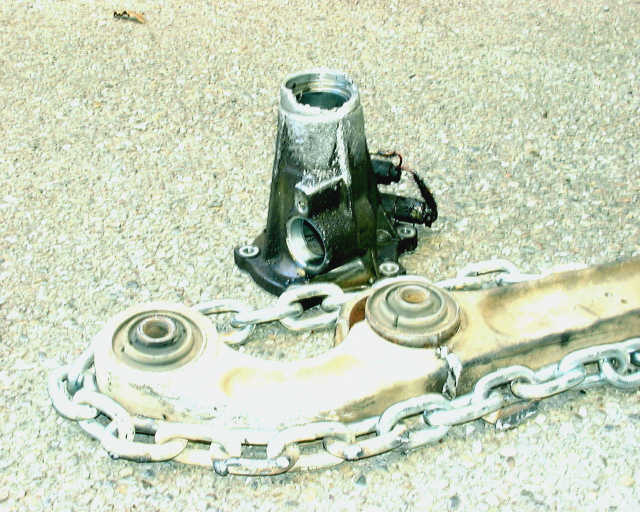
The main purpose for the trailing arms in a coil sprung suspension is to hold the rear axle perpendicular to the driveshaft at all times and throughout the full cycle of the suspension's travel.
Author: Ray Sala
Illus. & Images: Ray Sala
Ray Sala is currently Webmaster & Secretary for the Mitsubishi Four Wheel Drive Club of North America. He owns a 1990 3.0L v6 LWB Montero & has travelled a number of off road trails throughout the western United States. He is more than willing to pioneer in a number of Montero modifications including the ill-fated Rear Anti-Sway Bar Disconnects.
He currently resides in California's Silicon Valley & can be found regularly on both the Outdoorwire.com and VMAG Mitsubishi forums.

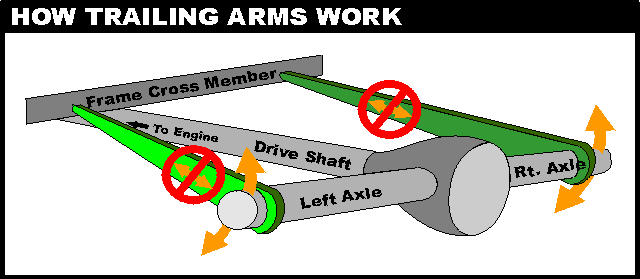

By having one tire down, and the other up, this twisting motion may be putting forces on the trailing arm which are beyond it's original design specifications.
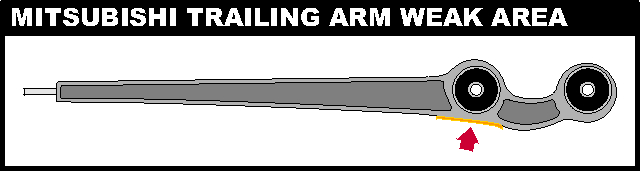
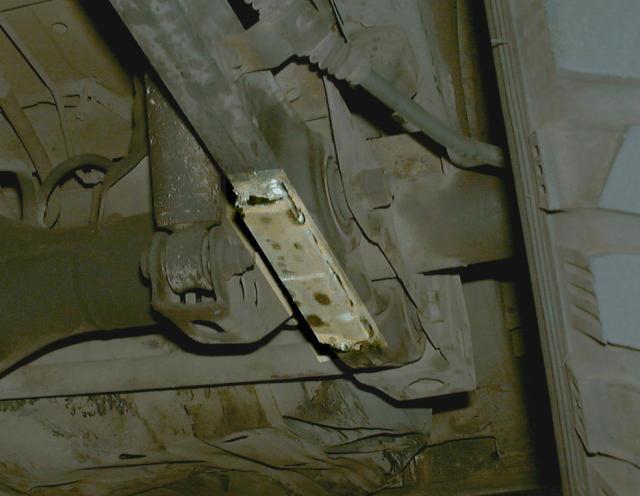
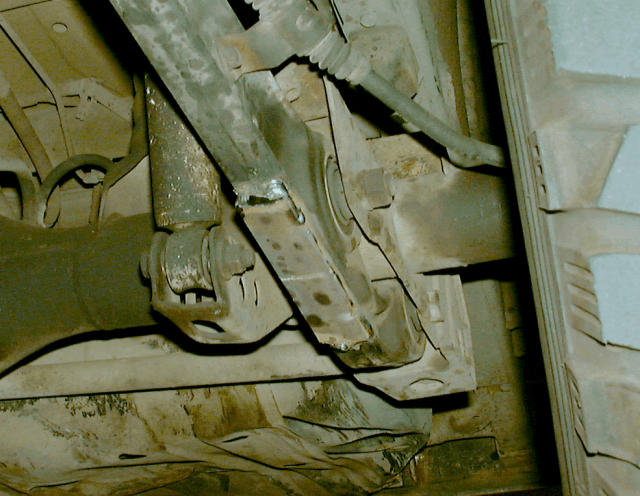
So how can a Mitsubishi 4x4 owner prevent trailing arms from failing on their rigs? Using the diagram above, you can easily see where your trailing arm may break under the conditions described above. By welding a piece of 1/4" thick steel through the weak area seems to effectively prevent this problem. Here are some pics of my rig's re-enforcements.