ANTALYA ( Please Click for Photos )
In recent
years, the gulf of Antalya, with a coastal strip of some 200 km with bays and
coves of exceptional beauty filled with the crystal clear waters of the
Mediterranean, has become one of the most popular tourist resorts in Turkey.
The coastal plain is covered with banana plantations and orchards of citrous
fruit, as well as pine forests and
groves of palm trees.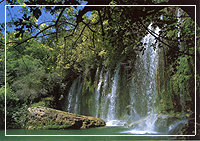
The peaks of the Taurus mountains, from which tall trees descend in places right down to the shore, remain covered in snow right up until the middle of summer. Antalya itself, as well as the nearby tourist centers of Kemer, Beldibi, Belek, Side and Alanya, are thronged with tourists through every season of the year.
The coves, valleys and forests in the vicinity offer picnic sites of extraordinary beauty. Besides the ancient cities, there are waterfalls and caverns and many other natural beauties waiting to greet the visitor.
The city
of Antalya is situated on cliffs at the extreme and of the gulf. The city center
is located in the region contained within the old defense walls surrounding the
yacht harbor, but, since the 1970's and 1980's the city has expanded very
rapidly towards the west and north. In last twenty years, immigration from
central and eastern Anatolia has raised the urban population by some 400%.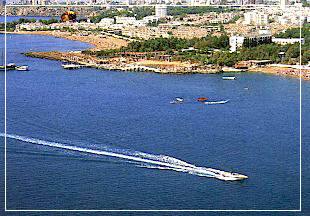
The production of cotton on the fertile soil, the huge greenhouses and of course, tourism all contribute to local wealth and prosperity. Antalya also contains a number of summer-houses owned by residents in other parts of Turkey.
Although the surrounding region has been inhabited for nearly 50.000 years, the center of the province of Antalya is a fairly recent settlement.
While the other ancient cities in the vicinity date back as far as 1000 B.C. Antalya was founded in the 2nd century A.D. by Attalus, King of Pergamon, who named the city "Atteleia".
The ancient city, whose main source of income were the trade in salt, olive oil, fish cereals, cedar wood and saddle beasts, was incorporated under the Roman Empire in 133 BC in accordance with the bequest of the last Pergamene king. Famous personalities who visited the city in ancient times included St Paul and Barnabas in the 1st century AD and the Emperor Hadrian in the 2nd. Its fertile soil, its warm climate and its exceptional geographical situation exposed Pamphylia, which actually means ”land of all tribes”, to invasions by a number of very different civilizations throughout the course of its history.
In 1207 the region was captured by the Seljuks and in the 15th century by the Ottomans, after which it was populated mainly by Turks.
In
1918-1921, after the end of the First World War, the whole region was occupied
by Italian forces.
Antalya is also one of the most important centers of art and culture in Turkey and is enlivened by various cultural activities such as the annual Art and Film Festival and Jewel Festival. Another of the specialties of the region is the preparation of jams made from all sorts of local fruit and vegetables.
The harbor area is undoubtedly the most interesting part of the city. Although construction was begun at the time of the foundation of the city the surviving remains generally date back to the 3rd century AD with traces of Roman and Ottoman restorations work in the upper parts of the walls. The marina is surrounded by numerous bars, cafes, restaurants and tea- gardens, and from the tea-gardens, set on the top of the cliffs, high above the harbor, one can enjoy a marvelous bird’s eye view of the loveliest part of the old city; Since the 1970s, many of the old stone or wooden Ottoman houses that line the narrow streets contained within the old defense walls have been restored and converted into pensions, hotels and restaurants.
The Fluted
Minaret in Republic Square, which has he come the symbol of the city, belongs to
the multi-domed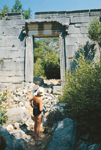 mosque built by the Seljuk Sultan Alaaddin Keykubad at the
beginning of the 13th century.
mosque built by the Seljuk Sultan Alaaddin Keykubad at the
beginning of the 13th century.
The minaret itself, which rises to a height of 38 m, rests on an octagonal base supported by a square stone plinth. Among the monuments located within the walls, the most interesting is the Truncated Minaret.
This minaret, which was partially destroyed by an earthquake, was added in the 14th century to a large edifice originally constructed as a temple in the 2nd century A.D. This was converted into a church during the Byzantine period and, finally, into a mosque by the Ottomans.
The Hýdýrlýk Tower, which rises to a height of 14 m on the cliffs to the south of the harbor entrance, was built as a lighthouse in the 2nd century AD
From the tower, a short walk takes one to the Karaali Park, whose tea- gardens, with their trees and pools, offer delightful coolness and shade on a hot summer afternoon together with a marvelous view over the city with the peaks of the Taurus Mts. in the background.
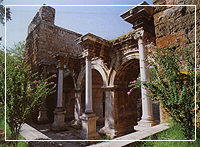
The section of the city walls on the east towards the ancient city of Perge contains a very well-preserved triple- arched monumental gate in the form of a Roman triumphal arch. Built in 130 AD on the occasion of the Emperor Hadrian’s visit to the city, it is known as Hadrian’s Gate after the Emperor to whom it was dedicated. One of the places that must definitely be visited during a visit to Antalya is the modern Archaeological Museum in the western part of the city. In 1972 the Antalya Archaeological Museum was transferred to this new building situated by the side of several 5-star hotels at the top of the road leading down to Konyaalti beach. The exhibits were re- arranged in 1985.
Here are preserved the most interesting of the findings discovered in the region, beautifully arranged in thirteen sections, with a large number of statues and excavations exhibited in the garden. All the well-preserved findings unearthed during the excavations carried out in the ancient cities around the region are brought here for exhibition. The museum contains an extraordinarily rich collection of objects ranging from prehistoric stone implements to statues of the gods, from Roman imperial sculpture to Roman and Greek coins, and from ancient floor mosaics to ethnographic artifacts of the Ottoman period.
This ancient city of Olympos is located between Kemer and the natural harbour of Adrasan, on the southern side of Mount Tahtali, dating back to Hellenistic era with remains from that age. Olympos was a haven for pirates until the Romans took over; now it is protected as a natural park. The city’s most interesting remains are an ancient bath with its beautiful mosaics, a temple gate, a large theatre, the walls and the towers around the bay. North of Olympos, up from cirali Beach, there is the mythology Yanartaþ(Burning Stone). Bellerophon on his winged horse Pegasus came to that point where he slew the fire-breathing monster but, as the legend says, its flames were never extinguished . This area was regarded as sacred by Byzantine ironsmiths and now there are remains of the temple they built. According to some historians, the Olympic Flame was first brought from this point.
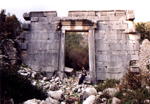
PERGE
Situated 18 km east of Antalya, Perge is in the city limits of Aksu Bucagi.
Because of its location on the Cilicia - Pisidia road, it was a vital part of
the province of Pamphylia, and was founded around the same time as the other
cities in the area (7th century BC). It was an important city for Christians of
Perge who had worshipped the mother goddess Artemis. St. Paul and Barnabas
visited the city and wealthy benefactors like Magna Plancia had a number of
important memorials built here.
The first excavations began in 1946 by Istanbul University and they resulted in
many important discoveries: The theatre consists of three main sections: the
seating, orchestra and stage. It held 12,000 spectators, with 19 rows of seats
on the lower section, 23 on the top section, and a 52-metre stage.
The stadium measures 34 square metres, with 13 rows of seats on top of the vaults. The eastern and western sides have 30 vaults each and the northern side has 10. For every three vaults there is an entrance to the stadium, and the other two were used as shops.
The Agora was the commercial and political centre of the city, with shops surrounding the central courtyard, some of which have mosaics on the floor. The agora measured 76 square metres, with a circular structure in the centre with a diameter of 13.40 metres The colonnaded boulevard lies between the Hellenistic Gate and the nympheum on the slopes of the acropolis. On boat sides of the street, 20 metres in width, are porticoes, some up to five meters high, behind which are shops. The street is divided into two by a 2-metre wide water canal running through the middle. Other structures include the necropolis, city walls gymnasium, Roman Baths memorial fountain and Greek and Roman gates .

ASPENDOS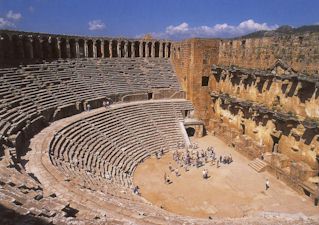
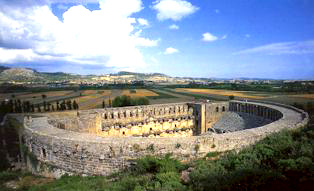
Aspendos is known for his best-preserved theater of antiquity with seating for 15.000. Still used today, the theater's galleries, stage decorations and acoustics all testify to the architects success. Nearby stand the remains of a basilica, agora and one of the largest aqueducts in Anatolia.
This city on the shores of the ancient Eurymedon,built by the colonial people from Argos,is renown over the world because of its Roman amphitheater of incrediple beauty,that is still in excellent shape .Aspendus was the only city,besides Side,that minted silver coins in 5th C.AD.The city walls were built in the Hellenistic period and were repaired restored in the late Roman period and in the Byzantine period.Aspendos is divided into two:Lower City and (Upper)High City.The Agora,Basilica,Bouleterion and the monumental fountain situated in the High City and the Theater,Stadium,the Roman Baths and the Water aqueducts situated in the Lower City are definitely worth seeing.The Aspendos Theater holds 15,000 people and was built by the famous Aspendosian architect Zenon,in Marcus Aurelius’time(secondhalfof2AD). This theater is in better condition than all other theaters built in the ancient times .In order to keep with Hellenistic traditions,a small part of the theater was built so that it leaned against the hill where the Citadel (Acropolis)stood,while almost all of the other parts were buit onvaulted arches . The high stage served to seemingly isolate the audience from the rest of the world.The very top section of this stage has been repaired and the acoustics were ameliorated with later additons .Because the stage area was later used as a caravansarai in Seljuk times,it was continuously repaired and maintained .Thus,the Aspendos Theater has been able to survive to this days without losing almost any of its original qualities.