ANKARA
( Please Click for Photos )
GENERAL PACK
Capitol and
2nd biggest city of Turkey. Heart of the ancient Galatia, former Ancyra or
Angora. A tour in Ankara includes the roman baths, the temple of Augustus and
the museum of Anatolian Civilizations.
GORDION MUSEUM
Established near a small
village with a population of 500, known as Yassıhöyük, in 1963. Today there is a
chronological exhibition in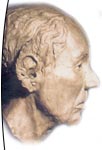 Gordion Museum and every period is represented with
characteristic examples. In three exhibition vitrines there are works of the the
Early Bronze Age and these are followed by artefacts of the Early Phrygian
Period, which ended with King Midas. The objects that are exhibited include:
handmade pots and pans belonging to the Early Iron Age, iron equipment belonging
to the Early Phyrigian Period, and equipment of textile production. In the new
exhibition gallery, a typical structure of layers of ruins dated 700 B.C. within
a panoramic window. Greek ceramics imported in the
ages 6 B.C.-4 A.C. and materials belonging to the Hellenistic Age and Roman
periods are exhibited in the other parts of the new gallery. The visitors are
able to see the examples of seals and coins that were found in Gordian in the
last section.
Gordion Museum and every period is represented with
characteristic examples. In three exhibition vitrines there are works of the the
Early Bronze Age and these are followed by artefacts of the Early Phrygian
Period, which ended with King Midas. The objects that are exhibited include:
handmade pots and pans belonging to the Early Iron Age, iron equipment belonging
to the Early Phyrigian Period, and equipment of textile production. In the new
exhibition gallery, a typical structure of layers of ruins dated 700 B.C. within
a panoramic window. Greek ceramics imported in the
ages 6 B.C.-4 A.C. and materials belonging to the Hellenistic Age and Roman
periods are exhibited in the other parts of the new gallery. The visitors are
able to see the examples of seals and coins that were found in Gordian in the
last section.
The Development of the
Museum
The increase in the number
of the visitors to Gordion Museum in the last years has led to new arrangements
being made. Within these studies, the main structures to be listed are the
180 m2 storage building, 150 m2 additional exhibition
gallery, 30 m2 laboratory,
35 m2 gallery of visual information and 5000 m2 open
exhibition area.
The area that has been
recently excavated has been afforested with the saplings that the Phyrigians
used in their furnishings such as cedar, scented juniper, boxwood, yellow pine,
walnut and yew tress.
The Roman Mosaic and the Galatian Tomb that have been transferred to this new
area, it is to be considered
as a part of the studies carried out.
Phrygian Monumental Tombs
The Gordian region is
surrounded with monumental tombs of various sizes dating from the last quarter
of 8th century B.C. to the Middle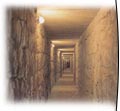 of 6th century B.C. Monumental
tombs are the tombs of the nobles and leading people of Phyrigia. The monumental
tomb known as the Midas Monumental Tomb, 300 m. in diameter and of 55 m. height,
has a magnificent appearance. The excavation of the Midas Monumental Tomb was
carried out in 1957 and the findings were presented to the public in 1960 with
the completion of the construction of concrete support by the excellent Turkish
engineering.
of 6th century B.C. Monumental
tombs are the tombs of the nobles and leading people of Phyrigia. The monumental
tomb known as the Midas Monumental Tomb, 300 m. in diameter and of 55 m. height,
has a magnificent appearance. The excavation of the Midas Monumental Tomb was
carried out in 1957 and the findings were presented to the public in 1960 with
the completion of the construction of concrete support by the excellent Turkish
engineering.
Kayabaşı mosaic
The Roman Period mosaic,
dated III. century A.D., which was found during a digging of a foundation in the
village of Kayabaşı of Polatlı in 1989, was reported by the owner of the
building to the Museum of Anatolion Civilizations and the excavations were
completed within that year. The mosaic, which couldn’t be transferred because of
the lack of space, was carried successfully to the garden of Gordion Museum in
1999, and was also mounted within a semi-enclosed place. There are animal
motives in the center of the mosaic and geometric ornamentation around the
mosaic with a size of 6,60x7,70 m. Conservation and restoration
studies continue.
The Galatian tomb
“Monumental Tomb O”
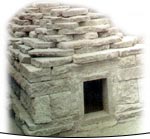
The tomb, which was found
in an unlicensed excavation in 1954, was named by the Gordian Excavation Group
as the “O” Monumental Tomb. The monument was exposed to destruction by humans
and nature at the end of the half-century. The monumental work was saved from
disappearance on the intervention of the Ministry of Culture. After numbering
the stone blocks, drawings of which have been made by museum experts, they were
transferred to the new garden of the Gordion Museum. The tomb, which will be
built again in the near future, will be presented for all humanity to see.
The settlement of
Ancient Gordion
The capital of the Kingdom
of Phrygia, the ruins of the famous city of Gordion; are near the
Ankara-Eskişehir highway and at the point upon which the Sangorios and Porsuk
rivers converge and 18 km to the northwest of Polatlı. The discoveries made
during German and American excavations and that were introduced in various
publications, let us date the settlement back to the Early Bronze Age (3000
B.C.).
Although Gordion was
destroyed by the Kimmers in the beginning of 7th century B.C., it experienced
its most successful period between 750-700 B.C. Many foundations and the
monumental tombs in the settlement prove that the occupation lasted until the
end of the 6th century. But Gordion was governed by Persians (beginning
from the middle of 6th century B.C.) until Alexander the Great restored the
city and it retained its independence.
The famous knot tied by
King Gordion was cut by Alexander the Great in Gordion, where he stayed during
the winter of 333 B.C.
The Hellenistic Period
started in Gordion after the conquest of the city by Alexander the Great
(300-100 B.C.). Then the Roman Period (1 B.C. – 4 B.C.) and the Seljuk period
(1100-1300 A.D.) started. All of this happened in Gordion in a short period of
more than 400 years.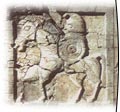
GORDION MUSEUM
1. Exhibition gallery
2. New-Exhibition gallery
3. Phyrigian Mosaic
4. Administration Bureau
5. W.C.
6. Storage
7. Laboratory
8. Roman Mosaic
9. Galatian Tomb
10. House (Residence)
11. House (Residence)
Yassihoyuk (Gordion)-capital of Phrygia. Those with an interest in the history
of the region will find a visit to Yassihoyuk (Gordion) (105 km), past Polatli
on the Eskisehir highway, and Gavurkalesi (60 km/, on the Haymana Highway near
to Derekoy, interesting and easily made. Gordion, a Phrygian capital, site of
the Gordion Knot (the key to Asia), is today of interest for the tumulus of King
Midas, of the Golden Touch and the asses ears. The remains of the old city,
still being excavated can be seen; and there is a small, pleasant museum. At
Gavurkalesi, there can be seen the remains of an open-air Hittite temple, a tomb,
and two reliefs of Hittite gods.
The 1993
season at Gordion--the site of the former capital of the Phrygian empire and the
home of the legendary King Midas of
the "golden touch"--involved many activities, including excavation; conservation,
restoration, and site presentation on the City Mound; architectural and
conservational study of the wooden tomb under the Midas Mound; geomorphological
survey; geological and botanical survey; research on previously excavated
materials; object conservation at Gordion; and conservation and study of wooden
objects in Ankara.
Midas Mound at Gordion Site
Of four
areas of the site investigated through excavation, the most important immediate
discoveries were found in the courtyard of the Early Phrygian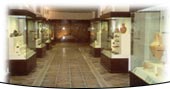 Citadel, at the
eastern part of the City Mound. Here a second part of a structure first exposed
in 1989 excavations and nicknamed the PAP ("Poros and Post") structure, and an
adjacent courtyard, were excavated. The PAP structure was built near or perhaps
up against the earliest Phrygian fortification wall excavated by Rodney Young in
the 1960s. Although the date of the structure, which appears to have had a
relatively elaborate
superstructure, and its demolition remain uncertain, it precedes the eighth
century citadel, and its construction may have extended into the ninth century
B.C.
Citadel, at the
eastern part of the City Mound. Here a second part of a structure first exposed
in 1989 excavations and nicknamed the PAP ("Poros and Post") structure, and an
adjacent courtyard, were excavated. The PAP structure was built near or perhaps
up against the earliest Phrygian fortification wall excavated by Rodney Young in
the 1960s. Although the date of the structure, which appears to have had a
relatively elaborate
superstructure, and its demolition remain uncertain, it precedes the eighth
century citadel, and its construction may have extended into the ninth century
B.C.
Dr.
Richard Liebhart continued his documentation and architectural study of the
great wooden tomb. With the aid of a generous grant from the Samuel H. Kress
Foundation, a conference on the preservation of the tomb and wooden furniture
from Gordion was organized by Dr. Elizabeth Simpson and Dr. Liebhart, and held
in Ankara and at Gordion.
The major
conservation project undertaken in 1993, supervised by William C.S. Remsen, AIA,
Director of Architectural Conservation for Gordion, was the partial rebuilding
and mortar capping of two adjacent walls belonging to an early Phrygian terrace
building. The project was a pilot program to determine the techniques, materials
and systems that should be used in future conservation at the site. Mr. Remsen
and his firm, RAD Associates of Boston, donated his time to the project.
The Golden Brew of King Midas
A team of U.S. archaeologists and a microbrewer have recreated a golden colored
braggot/metheglin/pyment based upon dried-up dregs found in the tomb of the
legendary King Midas.
Called ``King Midas's Golden Elixir'' , the brew was recreated by Delaware
microbrewer, Sam Calagione, from the remains of the king's funeral feast. Note:
not meant to imply "using" or "including" the remains, heaven forbid!
The
tomb of King Midas , king of the Phrygians, was discovered in 1957 near Ankara,
Turkey, and is dated about 2,700 years old.
University of Pennysylvania archaelogists discovered the tomb of Midas complete
with his skeleton during an excavation of the ancient capital of Phrygia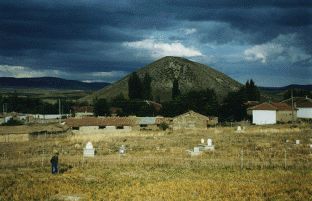 started
in the 1950's.
started
in the 1950's.
Chemical analysis of the dregs showed grapes, barley, honey, herbs and spices.
The recreated recipe includes white Muscat grapes, barley malt, thyme honey and
saffron with a final alcohol of 7.5% (unknown as to by volume or by weight)
using an ale yeast.
Two kegs of the elixir were brewed in April, 2000 for a banquet to benefit
Penn's Molecular Archaeology Program: `A Feast Fit for King Midas.' Good luck to
them!
Seems like Penn museum has got the brewing bug: they teamed up with Fritz Maytag,
founder of Anchor Steam Brewery and local brew deity, on Fritz's Ninkasi
project, which recreated a 3,800-year-old recipe found in a hymn to
the Sumerian beer goddess, Ninkasi. An award of the same name is presented to a
winning homebrewer at the Trivia: Fritz has gone on to make Gin (Old Junipero),
Rye (Old Potrero), and a single malt scotch (ol' too expensive for me ;))
A short history of King
Midas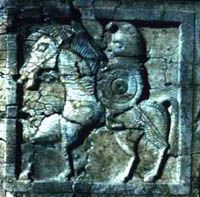
According to myth, King Midas lived in a rose-garden palace in Macedonia (a
region of present day Greece). Midas wished that everything he touched would
turn to gold. The god Dionysus granted him his wish but soon enough, Midas
backpedalled since food, drink, and his children also turned to gold. So he
pleaded to be set free of the wish, which was granted, but as penance Midas had
to wash in the river Pactolus (in present day Turkey). Subsequently, Midas was
adopted by childless Phrygian King Gordius (origin of the "gordian knot?").
In history, Midas was as warrior king who ruled Phrygia and conquered
neighboring Assyrians. He died a natural death at the age of 60 or 65 around 700
BC.
GENERAL PACK