The purpose behind this web page is to explain the general concept of shielding effect and the workings of slater's rule in great details.
It also provides us with some relevant background information on structure of an atom. The word shielding means to hide or to protect something from some other thing. That's what the concept of shielding effect is all about. It explains how the inner shell electrons which are closer to nucleus, shield the outer shell electrons which are far away from the nucleus, in an atom. This explanation then further leads to the explanation about Slater's rule, which is a way to calculate the effective nuclear charge of an electron.
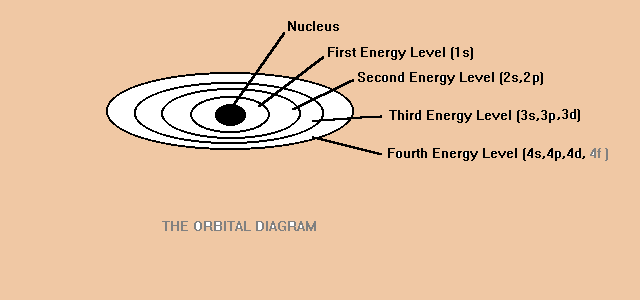
An atom contains a nucleus, surrounded by different energy
levels. These energy levels contain different orbitals of
electrons having a certain number of electrons
assigned to it. The electrons present in an orbital cannot
exceed this number. All these energy levels together make
an electronic configuration of an atom.
For example: (1s) (2s,2p) (3s,3p) (3d) (4s,4p) is an
electronic configuration of the element Krypton.
Different energy levels in the atomic structure have
different energies. Even the electrons in the same level
have different energies. Sometimes it is difficult to
predict energies of specific levels and their respective
electrons.
To easily understand the idea of different
electrons having different energies or different charges,
the common approach of SHIELDING is used here. The main
idea behind this approach is that each electron closer to
the nucleus acts as a shield for electrons further away
from the nucleus. Which in turn decreases the attraction
between the nucleus and the distant electrons. Therefore,
as the number of electrons increases, the shielding effect
for the last electron decreases. Even though the energies decrease with increasing electrons, the changes in them are not regular.While calculating energy
in atoms with more than one electron, n the energy level
number as well as l the orbital number must be included in
the calculations.(Gary L.Miessler and Donald A.Tarr. 1998. p35-p39)
Every element carries a nuclear charge Z on it, with which
we tell the charge on the element. To tell the charge on
different electrons in an element, we can use the concept
of Slater's rule. These charges on electrons are commonly
known as effective nuclear charge Z*.
Professor John C. Slater, a former faculty member at M.I.T.
proposed a simple set of rules for approximating the
effective nuclear charge. He defined the effective nuclear
charge Z* as a calculated value for the nuclear attraction,
for an electron.
He said that Z* can be calculated from
Z*=Z-S.
Where Z=the nuclear charge which can be obtained
from a periodic table.
And S=the shielding constant which
is calculated with help of certain rules.
The justification
for this type of calculations for determining the effective
nuclear charge comes from the probability curves,which describe the probability of finding electrons at a given distance, calculated from all angles.
The steps for determining S the shielding constant for a
specific electron are as follows:
The electronic configuration of an atom is written as
follows:(1s) (2s,2p) (3s,3p) (3d) (4s,4p) (4d) (4f)
(5s,5p), etc. Orbitals within a bracket are said to be in
the same group. According to the various observations done
to date, electrons toward the right or in higher groups in
the above stated list do not shield the electrons toward
left or in the lower groups. Therefore, they are not taken
into account when calculating the effective nuclear charge
for the electrons on the left.
If the electron for which you want to calculate the
effective nuclear charge is from ns or np valence electron
group then:
a. Shielding of ns or np electron by other ns or np
electrons is only 35% effective, due to which the electrons
in the same ns or np group contribute 0.35 towards S the
shielding constant, except the 1s electrons, where 0.30 is
used.
b. Shielding of ns or np electrons by (n-1)s and (n-1)p
electrons is only 85% effective, due to which the electrons
in the n-1 group contribute 0.85 towards S the shielding
constant.
c. Rest of the electrons on the left contribute 1.00
towards the shielding constant because of the 100%
shielding caused by them.
If the electron for which you want to calculate the
effective nuclear charge is a nd or nf valence electron
then:
a. Shielding of nd or nf electron by the electrons of the
same group is only 35% effective. Therefore, those
electrons contribute 0.35 towards S the shielding constant.
b. Shielding of nd or nf electron by ns or np electrons is
calculated to be 100% effective. Therefore, all the other
electrons on the left contribute 1.00 towards the shielding
constant S.
All these contributed values are then added together to
calculate the total shielding constant S. The S value is
then subtracted from the nuclear charge Z of an element to
obtain the effective nuclear charge Z* for the selected
electron.(Gary L.Miessler and Donald A.Tarr. 1998. p35-p39)
Let's suppose that someone asked us about the difference between the energies required, to remove a 3d10 electron or
a 4s1 electron of Copper metal. An easy way to answer this
question will be by calculating the effective nuclear charge on
the two electrons and comparing them.
The electronic configuration of Copper is : (1s2) (2s2,
2p6) (3s2, 3p6) (3d10) (4s1)
1. For a 3d10 electron
( the last 3d electron is not taken into consideration as
the Z* value is being calculated for it)
The calculations for determining S are:
The 9 3d electrons contribute 0.35, 9*0.35=3.15
The 18 3s, 3p, 2p, 2s and 1s electrons contribute 1.00, 18*
1.00=18.00
The total shielding constant=18.00+3.15=21.15
Therefore, the Z* value is= Z-S= 29-21.15= 7.85
2. For a 4s electron
(the 4s electron is not taken into consideration as the Z*
value is being calculated for it)
The calculations for determining S are:
The 18 3d, 3p and 3s electrons contribute 0.85,18*0.85=
15.30.
The 10 2s,2p and 1s electrons contribute 10*1.00=10.00
The total value of S=10.00+15.30=25.30.
Therefore, the Z* value is Z-S= 29-25.30= 3.70.
Observations:
The difference between the values of Z* for both the
electrons show that as the electron moves further away from
the nucleus, the value for the nuclear attraction decreases
and therefore, the nuclear charge on the electrons
decreases as well. By comparing the two different answers,
we can also tell that the energy required to remove the 4s
electron is much lesser than the energy required to remove
the 3d electron.
Even though the slater's rule works quiet efficiently, there
are certain limitations regarding it. As we move further
down in the periodic table, a problem arises regarding the
elements Cromium, Copper and other elements under them.
These elements do not have a normal electronic
configuration. Cr has a configuration of [Ar]4s1,3d5
instead of [Ar]4s2,3d4 which is normal to the rules.
To explain this concept properly and to calculate the
correct effective charge we need to consider the effects of
increasing nuclear charge on the 4s and 3d levels and the
interaction between the electrons sharing the same orbital.
Therefore, instead of just using the shielding effect we
need to look at the electronic interactions too.(Gary L.Miessler and Donald A. Tarr. 1998. p35-p39)
Slater's rule is an effective way to calculate Z* the
effective nuclear charge, keeping in mind the shielding
effect of the electrons. But as you move further down the
periodic table, some complications arises. Therefore,
instead of relying on only one method, we should consider
the problem through all aspects and calculate the final
answer using the best possible method available to us.
 ��Introduction