|
Kwanzaa

Information
Kwanzaa was created by Dr. Maulana Karenga in 1966.
Kwanzaa is not a religious celebration, but a celebration of
African-American heritage and togetherness. Kwanzaa is
built on seven principles that are known as Nguzo Saba. The modern
celebration of Kwanzaa lasts for seven days (December26 through January 1).
Each day of celebration is dedicated to one of the seven principles, and a
candle is lit.
|
Nguzo Saba
(EN-goo-zoh-SAH-bah) |
|
Day |
Principle |
Meaning |
| |
|
1 |
Umoja
(OO-MO-JAH) |
Unity |
|
2 |
Kujichagulia
(koo-jee-cha-goo-LEE-ah) |
Self-determination |
|
3 |
Ujima
(oo-JEE-mah) |
Collective
Work and Responsibility |
|
4 |
Ujamaa
(OO-JAH-MAH) |
Cooperative
Economics |
|
5 |
Nia
(nee-AH
) |
Purpose |
|
6 |
Kuumba
KOO-OOM-BAH |
Creativity |
|
7 |
Imani
(EE-MAH-NEE) |
Faith |
There are seven symbols of Kwanzaa.
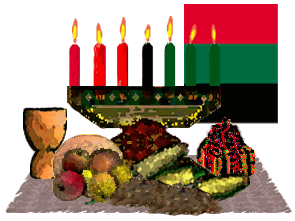
When preparing for the celebration, one sets the table with the seven
symbols. The
kinara (candle holder) is the centerpiece of the table. The mishumaa saba
(seven candles) are placed in the kinara. The kinara is then placed on a
mkeka (mat) and surrounded by the other symbols. Muhindi (ears of corn)
are placed on the mat--one to represent each child in the household. If
there are no children, one muhindi is placed on the mkeka to represent
future children. Mazao (fruits and vegetables) and the kikombe cha umoja (unity cup)
are also placed on the mkeka. The zawadi (gifts) are given on Imani, the last day
of Kwanzaa. The zawadi are hand made or naturally grown rather than bought because Kwanzaa emphasizes
creativity (kuumba), one of the seven principles.
|
The
Symbols of Kwanzaa
|
|

Kinara
(kee-NAH-rah) |
The Candle
Holder
|
The
ancestors -- the people who came from Africa.
|
|
Mishumaa Saba
(mee-SHOO-maah sah-BAH)
|
The Seven Candles
|
These are symbolic of the Nguzo Saba,
the Seven Principles, the
way African people are urged to live
by in
order to live their lives in their own image and needs. |
|
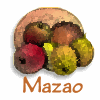
(mah-ZAH-oh) |
The Crops
|
These are symbolic of African harvest celebrations and of the rewards
of productive and collective labor. |
|
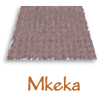
(m-KAY-cah) |
The Mat
|
The foundation or base
upon which all else is built. It represents the history of the
African people. |
|
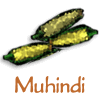
(moo-heen-dee) |
The Corn
|
The children and the
future which they represent.
|
|
(Kee-coam-bay chah-oo-moe-jah) |
The Unity Cup
|
The practice of unity makes all else
possible.
|
|
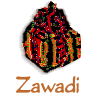
(sah-WAH-dee) |
The Gifts
|
The labor and love of
parents and the promises made and kept by the children.
|
| |
|
|
| |
|
|
| |
|
|
Bendera
|
The Flag
|
The
colors of the Kwanzaa flag are: black for the people,
red for their struggle,
and green for the
future and hope that comes from their struggle. |
Karamu
|
Feast
|
Celebration that brings the community together. It is held on the
night of December 31. The karamu includes food, drink, music, dance,
conversation, laughter and ceremony. |
There are some
important phrases used in the Kwanzaa celebration.
|
Special Phrases |
Habari Gani
(ha-BAH-ree GAH-nee)
During Kwanzaa, people greet
each other by saying "Habari Gani." Habari Gani means "What's new?"
The other person answers by saying the name of the principle being
celebrated that day. |
Harambee
(hah-ROM-beh)
Harambee means "Let's pull
together." |
Literature
Songs/Poems
|
Kwanzaa's
Here
(Tune: Three Blind Mice)
Red, green,
black
Red, green, black
Kwanzaa's here.
Kwanzaa's here.
The decorations are quite a sight.
We light a candle every night.
The holiday is filled with light.
Kwanzaa's here. |
Activities
| |
|
Mkeka (mat)
Fold a rectangular piece
of black construction paper in half and cut 1 inch slits in the
paper. Cut 1 inch strips of red and green paper. Have children
weave the red and green strips in and out of the black mat and
attach at either end. |
| |
|
Kikombe cha
umoja (unity cup)
Umoja (unity)
is one of the seven Kwanzaa principles. Have the children make their
own Kikombe cha umoja
(unity cup). Get some plastic champagne glasses. Let the
children paint them with red and green fabric paint. Now the
children have their own unity glass to use at home! |
| |
|
Kikombe cha
umoja (unity cup)
Put together two Styrofoam cups (end
to end). Secure tape around the cups. Cover the cups with aluminum
foil. Add stickers or paint. |
|
|
|
Kinara
Have the children use toilet paper
tubes or paper towel tubes (cut in 1/2) to make a kinara. Let each
children paint 7 tubes: 3 red, 1 black, and 3 green. Once the tubes
are dry, tape them together with double sided tape. Next, tape the
seven tubes onto a piece of poster board. Last, add tissue paper for
flames. |
|
|
|
Mishumaa Saba
(candles) favors
Cover a toilet paper tube
with red, green, or black construction paper. Second, cut a 10 inch square of tissue paper and place candy, nuts or a
small prize in the middle of the square. Last, gather the tissue up around the prize and push the prize down into
the tube so that the ends of the tissue paper are sticking out like
a candle flame. |
|
|
|
Bendera
(flag)
To reinforce the colors of Kwanzaa, make a
bendera (flag).
Let the children glue red, green, and black paper
onto a long sheet of black paper. When they are finished, they have created their
own flag. |
|
|
|
Necklace
Have the children make a
necklace and give it to someone (zawadi---gifts).
Use alcohol and food coloring to dye some noodles red, green, and black. Give each child a
piece of yarn with a small piece of masking tape wrapped around one
end. Let each child string the noodles to form
a pattern. |
|
|
|
Necklace
Another alternative to using dyed
noodles is to use ponytail beads. |
| |
Internet Activities
Links
|