NETWORKS
Network Topology's
A network topology describes the configuration of a
network (how the network components are connected together). There are FOUR
main topology's.
- Star
The star topology uses a central hub through which all
components are connected. In a computer network, the central hub is the host
computer, and at the end of each connection is a terminal.
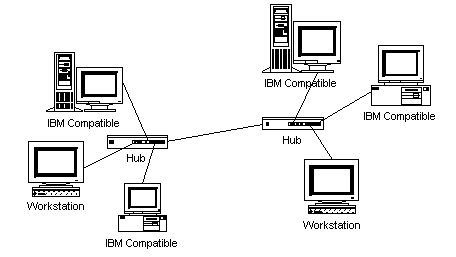
Star Topology
A star network uses a significant amount of cable (each terminal is wired
back to the central hub, even if two terminals are side by side several
hundred meters away from the host). All routing decisions are made by the
central hub, and all other workstations can be simple.
An advantage of the star topology is failure in one of the terminals does
not affect any other terminal, how-ever, failure of the central hub affects
all terminals.
This type of topology is frequently used to connect terminals to a large
time-sharing host computer.
- Ring
The ring topology connects workstations in a closed loop.
Each terminal is connected to TWO other terminals (the next and the previous),
with the last terminal being connected to the first. Data is transmitted
around the ring in one direction only, each station passing on the data to the
next station till it reaches its destination.
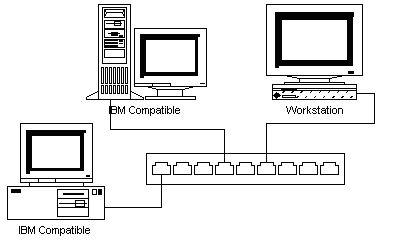
Ring Topology
Faulty workstations can be isolated from the ring. When the workstation is
powered on, it connects itself into the ring. When power is off, it
disconnects itself from the ring and allows the information to bypass the
workstation.
Information travels around the ring from one workstation to the next. Each
packet of data sent on the ring is prefixed by the address of the station to
which it is being sent to. When a packet of data arrives, the workstation
checks to see if the packet address is the same as its own. If it is, it grabs
the data in the packet. If the packet does not belong to it, it sends the
packet to the next workstation in the ring.
Ring systems use 4 pair cables (separate send/receive). The common
implementation of this topology is token ring. A break in the ring
causes the entire network to fail. Individual workstations can be isolated
from the ring.
- Bus
The bus topology connects workstations using a single cable.
Each workstation is connected to the next workstation in a point to point
fashion. All workstations connect to the same cable.
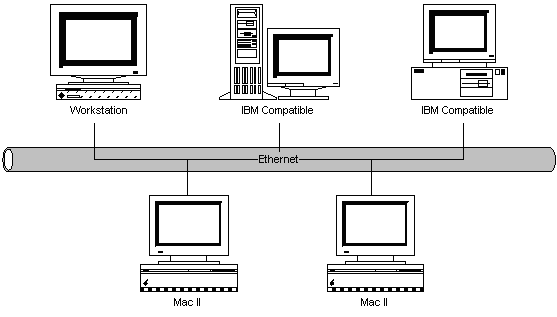
Fig 8.3: Bus Topology
If one workstation goes faulty, all workstations are affected. Workstations
share the same cable for the sending and receiving of information. The cabling
costs of bus systems is the least of all the different topology's. Each end of
the cable is terminated using a special terminator.
The common implementation of this topology is Ethernet. A message
transmitted by one workstation is heard by all the other workstations.
- Mesh
The mesh topology connects all computers to each other. The
cable requirements are high, but there are redundant paths built in. Any
failure of one computer allows all others to continue, as they have
alternative paths to other computers.
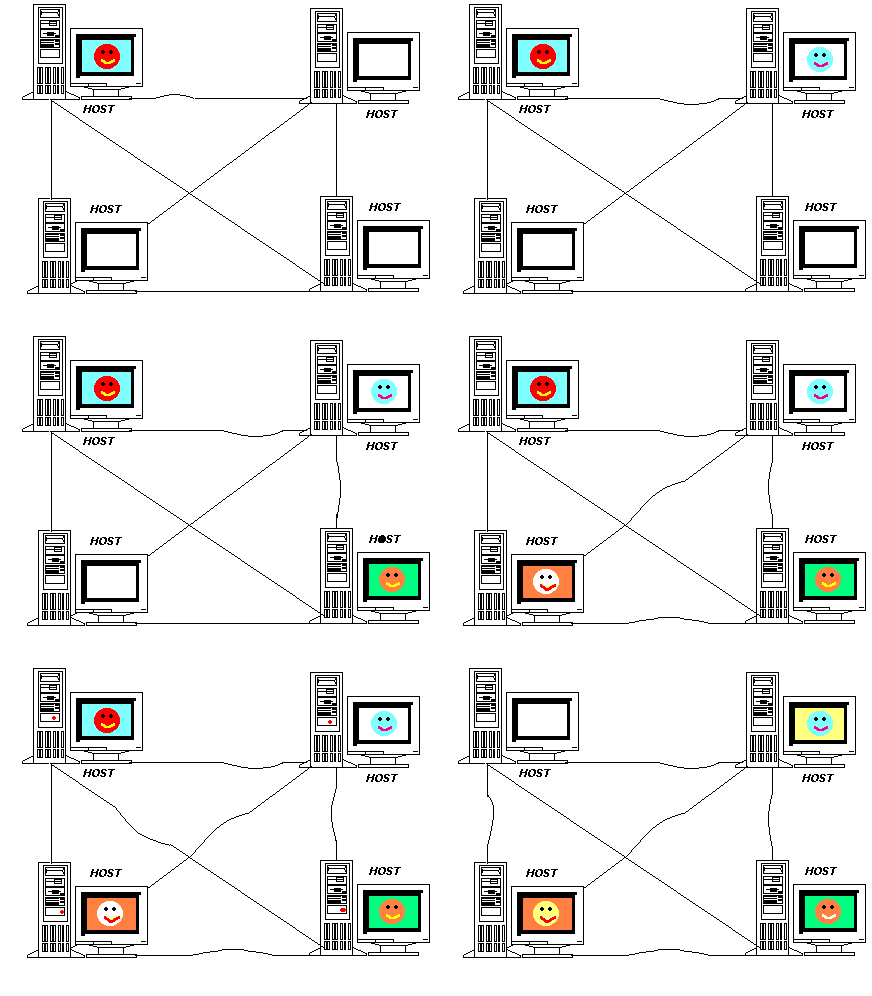
Fig 8.4: Mesh Topology
Mesh topology's are used in critical connection of host computers
(typically telephone exchanges). Alternate paths allow each computer to
balance the load to other computer systems in the network by using more than
one of the connection paths available.
Network Protocols
This section describes the protocols used in
different network topology's. Remember that a protocol defines the rules for
sending data from one point to another.
- Carrier Sense Multiple Access with Collision Detection (CSMA/CD)
This protocol is commonly used in bus (Ethernet) implementations. Multiple
access refers to the fact that in bus systems, each station has access to the
common cable. Carrier sense refers to the fact that each station listens to
see if no other station is transmitting before sending data. Collision
detection refers to the principle of listening to see if other stations are
transmitting whilst we are transmitting.
In bus systems, all stations have access to the same cable medium. It is
therefore possible that a station may already be transmitting when another
station wants to transmit. Rule 1 is that a station must listen to determine
if another station is transmitting before initiating a transmission. If the
network is busy, then the station must back off and wait a random interval
before trying again.
Rule 2 is that a station which is transmitting must monitor the network to
see if another station has begun transmission. This is a collision, and
if this occurs, both stations must back off and retry after a random time
interval. As it takes a finite time for signals to travel down the cable, it
is possible for more than one station to think that the network is free and
both grab it at the same time.
CSMA/CD models what happens in the real world. People involved in group
conversation tend to obey much the same behavior.
- Token Ring
This protocol is widely used in ring networks for
controlling station access to the ring. A short message (called a token
) is circulated around the ring, being passed from station to station (it
originates from a controller or master station which inserts it onto the
ring).
A station which wants to transmit waits for the token to arrive. When it
arrives, it changes it from a token to a connector message, and appends
its message on the end. This is then placed on the outgoing side of the ring.
Each station passes on received tokens if they have nothing to transmit.
They monitor connector messages to see if the message is addressed to them. If
connector messages are addressed to them, they copy the message, modify it to
signify its receipt, then send it on around the ring. Connector messages which
are not addressed to them are passed directly onto the next station in the
ring.
When the connector message travels full circle and arrives at the original
sending station, it checks the message to see if its been received. It then
discards the message and replaces it with a token.
- Integrated Services Data Network (ISDN)
ISDN refers to a new
form of network which integrates voice, data and image in a digitized form.
It offers the customer a single interface to support integrated voice and
data traffic. Rather than using separate lines for voice (PABX system) and
data (leased lines), ISDN uses a single digital line to accommodate these
requirements.
- Local Area Network
A LAN is a group of microcomputers or other
workstation devices located in the same general area and connected by a common
cable. The characteristics of LAN's are
- physically limited < 2Km
- high bandwidth > 1Mhz
- inexpensive cable media
- data and hardware sharing amongst users
- owned by the user
A LAN is used to share resources amongst a group of individuals or company
employees. These resources are typically
- files
- application software
- printers
- computing power
- modems
- fax machines
- Wide Area Network
A Wide area network is similar to a LAN, but
geographically spread over a wider area. The different segments of the WAN are
interconnected by communication links (high speed serial, X.25 etc). In fact,
a WAN often comprises a number of interconnected LAN's at various sites.
The characteristics of a WAN are
- geographically expansive
- large number of computers and multiple host machines
- sophisticated support devices like routers and gateways for
interconnecting the various segments
LAN Connections
A LAN connects resources together so they can be
shared by users. In today's terms, this often means linking PC's together. As
discussed earlier, the PC's can be linked together using a bus, ring or star
topology.
Each PC is equipped with a network interface card, which fits into an
available expansion slot. Appropriate driver software provides an interface
between the PC operating system and the network interface card.
Once the network software is loaded, access to provided to other machines on
the network. There are THREE main types of network access provided.
- Peer to Peer Services
Each PC in the network can directly
communicate and share resources with any other machine in the network.
Examples of this are
- File Server Services
A number of machines are designated as HOST
servers. Users login to the host machines and access files and application
software stored on them. Users have no access to other non host machines.
Examples of this are
- Novell NetWare
- (Also LAN Manager, Windows NT, and LANtastic)
Software is
executed on the users machine. The file server only provides file access;
the file is downloaded from the file server into the workstation, where it
is then executed.
- Client/Server Services
This is used extensively in database
applications, where a front end software program sends commands to a server
for execution, with the results being displayed on the users machine. It
utilizes the high speed of the server machine to do number crunching and
complex operations.
The major problems associated with using Networks are
- user training
- support (user and system)
- configuration
Comparison of LAN and MAN Characteristics
| Characteristic |
LAN |
WAN |
| geographical size |
0-2Km |
1-100Km |
| number of nodes |
1-200 |
1-500 |
| data rate |
1-100Mbps |
1-100Mbps |
| error rate |
<10-9 |
<10-6 |
| delays |
1-100ms |
100ms-100s |
| routing |
simple |
sophisticated |
| linkage |
bridges/repeaters |
gateways/routers |