Collie Eye Anomaly
and other eye diseases in Collies
The following was published by the Collie Club of America:
Dogs, like people, are subject to a large number of inherited diseases. Two which affect Collie eyes should be of concern to all breeders. The most common is called Collie Eye Anomaly.
The Collie Eye Anomaly (CEA)- Veterinarians first noted this problem nearly fifty years ago. It was later found to exist in most Collies. This so-called syndrome, meaning a group of conditions which appear in conjunction with each other, is present prior to birth. It can be diagnosed by a trained observer, i.e., a canine ophthalmologist, when a puppy is just a few weeks old. Drops are given to dilate the pupil and the interior of the eye is examined with an ophthalmoscope. The eye is then graded as "clear," not affected, or as affected, showing signs of the syndrome listed below. (More than one term is often given as there is no uniform nomenclature used by the doctors.)
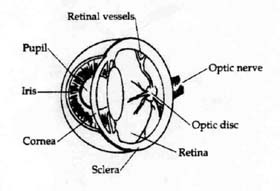
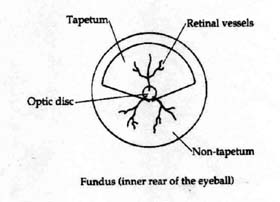
Staphyloma, Coloboma, Ectasia- While not completely synonymous, these terms all refer to a cupping or bulging in the eyeball usually in the area of the optic nerve.
Choroidal Hypoplasia, Chorioretinal Change- These terms refer to abnormalities in the coloring or pigmentation of the choroid or central layer of the eye's lining. There are variations even in normal eyes. These correspond somewhat to a dog's coat color. Thus it is often difficult to judge the pigment in a blue merle's eyes as it is diluted along with their coat color.
Vascular Disease, Tortuous Blood Vessels- Defects in the vessels of the eye which are responsible for its blood supply or "nourishment". These may be malformed, undersized, or even lacking.
Retinal Detachment- Loosening or separation of the inmost, or retinal, layer from the wall of the eye. This may involve a tiny area or the entire retina. The latter is termed as a complete detachment, the result being blindness in the eye.
Can the Collie's eyes become worse? Might he later go blind? The basic answer is "no" as the CEA is present prior to birth. However, a dog born with a severe Staphyloma or with Vascular Disease may later suffer loss of sight if a detachment or severe hemorrhage occur. The majority of dogs which are slightly affected have perfectly adequate eyesight during their lives. (Even a dog with one blind eye will cope perfectly with his surroundings.) It should be noted that CEA can exhibit such subtle variations that among mildly affected dogs we find differences of opinion among experts as to which are clear or not.
What have breeders done to improve Collie Eye? Because CEA has involved so much of the breed, eradication has had to be slow in order to keep other desirable qualities. Even among dogs that examine clear, most are carriers for the condition. They have a "hidden" or recessive gene for the condition. Such a dog will transmit the gene to half its offspring.
Two other conditions not part of the syndrome which can occur should be mentioned:
Hypoplasia Of The Optic Nerve- An undersized nerve, noted where it enters the back of the eyeball. In extreme cases, this can cause blindness.
Corneal Dystrophy- This condition comes on when a dog is mature, often during stress. Opaque spots centrally on the surface of the cornea. (It is often confused with cataracts which occur in the lens.)
In the beginning there was a lack of veterinarians trained to examine eyes. Then in 1972, the American Veterinary Medical Association formed the American College of Veterinary Ophthalmologists (ACVO), thus providing specialists in the animal eye field.
The Collie Club of America encourages its members to have all their puppies checked as young as possible by a member of the ACVO. Where there is none in the area, the alternative is to sell a dog contingent on a later check. No dog should be used for breeding until examined and found to be above the examiner's standard. The most accurate readings can be made when a puppy is young. Minor symptoms often become inapparent later on. Such cases are referred to as "Go Clears" or "Go Normals" and will produce as if affected.
What pattern of heredity is
involved? Most of the specialists agree that Choroidal Hypoplasia is
carried as a simple recessive. For a dog to show symptoms, both parents,
even if they show no signs themselves, must carry a gene for the condition.
Evidence exists that some other parts of the syndrome are handed down
differently. Staphyloma, for instance, rarely occurs except in the
presence of Choroidal Hypoplasia. Dogs recommended for breeding will vary
according to the standard set by the individual doctor. The ideal, of
course, is to eliminate all but the clear, non-carriers, from the breed.
Progressive
Retinal Atrophy (PRA)- Unlike CEA, this disease occurs in many breeds
of dogs. Originally thought to be rare in the Collie, it has become an
increasing menace. PRA is a term which describes retinal degeneration
resulting in total blindness in both eyes. The most common form is
Generalized PRA. (Another, known as CPRA, arises first in the center of
the retina. It comes on later in a dog's life. This has not been
considered a threat to the American Collie.)
Generalized PRA has proven to be a simple recessive in all the breeds studied. Again, this means that even though the condition is not present at birth, both parents must have been involved as carriers or affecteds. Early signs of the problem may be noticed by the owner as "night blindness". The dog has trouble seeing in dim light. An expert may detect early signs in the eye at six months or younger.
By two years, if the Collie shows no ophthalmoscopic signs, he may be assumed to be permanently safe from PRA. We have pointed out that puppies should be examined for CEA as early as possible. Then they should be looked at again for the onset of PRA at six months or so, especially if they are to be used for breeding. Then a final check can be made at one and one-half to two years.
Make sure if
possible that there is no evidence of PRA in the dogs produced by those directly
behind yours in its pedigree. Hopefully, you can rely on the breeder and
the owner of the sire to give you the facts on its "eye
pedigree". No reliable breeder would carelessly use a dog capable of
producing PRA puppies. If any reasonable doubt exists, the breeder can
request that a puppy be neutered. This will in no way reflect on its worth
as a family pet.