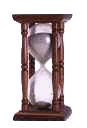
The gorean time system is a bit different then what earth uses but in ways similar. There is 12 months in the gorean year but only 25 days per month, weeks are divided into 5 days per week and 5 weeks per month, or that is in most cities, plus another week called a Passage Hand between each month and one more between each year so technically they end up with 365 days a year as well as Earth.
Time is measured a bit differently as well. Not by electricity as on Earth but by beautifully carved sundials, moondials, intricately designed waterclocks or oil clocks and sand glasses to mark the passing of time.
An interesting note, gorean time pieces or clock move in a counter clockwise direction where the Earth clocks move in a clockwise direction.
"Chronometers exist on Gor, but they are rare
and valuable. Marcus and I did not have any, of intent, at the time, among
our belongings. They would not have seemed to fit in well with our guise
as auxiliary guardsmen. In many cities, of course, including Ar, time tends
to be kept publicly. Official clocks are adjusted, of course, according
to the announcements of scribes, in virtue of various astronomical measurements,
having to do with the movements of the sun and stars. The calendar, and
adjustments in it, are also results of their researches, promulgated by
civil authorities. The average Gorean has variety of simple devices at
his disposal for making the passage of time. Typical among them are marked,
or calibrated, candles, sun dials, sand glasses, clepsydras, and oil clocks."
Magicians of Gor, pg 358

|
|
(80 in an ehn or roughly a minute) |
|
|
|
|
|
|
|
|
|
|
|
|
|
|
|
(weeks are called hands) |
|
|
|
|
|
|
"There are twelve twenty-five day Gorean months,
incidentally, in most of the calendars of the various cities. Each month,
containing five five-day weeks is separated by a five-day period, called
the Passage Hand, from every other month, there being one exception to
this, which is that the last month of the year is separated from the first
month of the year, which begins with the Vernal Equinox, not only by a
Passage Hand, but by another five day period called the Waiting Hand."
Assassin of Gor, page 78
"Month names differ, unfortunately, from city
to city, but, among the civilized cities, there are four months, associated
with the equinoxes and solstices, and the great fairs at the Sadar, which
do have common names, the months of En'Kara or En'Kara-Lar-Torvis; En'var
or En'Var-Lar_Torvis; Se’Kara or Se’Kara-Lar-Torvis; and Se’Var or Se’Var-Lar-Torvis.”
Assassin of Gor pg 78-79
"It was past the fourteenth Gorean Ahn, or
hour, the Gorean Day is divided into twenty Ahn, which are numbered consecutively,
the tenth Ahn is noon, the twentieth, midnight. Each Ahn consists of 40
Ehn, or minutes, and each Ehn of eighty Ihn, or seconds."
Outlaw of Gor, page 26
There is also a system of latitude and longitude
figured on the basis of the Gorean day, calculated in Ahn, twenty of which
constitute a Gorean day, and Ehn and Ihn, which are subdivisions of the
Ahn, or Gorean hour. Ta-Sardar-Var is a direction which appears on all
Gorean maps; Ta-Sardar-Ki-Var, of course, never appears on a map, since
it would be any direction which is not Ta-Sardar-Var. Accordingly, the
main divisions of the map are Ta-Sardar-Var, and the other seven; taking
the Sardar as our "north pole" the other directions, clockwise as Earth
clocks move (Gorean clock hands move in the opposite direction)
Nomads of Gor (footnotes) pages 3-4
|
|
|
|
|
(which means The First Turning of the Central Fire or also called En'Kara or The First Kara) *first month of the year* |
|
|
(The First Resting of the Central Fire or En'Var) *4th month of the year* |
|
|
(Se'Kara, The Second Kara or The Second Turning) *7th month of the year* |
|
|
(Second Resting of the Central Fire or Se'Var) *11th month of the year* |
Assassin of Gor page 78
publically sold during the ninth passage hand,
that preceding the winter solstice.
Assassin of Gor, page 192
"It was now the month of the vernal equinox
on Gor, called En'Kara, or The First Kara. The full
expression is En'Kara-Lar-Torvis, which means,
rather literally, The First Turning of the Central Fire. Lar-Torvis is
a Gorean expression for the sun. More commonly, though never in the context
of time, the sun is referred to as Tor-Tu-Gor, or Light Upon the Home Stone.
The month of the autumnal equinox is called fully Se'Kara-Lar-Torvis, but
usually simply, Se'Kara, The Second Kara, or The Second Turning. As might
be expected, there are related expressions for the months of the solstices,
En'Var- Lar-Torvis and Se'Var-Lar-Torvis, or, again rather literally, the
First Resting and the Second Resting of the Central Fire. These, however,
like the other expressions, usually occur in speech only as En'Var and
Se'Var, or The First Resting and The Second Resting."
Outlaw of Gor, page 178
"He did so late in the spring, on the sixteenth
day of the third month, that month which in Ar is called Camerius, in Ko-ro-ba
Selnar."
Assassin of Gor pages 234-235
for the Wagon Peoples calculate the year from
the Season of Snows to the Season of Snows; Turians, incidentally, figure
the year from summer solstice to summer solstice; Goreans generally, on
the other hand, figure the year from vernal equinox to vernal equinox."
Nomads of Gor, page 11
"Chronology…is the despair of scholars on
Gor, for each city keeps track of time by virtue of its own Administrator
Lists; for example, a year is referred to as the Second Year when so-and-so
was Administrator of the city."
Outlaw of Gor Page 178
Outlaw of Gor Page 179