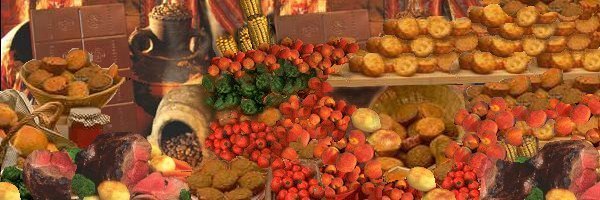
There are some foods that are native to Gor, but the basic fare of the Gorean diet tends to be simple. Goreans are meat and potato people although there is alot of fruits available to them as well as vegetables.
Breads
Fruits
Meats
Sweets Vegetables
Prepared Dishes Miscellaneous
Steps to a
food serve servery
and utensil descriptions
BLACK BREAD
baked soft and full flavored from Gorean grains,
heavy and dark, served with clotted Bosk Cream or honey.
Hunters of Gor, page 13
baked in round flat loaves, they may be divided into 4-8 pieces depending on the size of the loaf, yellow in color
fresh and hot;…"
Outlaw of Gor, page 76
"He removed my hand
from the binding fiber. I reached out for him. He thrust a
huge piece of the
yellow Sa-Tarna bread into my hands."
Captive of Gor, page 114
There were great quantities of the yellow Sa-Tarna
bread, in its rounded, six-part loaves
Raiders of Gor Page 114
Then, while the other fellow took his place
on the wagon box and started the ponderous draft beast into motion, he
gave me two generous pieces of bread, two full wedges of Sa-Tarna bread,
a fourth of a loaf. Such bread is usually baked in small, round loaves,
with eight divisions in a loaf. Some smaller loaves are divided into four
divisions. These division are a function, presumably, of their simplicity,
the ease with which they may be made, the ease with which, even without
explicit measurement, equalities may be produced.
Kajira of Gor Page 216

APRICOTS
Tribesman of Gor page 45
in length, I was fastened by the neck to Ute. We were picking berries."
Captive of Gor, page 208
Blood Brothers of Gor pg. 46
These come from the City of Tor.
Tribesmen of Gor, page 37
Fruit that makes a very potent dry wine or sweet red wine, grows on a tree with very strong yellow wood.
the Council of Ko-ro-ba, a member of the Ubar’s family goes to the roof at night, under the three
full moons with which the feast is correlated, and casts grain upon the stone and drops of a red,
winelike drink made from the fruit of the Ka-la-na tree. The member of the Ubar’s family then
prays to the Priest-Kings for an abundant harvest and returns to the interior of the cylinder, at
which point the Guars of the Home Stone resume their vigil.”
Tarnsman of Gor, page 68
there are two types of larma, one is a single seeded fruit, rather like an apple (sometimes referred to as pit fruit) and the other a segmented juicy larma. It is served sliced, either fresh or fried, and served with browned honey sauce. The act of offering a larma, real or imagined, by a slave girl to her Master (when he not specifically requested one) is often regarded as a silent plea by a slave when they wish to be "used" by that Master or Mistress sexually.
Players of Gor Page 267
"Another bit of larma, Master?" asked the slave,
kneeling behind me and to my left. I turned and, from where I sat cross-legged
behind the low table, removed a small, crisp disk of fried larma, with
a browned-honey sauce, from the silver tray."
Guardsman of Gor, page 231
"The larma is luscious. It has a rather hard
shell but the shell is brittle and easily broken. Within, the fleshy endocarp,
the fruit, is delicious and very juicy. Sometimes, when a woman is referred
to as a `larma,' it is suggested that her hard or frigid exterior conceals
a rather different sort of interior, one likely to be quite delicious."
Renegades of Gor. p 437
He then picked up a juicy, red larma fruit,
biting into it with a sound that seemed partly squishing as he bit into
the fleshy, segmented endocarp. He seemed to make a great deal of noise.
Although one or two of the girls stirred uneasily, none, to my relief,
awakened. Harold was now fishing about, still chewing on the fruit
Nomads of Gor Page
220
"On Gor, the female slave, desiring her master,
yet sometimes fearing to speak to him, frightened that she may be struck,
has recourse upon occasion, to certain devices, the meaning of which is
generally established and culturally well understood….Another device, common
in Port Kar, is for the girl to kneel before the master and put her head
down and lift her arms, offering him fruit, usually a
larma or a yellow Gorean peach, ripe
and fresh.
Tribesmen of Gor, pages 27-28
Are quoted in the Tribesman book of gor, as being in existence in many varieties.
me."
Tribesmen of Gor, page 45
Tribesmen of Gor, page 47
torian olivesPEACHES
are commonly from the City of Tor. (referred to as Torian Olives)"The Tarn Keeper...brought the food, bosk steak and yellow bread, peas and Torian olives, and two golden-brown, starchy Suls, broken open and filled with melted bosk cheese." red olives
Assassin of Gor, page 168
These come from the groves of Tyros."Clitus, too, had brought two bottles of Ka-la-na wine, a string of eels, cheese of the Verr and a sack of red olives from the groves of Tyros."
Raiders of Gor, page 114
Slightly smaller than the earth variety but just as sweet. Can be dried for long journeys and made
into pies or tarts.
that she may be struck, has recourse upon occasion, to certain devices, the meaning of which is
generally established and culturally well understood. Another device, common in Port Kar, is for
the girl to kneel before the master and put her head down and lift her arms, offering him fruit,
usually a larma or a yellow Gorean peach, ripe and fresh."
Tribesmen of Gor, pages 27-28
page 45, Tribesman
Tribesmen of Gor, page 45
small, succulent purple berries. They are tiny, bittersweet, but edible. Often they are dried and made into pies.
small reddish fruit with edible seeds, not unlike plums save for the many small seeds."
Captive of Gor, page 305
Fruit similar to earth grapes comes from the Isle of Cos. Deep purple grapes grown from the terraces of Tor. Make excellent white wine, called ta-wine.
Ta grapes, from the terraces of Cos…"
Tribesmen of Gor, page 213
"The grapes were purple and, I suppose, Ta-grapes
from the lower vine-yards of the terraced island
of Cos..."
Priest-Kings of Gor, page 45
A bitter, juicy citrus fruit. Used to make wagers on the number of seeds (odd or even, or the
number of odd seeds, since most tospits have and odd number of seeds). The tospit is yellow in
color. Small, peach-like fruit that is about the size of a plum. They are bitter, but edible. Often they
are dried and candied. It is also used in both throwing games of skill with the knife. Due to its high
vitamin C content it is used in the prevention of nutritional deficiencies at sea. Sometimes called
the seaman's larma.
Tribesman of Gor page 45
"She had been carrying tospits and vegetables
to the deck locker, to fill it."
Marauders of Gor, page 289
"He looked at me shrewdly and, to my surprise,
drew a tospit out of his pouch, that
yellowish-white, bitter fruit, looking something
like a peach, but about the size of a plum."
Nomads of Gor, page 149
"The common tospit almost invariably has an
odd number of seeds. On the other hand, the rare,
long-stemmed tospit usually has an even number
of seeds."
Nomads of Gor, page 149
BOSK
This animal closely resembles a buffalo or
Yak of Earth, used for many things on Gor. Can be served roasted and sliced,
or as steaks. The milk of the bosk is very drinkable and can be used to
make cheese and churned for butter.
Nomads of Gor. p 4
"The bosk, without which the Wagon Peoples
could not live, is an ox like creature. It is a huge, shambling animal,
with a thick, humped neck and long, shaggy hair. Not only does the flesh
of the bosk and the milk of its cows furnish the Wagon Peoples with food
and drink, but its hides cover the dome like wagons in which they dwell;
its tanned and sewn skin cover their bodies"
Nomads of Gor, pages 4-5
EELS
sack of red olives from the groves of Tyros."
Raiders of Gor, page 114
Cooked and used like chicken eggs on Earth
with heated yellow bread, for him."
Slave Girl of Gor, page 73
arctic gantFISH
migratory bird that nests on cliffs in the Hrimgar Mountains, the southern border of the polar north. When frozen, their eggs are eaten like applesI stepped aside to let a young girl pass, who carried two baskets of eggs, those of the migratory arctic gant. They nest in the mountains of the Hrimgar and in steep, rocky outcroppings, called bird cliffs, found here and there jutting out of the tundra. The bird cliffs doubtless bear some geological relation to the Hrimgar chains. When such eggs are frozen they are eaten like apples. vulo
Beasts of Gor Page 196
a tawny colored poultry bird, similar to a pigeon, which also exists in the wild. The bird is used for meat and eggs."Soon, I smelled the frying of vulo eggs in a large, flat pan…"
Slave Girl of Gor, page 73
many different varieties of fish are consumed. ex parsit - a silvery fish having brown stripes and wingfish - tiny blue saltwater fish with 4 poisonous spines on its dorsal fin; its liver is considered a delicacy in Turia.
the serpent, for parsit fish, and the third, near the stem, with a hook and line, baited with vulo liver,
for the white-bellied grunt, a large game fish which haunts the plankton banks to feed on parsit
fish."
Marauders of Gor, page 59
COSIAN WINGFISHINSECTS
Called due to its ability to fly above the waters of Thassa for short distances. It's livers are considered a delicacy."'Now this,' Saphrar the merchant was telling me, 'is the braised liver of the blue four-spired PARSIT FISH
Cosian wingfish.' This fish is a tiny, delicate fish, blue, about the size of a tarn disk when curled in one's hand; it has three or four slender spines in its dorsal fin, which are poisonous; it is capable of hurling itself from the water and, for brief distances, on its stiff pectoral fins, gliding through the air, usually to evade the smaller sea-tharlarions, which seem to be immune to the poison of the spines. This fish is also sometimes referred to as the songfish because, as a portion of its courtship rituals, the males and females thrust their heads from the water and utter a sort of whistling sound. The blue, four-spired wingfish is found only in the waters of Cos. Larger varieties are found farther out to sea. The small blue fish is regarded as a great delicacy, and its liver as the delicacy of delicacies."
Nomads of Gor, pages 84-85
Slender silver fish with brown stripes, put into the slave gruel (bond-maid) gruel in Torvoldsland.
Also salted and exported to the south."The men of Torvaldsland are skilled with their hands. Trade to the south, of course is largely in furs acquired from Torvaldsland, and in barrels of smoked, dried parsit fish." SHARK
Marauders of Gor, page 28"Tomorrow night," said Ivar Forkbeard to her, " I shall have your ransom money." She did not deign to speak to him, but looked away. Like the bond-maids, she had been fed only on cold Sa-Tarna porridge and scraps of dried parsit fish."
Marauders of Gor, page 56"The men who had fished with the net had now cleaned the catch of parsit fish, and chopped the cleaned, boned, silverish bodies into pieces, a quarter inch in width. Another of the bond-maids was then freed to mix the bond-maid gruel, mixing fresh water with Sa-Tarna meal, and then stirring in the raw fish."
Marauders of Gor, pages 63-64The red hunters lived as nomads, dependent on the migrations of various types of animals, in particular the northern tabuk and four varieties of sea sleen. Their fishing and hunting were seasonal, and depended on the animals. Sometimes they managed to secure the northern shark, sometimes even the toothed Hunjer whale or the less common Karl whale, which was a four-fluked, baleen whale. WHITE-BELLIED GRUNT
Beasts of Gor Page 36
a large game fishThree other men of the Forkbeard attended to fishing, two with a net and the third, near the stem, with a hook and line, baited with vulo liver, for the white-bellied grunt, a large game fish which haunts the plankton banks to feed on parsit fish. WINGFISH
Marauders of Gor Page 59
These are tiny blue salt-water fish with 4 poisonous spines on their dorsal fin; found in the waters off Port Kar; its liver is considered a delicacy in Turia"'Now this,' Saphrar the merchant was telling me, 'is the braised liver of the blue four-spired
Cosian wingfish.' This fish is a tiny, delicate fish, blue, about the size of a tarn disk when curled in one's hand; it has three or four slender spines in its dorsal fin, which are poisonous; it is capable of hurling itself from the water and, for brief distances, on its stiff pectoral fins, gliding through the air, usually to evade the smaller sea-tharlarions, which seem to be immune to the poison of the spines. This fish is also sometimes referred to as the songfish because, as a portion of its courtship rituals, the males and females thrust their heads from the water and utter a sort of whistling sound. The blue, four-spired wingfish is found only in the waters of Cos. Larger varieties are found farther out to sea. The small blue fish is regarded as a great delicacy, and its liver as the delicacy of delicacies."
Nomads of Gor, pages 84-85
door. I screamed. Tiny things, with tiny sounds, moved, crawling over and about one another in it.
I screamed again, and thrust it back out. It had been filled with the fat, loathsome green insects
which, in the Ka-la-na thicket, Ute had told we were edible. Indeed, she had eaten them. 'they are
nourishing,' she had said."
Captive of Gor, page 315
gigantic, dangerous beast that stands 20-25 hands at the shoulder and weighing as much as 4,000 lbs, they migrate across the Barrens in massive herds, hunted by Red Savages and those who trade in their hides. They have a trident horn.
Savages of Gor, page 40
even oysters from the delta of the Vosk,…"
Captive of Gor, page 301
She threw me one of the oysters.
Captive of Gor Page 301
POULTRY/FOWL
MARSH GANTSA-TASSNA
Aquatic fowl; small, web footed, horned. Hunted by Marsh girls and/or Rencers for food"I heard a bird some forty or fifty yards to my right; it sounded like a marsh gant, a small, horned, web-footed aquatic fowl, broad-billed and broad-winged. Marsh girls, the daughters of Rence growers, sometimes hunt them with throwing sticks." TUMITS
Raiders of Gor, page 4"The cries of the marsh gants were about us now. I saw that her hunting had been successful. There were four of the birds tied in the stern of the craft."
Raiders of Gor, page 10"I had carried about bowls of cut, fried fish, and wooden trays of roasted tarsk meat, and roasted gants, threaded on sticks, and rence cakes and porridges, and gourd flagons, many times replenished, of rence beer."
Raiders Gor, page 44
A large carnivorous bird of the plains. Is hunted and eaten by the nomadic people of Gor. Traditionally hunted with bolos the sport lies in whether you or the bird gets to eat that night. This meat is roasted and can be stuffed with peppers.A large flightless carnivorous bird, about the size of an ostrich, having an 18'-long hooked beak. It is often eaten by the Nomads of Gor. VULO
Nomads of Gor. p 2"I gathered that the best time to hunt tumits, the large flightless, carnivourous birds of the
southern plains, was at hand..."
Nomads of Gor, page 331
A tawny colored poultry bird, similar to a pigeon or chicken, which also exists in the wild; used for meat and eggs. Delicious when roasted over burning embers. The very small eggs are cooked for the breakfast meal by frying them in a large, flat pan. Takes several birds or many eggs to make a meal."vulo stew with raisins, nuts, onions and honey"
Tribesmen of Gor, page 48"It is the spiced brain of the Turian vulo," Saphrar was explaining.
I shot the spiced vulo brain into my mouth on the tip of a golden eating prong, a utensil, as far as I knew, unique to Turia. I took a large swallow of fierce Paga, washing it down as rapidly as possible."
Nomads of Gor, page 8"I smelled roast bosk cooking, and fried vulo. I held the leg of the fried vulo toward one of the girls..."
Hunters of Gor, page 34
Meat food in general. Sa-Tassna, which means Life-Mother
when one speaks of food in general, one always speaks of Sa-Tassna."
Tarnsman of Gor, pages 43-44
Assassin of Gor, pages 271
long sleek mammal with flippers and six legs and double fanged jaws can weigh as much as 1000 pounds and as much as 20 feet in length hunted by the Red Hunters for food and pelt.
Beasts of Gor Page 38
And behind then, in a rich swirling cloak of
the fur of the white spotted sea sleen, sword in hand, looking wildly about,
was another man, one I did not know.
Beasts of Gor Page 300
In the south, the tabuk is a yellow, one-horned antelope-like animal, used for meat, hides, and the
like. The northern tabuk is much larger, tawny colored, also used for meat and hides. The basic
differences are explained below. Known for their sweet meat and speed, the Tabuk is generally
served roasted or grilled, and served as steaks.
quite different animal from the small, yellow-pelted antelope-like quadruped of the south. On the
other hand, they too were distinguished by the single horn of the tabuk. On these animals,
however, that object, in swirling ivory, was often, at its base, some two and one half inches in
diameter, and better than a yard in length. A charging tabuk, because of the swiftness of its
reflexes, is quite a dangerous animal."
Beasts of Gor, page 152
"my mouth watered for a tabuk steak…"
Outlaw of Gor, page 76
The 6 tusked wild boar; it’s meat is pork-like. Porcine animal akin to the Earth pig, having a bristly
mane which runs down its spine to the base of the tail. This meat is roasted. One way to prepare it
is stuffed with suls and peppers from the City of Tor.
forests."
Assassin of Gor, page 87
"Before the feast I had helped the women, cleaning
fish and dressing marsh gants, and then, later,
turning spits for the roasted tarsks,
roasted over rence-root fires, kept on metal pans, elevated
above the rence of the islands by metal racks,
themselves resting on larger pans."
Raiders of Gor, page 44
"I had carried about bowls of cut, fried fish,
and wooden trays of roasted tarsk meat, and roasted
gants, threaded on sticks, and rence cakes
and porridges, and gourd flagons, many times
replenished, of rence beer."
Raiders Gor, page 44
"The slave boy, Fish, had emerged from the
kitchen, holding over his head on a large silver platter
a whole roasted tarsk, steaming and crisped,
basted, shining under the torch light, a larma in its
mouth, garnished with suls and Tur-Pah."
Raiders of Gor, page 219
"I thought of the yellow Gorean bread, baked
in the shape of round, flat loaves, fresh and hot; my
mouth watered for a tabuk steak or, perhaps,
if I were lucky, a slice of roast tarsk, the formidable
six tusked wild boar of Gor's temperate forests."
Outlaw of gor, page 76
The tarn was ready. It was within the cot,
tearing at a piece of meat, a haunch of tarsk, hung from a rope. The rope
was some two inches thick. The suspension of the meat reminded me of the
way peasant women sometimes cook roasts, tying them on a cord and dangling
them, before a fire, then spinning the meat from time to time. In this
way, given the twisting and untwisting of the cord, the meat will cook
rather evenly, for the most part untended, and without spit turning.
renegades of gor page 120
A goat-like animal. The meat can be roasted or stewed. It's milk can be used for drinking or the making of cheese and butter. To prepare Verr, it is steamed, by being placed in the ground, wrapped in leaves and slow cooked for 24 hours so as to take away its bitterness and stringy consistency.
page 37, Tribesman"
baleen, Hunjer, and Karl Whales were part of the seasonal hunting for the Red Hunters in the north.
Beasts of Gor Page 36
Two weeks ago, some ten to fifteen sleeps ago,
by rare fortune, we had managed to harpoon a baleen whale, a bluish, white
spotted blunt fin. That two whales had been taken in one season was
rare hunting, indeed. Sometimes two or three years pass without a
whale being taken.
Beasts of Gor Page 265
similar to earth caviar
Fighting Slave of Gor, pages 275-276
CAKE
fried maize cakeCANDY"Master?" asked Tuka, kneeling, holding the tray. We took the fried maize cakes from the tray. Then the tray was empty, save for one object, a segment of dried root, about two to three inches long and a half inch wide. honey cake
Blood Brothers of Gor Page 369“from a vendor, the Forkbeard bought his girls honey cake; with their fingers they ate it eagerly, crumbs at the side of their mouths.” pemmican cake
Marauders of Gor, page 144"She seems hungry," I said. I had noted that she was eyeing the cake of pemmican in his hand. rence cake
"Forgive me, Strawberry!" he said. "I am so thoughtless"
He quickly broke the cake of pemmican in two.
I put my hand on his arm. "You are the male," I said. "It is yours, not hers."
"I will share it with her of course." he siad.
"She has not yet begged." I said.
He looked at me, startled. Then he, in confusion, looked again upon the girl.
"I beg for something to eat," she said, smiling.
He quickly gave her half of the tiny cake of pemmican and she, on her knees, naked, swiftly, ravenously, ate it.
Blood Brothers of Gor pg. 294We then went and sat down where Mira, on leaves, had set forth our food. We chewed the cold pemmican. We would not make a fire in this place. From time to time, chewing, we cast a glance at Mira. She knelt to one side, her head down. She was very beautiful. It was difficult not to anticipate the pleasures we would later receive from her. I threw her a piece of pemmican.
Blood Brothers of Gor Page 329"I had carried about bowls of cut, fried fish, and wooden trays of roasted tarsk meat, and roasted gants, threaded on sticks, and rence cakes and porridges, and gourd flagons, many times replenished, of rence beer."
Raiders Gor, page 44
tasta (stick candy)PASTRIES"He yelled something raucous and rubald. It had to do with "tastas" or "stick candies." These are not candies, incidentally, like sticks, as for example, licorice or peppermint sticks, but soft, rounded, succulent candies, usually covered with a coating of syrup or fudge, rather in the nature of the caramel apple, but much smaller, and, like a caramel apple, mounted on sticks. the candy is prepared and the the stick, from the bottom, is thrust up, deeply, into it. It is then ready to be eaten." ... "These candies are usually sold at such places as parks, beaches, and promenades, at carnivals, expositions and fairs, and at various types of popular events, such as plays, song dramas, races, games, and kaissa matches. They are popular even with children." ... "The expression was sometimes used by men for women such as we." MINT STICKS
Dancer of Gor p. 81
Long sticks of mint flavored candy."She withdrew, head down. She picked up the small tray from the stand near the table. On it was a small vessel containing a thick, sweet liqueur from the distant Turia, the Ar of the South, and the two tiny glasses from which we had sipped it. On the tray too, was the metal vessel which contained black wine, steaming and bitter from far Thentis, famed for its tarn flocks, the small yellow-enameled cups from which we had drunk the black wine, its spoons and sugars, a tiny bowl of mint sticks, and the softened, dampened cloths on which we had wiped our fingers."
Explorers of Gor, page 10
Guardsman of Gor, page 239
"I shop for wealthy women," said she, "for
pastries and tarts and cakes—things they will not trust
their female slaves to buy."
Nomads of Gor, page 238
"I lived in Ar for a year," she said. "Not
far from my apartments there was a pastry shop. Marvelous smells used to
come from the shop. In the eveneing, when the shop was closing slave girls,
in their brief tunics and collars, would come and kneel down, near the
hinged opening to the open air counter. The baker, who was a kind hearted
man, would sometimes come out and, from a flat sheet, throw them unsold
pastries.
Blood Brothers of Gor pg. 333
little of this is exported. At the oasis, will be grown a hybrid, brownish Sa-Tarna, adapted to the
heat of the desert; most Sa-Tarna is yellow; and beans, berries, onion tuber suls, various sorts of
melons, a foliated leaf vegetable, called Katch, and various root vegetables, such as turnips, carrots,
radishes, of the sphere and cylinder varieties, and korts, a large brownish-skinned, thick-skinned,
sphere shaped vegetable, usually some six inches in width, the interior of which is yellow, fibrous,
and heavily seeded."
Tribesmen of Gor, page 37
radishes, of the sphere and cylinder varieties, and korts, a large brownish-skinned, thick-skinned,
sphere shaped vegetable, usually some six inches in width, the interior of which is yellow, fibrous,
and heavily seeded."
Tribesmen of Gor, page 37
Savages of Gor pg. 233
A foliated leaf vegetable. Often grown by the people of the Tahari Desert. Similar to lettuce.
Tribesmen of Gor, page 37
a shrub whose salty, blue secondary roots are a main ingredient in sullage.
Tur-Pah, a tree parasite, cultivated in host orchards of Tur trees and the salty, blue secondary roots
of the Kes shrub, a small, deeply rooted plant which grows best in sandy soil."
Priest Kings of Gor, page 45
a rind vegetable of the Tahari, may be served sliced with melted cheese and nutmeg. A large brownish skinned, thick skinned, sphere shaped vegetable, usually some six to eight inches in width, the interior of which is yellow, fibrous and heavily seeded, served with melted cheese over the top. (similar to honeydew)
Tribesman of Gor page 37
Eaten by the Muls, slaves within the Nest of the Priest Kings, it's bland and tasteless, pale, vegetablelike wetmatter that will only be found there in Gor
Priest Kings of Gor, page 109
"What are they stuffed with?" I asked Hurtha.
"Sausage." he said.
"Tarsk?" I asked.
"Of course." he said.
Mercenaries of Gor pg. 83
Tribesmen of Gor, page 47
"I have peas, and turnips, garlic and onions
in my hut," said the man
Outlaw of Gor Page 29
warm water mixed with wine."
Assassin of Gor, page 87
"I have peas, and turnips, garlic and onions
in my hut," said the man
Outlaw of Gor Page 29
and roasted; vulo stew with raisins, nuts, onions and honey; a kort with melted cheese and nutmeg;
hot Bazi tea, sugared, and, later, Turian wine.
Tribesmen of Gor pg. 47
Savages of Gor pg. 233
radishes, of the sphere and cylinder varieties, and korts, a large brownish-skinned, thick-skinned,
sphere shaped vegetable, usually some six inches in width, the interior of which is yellow, fibrous,
and heavily seeded."
Tribesmen of Gor, page 37
Savages of Gor pg. 233
A tuberous root, vegetable similar to the potato; often served sliced and fried. Starchy, with a bland flavor, golden brown, principal ingredient in sullage, often served sliced and fried. One way of serving is to break it open and fill it with melted bosk cheese, topped with soured bosk cream. Can be distilled into the drink called paga.
There are a thousand ways in which it is prepared. It is fed even to slaves. I had had some at the
house; narrow, cooked slices, smeared with butter, sprinkled with salt, fed to me by hand."
Dancer of Gor, page 80
"With a serving prong she placed narrow strips
of roast bosk and fried sul on my plate."
Guardsman of Gor, page 234
"The slave boy, Fish, had emerged from the
kitchen, holding over his head on a large silver platter
a whole roasted tarsk, steaming and crisped,
basted, shining under the torch light, a larma in its
mouth, garnished with suls and Tur-Pah."
Raiders of Gor, page 219
radishes, of the sphere and cylinder varieties, and korts, a large brownish-skinned, thick-skinned,
sphere shaped vegetable, usually some six inches in width, the interior of which is yellow, fibrous,
and heavily seeded."
Tribesmen of Gor, page 37
"I have peas, and turnips, garlic and onions
in my hut," said the man
Outlaw of Gor Page 29
An edible tree parasite with curly, red, ovate leaves, grows on the tur tree, a main ingredient in sullage. Considered a vegetable.
standard ingredients, and, as it is said, whatever else may be found, saving only the rocks of the
field. The principal ingredients of Sullage are the golden Sul, …the curled, red, ovate leaves of the
Tur-Pah, a tree parasite,… and the salty, blue secondary roots of the Kes shrub…"
Priest Kings of Gor, page 45
"The slave boy, Fish, had emerged from the
kitchen, holding over his head on a large silver platter
a whole roasted tarsk, steaming and crisped,
basted, shining under the torch light, a larma in its
mouth, garnished with suls and Tur-Pah."
Raiders of Gor, page 219
CUSTARD
Beasts of Gor Page 20
A cold, unsweetened mixture of water and Sa-Tarna meal, on which slaves are fed; in Torvaldsland, it is called 'bond-maid gruel', and often mixed with pieces of chopped parsit fish.
I was then handed the bowl.
"Mix it with your fingers," said the first man.
I, mixing the water with the precooked meal, formed a sort of cold porridge or gruel. I then, with my fingers, and putting the bowl even to my lips, fell eagerly upon that thick, bland moist substance.
Kajira of Gor. P 257
"We had been called from our cells well before
dawn. Each of us had been forced to eat a large
bowl of heavy slave gruel. We wouldn’t be
fed again until that night."
Captive of Gor, page 208
"The bond-maids did not much care for their
gruel, unsweetened, mud-like Sa-Tarna meal; with
raw fish."
Marauders of Gor, page 65
a soup made principally from suls, tur-pah, and kes, along with whatever else may be handy.
standard ingredients, and, as it is said, whatever else may be found, saving only the rocks of the
field. The principal ingredients of Sullage are the golden Sul, …the curled, red, ovate leaves of the
Tur-Pah, a tree parasite,… and the salty, blue secondary roots of the Kes shrub…"
Priest Kings of Gor, page 45
DAIRY PRODUCTS
BUTTERFLAVORED ICES
Churned from the milk of the Bosk or the Verr." Olga," he said, "there is butter to be churning in the churning shed."
"Yes, my Jarl," said she, holding her skirt up, running from the place of our exercises."
Marauders of Gor, page 101"We stopped by the churning shed, where Olga, sweating, had finished making a keg of butter."
Marauders of Gor, page 101"These females," she said, indicating the Forkbeard's girls, who knelt at her feet, their heads to the turf, "could be better employed on your farm, dunging fields and making butter."
Marauders of Gor, page 156CHEESE
Pressed from the milk of the Bosk"In the cafes I had feasted well. I had had verr meat, cut in chunks and threaded on a metal rod, with slices of peppers and larma, and roasted; vulo stew with raisins, nuts, onions and honey; a kort with melted cheese and nutmeg; hot Bazi tea, sugared and later, Turian wine." MILK
Tribesmen of Gor, page 48"The Tarn Keeper brought the food, bosk steak and yellow bread, peas and Torian olives, and two golden-brown, starchy Suls, broken open and filled with melted bosk cheese."
Assassin of Gor, page 168bosk milkPOWDERED BOSK MILKThe Wagon People grow no food, nor do they have manufacturing as we know it. They are herders and it is said, killers. They eat nothing that has touched the dirt. They live on the meat and milk of the bosk. kaiila milk
Nomads of Gor Page 4Not only does the flesh of the bosk and milk of its cows furnish the Wagon Peoples with food and drink, but its hides cover the domelike wagons in which they dwell;
Nomads of Gor Page 5kaiila milk, which is used, like verr milk, by the peoples of the Tahari, is reddish and has a strong, salty taste; it contains much ferrous sulfate; verr milk
Tribesmen of Gor Page 71kaiila milk, which is used, like verr milk, by the peoples of the Tahari, is reddish and has a strong, salty taste; it contains much ferrous sulfate;
Tribesmen of Gor Page 71"Too, I had brought up a small bowl of powdered bosk milk. We had finished the creams last night and, in any event, it was unlikely they would have lasted the night. If I had wanted creams I would have had to have gone to the market."
Guardsman of Gor page 295
veils, and there were yellow and purple stains on the rep-cloth.
Assassin of Gor pg. 141
There are flour like substances from the dark wheat they grind to make the blackbread and there is
sa-tarna meal (rather the consistency of cornmeal) that we use for the nice yellow sa-tarna loaves we
make and it can be crushed a bit more and create a nice flour consistency, also rence (like rice and
white) can be ground down into a flour like substance that is very good for pancakes
Sa-tarnaHONEY
A grain, specifically wheat yellow in color. It is a staple of Gor. It is brewed into paga. It is also ground and used to bake the sa-tarna bread that is a staple food at every gorean meal. The bread is a rounded, flat loaf that is yellow in color. It is marked, before baking, into 4-8 sections."At the oasis will be grown a hybrid of brownish Sa-Tarna, adapted to the heat of the desert; most Sa-Tarna is yellow; and beans, berries, onions, tuber suls, various sorts of melons, a foliated leaf vegetable, called Katch and various root vegetables, such as turnips, carrots, radishes, of the sphere and cylinder varieties, and korts, a large, brownish-skinned, thick skinned, sphere-shaped vegetable, usually some six inches in width, the interior of which is yellowish, fibrous and heavily seeded. At the oasis, because of the warm climate, the farmers can grow two or more crops a year. Larma and tospits are also grown at the oases, in small orchards. Some rep is grown, for cloth, but most cloth comes to the oasis from caravans." RENCE
page 37, Tribesmen"Economically, the base of the Gorean life was the free peasant, which was perhaps the lowest but undoubtedly the most fundamental caste, and the staple crop was a yellow grain called Sa-Tarna, or Life-Daughter."
Tarnsman of Gor, page 43
A water plant, the grain is eaten and the stems harvested and pressed into paper or woven into cloth. The grain may be boiled or ground into a paste and sweetened; this paste can also be fried into a type of pancake. Like rice. The pith (or center of the stem) is edible it is made into a paste or porridges, or made into rence beer and drank from flagons."The plant has many uses besides serving as a raw product in the manufacture of rence paper, from the stem the rence growers can make reed boats, sails, mats, cords and a kind of fibrous cloth; further it’s pith is edible…"
Raiders of Gor, page 7"In the morning, before dawn, she had placed in my mouth a handful of rence paste."
Raiders of Gor, page 28"In a moment the woman had returned with a double handful of wet rence paste. When fried on flat stones it makes a kind of cake, often sprinkled with rence seeds."
Raiders of Gor, page 25"I had carried about bowls of cut, fried fish, and wooden trays of roasted tarsk meat, and roasted gants, threaded on sticks, and rence cakes and porridges, and gourd flagons, many times replenished, of rence beer."
Raiders Gor, page 44
with slices of peppers and larma, and roasted; vulo stew with raisins, nuts, onions and honey; a kort
with melted cheese and nutmeg; hot Bazi tea, sugared and later, Turian wine."
Tribesmen of Gor, page 48
"I saw small fruit trees, and hives, where
honey bees were raised; and there were small sheds, here
and there, with sloping roofs of boards; in
some such sheds might craftsmen work, in others fish
might be dried or butter made."
Marauders of Gor, page 81
on Gor. Generally, food is preserved by being dried or salted. Some cold storage, of course,
does exist. Ice is cut from ponds in the winter, and then stored in ice houses, under sawdust.
One may go to the ice houses for it, or have it delivered in ice wagons. Most Goreans, of
course, cannot afford the luxury of ice in the summer."
Guardsman of Gor, page 295
page 46, Tribesman
cinnamonSALT"Do you smell it?" asked Ulafi. "Yes," I said. "It is cinnamon and cloves, is it not?" cloves
"Yes," said Ulafi, "and other spices, as well."
Explorers of Gor pg. 98"Do you smell it?" asked Ulafi. "Yes," I said. "It is cinnamon and cloves, is it not?" garlic
"Yes," said Ulafi, "and other spices, as well."
Explorers of Gor pg. 98"I have peas, and turnips, garlic and onions in my hut," said the man nutmeg
Outlaw of Gor Page 29"..a kort with melted cheese and nutmeg." pepper
Tribesmen of Gor, page 48Some of the peppers and spices, relished even by the children of the Tahari districts, were sufficient to convince an average good fellow of Thentis or Ar that the roof of the mouth and his tongue were being torn out of his head.
Tribesmen of Gor pg. 46
red saltSUGAR
though there are mines in the south that produce red salt, red from ferrous oxide in its composition, it is called the Red Salt of Kasra, after it's port of embarkation at the juncture of the Upper and Lower Fayeen."salt, incidentally, is obtained by the men of Torvaldsland, most commonly, from sea water or the burning of seaweed. It is also, however, a trade commodity, and is sometimes taken in raids. the red and yellow salts of the south, some of which I saw on the tables, are not domestic to Torvaldsland" white salt
Marauders of Gor, pages 186-187The red salt of Kasra, so called from its port of enbarcation, was famed on Gor. It was brought from secret pits and mines, actually, deep in the interior, bound in heavy cylinders on the back of pack kaiila. Each cylinder, roped to others, eieghed in the neighborhood of ten stones, or some forty pounds, a Gorean "Weight".
Tribesman of Gor Page 20Most salt at Kilma is white, but certain of the mines deliver red salt, red from ferrous oxide in its composition, which is called the Red Salt of Kasra, after its port of embarkation, at the juncture of the Upper and Lower Fayeen.
Tribesman of Gor Page 238"...Near him in places of honor, at a long, low table, above the bowls of yellow and red salt...."
Nomads of Gor, page 253"Most salt at Klima is white, but certain of the mines deliver red salt, red from ferrous oxide in its composition, which is called the Red Salt of Kasra, after its port of embarkation, at the juncture of the Upper and Lower Fayeen." yellow salt
Tribesmen of Gor Page 238"salt, incidentally, is obtained by the men of Torvaldsland, most commonly, from sea water or the burning of seaweed. It is also, however, a trade commodity, and is sometimes taken in raids. the red and yellow salts of the south, some of which I saw on the tables, are not domestic to Torvaldsland"
Marauders of Gor, pages 186-187"...Near him in places of honor, at a long, low table, above the bowls of yellow and red salt...."
Nomads of Gor, page 253
there is a reference to 4 gorean sugars but unable to find so far only two, or could mean four spoonfuls of sugar
tospit, sprinkled with four Gorean sugars.
Rogue of Gor pg 132
white sugarBasic steps for a food serve that one can use for most all the foods:"With a tiny spoon, its tip no more than a tenth of a hort in diameter, she placed four measures of white sugar, and six of yellow, in the cup; with two stirring spoons, one for the white sugar, another for the yellow, she stirred the beverage after each measure." yellow sugar
page 89, Tribesman of Gor
It is believed that the yellow sugar are made from the juices of crushed cane stalks."With a tiny spoon, its tip no more than a tenth of a hort in diameter, she placed four measures of white sugar, and six of yellow, in the cup; with two stirring spoons, one for the white sugar, another for the yellow, she stirred the beverage after each measure."
page 89, Tribesman of Gor
1. get the request and thank the Free Person for allowing you to serve.
2. rise (if kneeled before the Free Person take 3 steps back before turning) and go to the servery.
3. acquire a platter or bowl or both depending on Their hunger and request, and polish them, check the rim for scratches or nicks.
4. acquire a tray and polish it.
5. gather the food itself, wherever it is located at, for example: if They wiss tabuk steaks, you may have plucked a big juicy steak already from the cool room and it may be sizzling on the grill upon the fire as you are polishing the trays, or if They requested soup, then you can ladle it into the bowl, perhaps adding sa-tarna bread with butter to the tray to go along with it, or if perhaps fruit and cheese as requested, you and the platter may be in the cool room, plucking forth different fruits and arranging them and the slices of cheese upon your platter, there are so many different types of foods that could be requested, and some you might have to cook or maybe they can be eaten fresh, be flexible and creative
6. bring it back to the Master/Mistress
7. kneel and set the platter down, tasting very small slivers of each type of food you bring to check for poison, (*note* the checking for poison may be skipped here as no quotes can be found to verify this step and the food offered up, but then after the tray has been taken the girl would open her mouth, offering to test any foods that the Master wished to show her willingness to take any risks with her life to possibly save His)
8. pause for 6 beats of your heart to show your submission and perhaps offer good tidings or a silent prayer to the Priest Kings if you wish.
9. kiss the rim of the platter if you wish at this point if offering the platter up to them
10. offer to the Free Person and say what you have brought them and that you hope the serve has been pleasing to them.