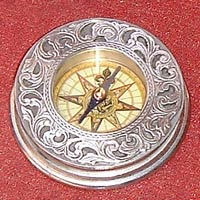
 Directions
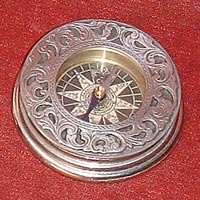 Directions
The two main directions are Ta-Sardar-Var and Ta-Sardar-Ki-Var or called Var and Ki-Var.
Var means "a turning", Ki being a negative, so you might call it "turning to the Sadar" or "not turning to the Sadar", like facing north or facing south.On a map, Ta-Sardar-Var is always listed but you never see Ta-Sardar-Ki-Var because it's any direction that isn't Ta-Sardar-Var (north), so no matter what direction you are looking if not Ta-Sardar-Var (north) it's Ta-Sardar-Ki-Var.
According to the gorean compass, there is 8 directions upon Gor as compared to only 4 on Earth. All their directions are calculated from the Sadar Mountains where on earth they are calculated from the north pole.
Image a pie, cut into 8 slices, the northern most slice being Ta-Sardar-Var, from then you would move in a clockwise direction (clockwise on earth, on Gor clocks move in the opposite direction), there would be Ta-Sardar-Ror (being northeast), Ta-Sardar-Rim (East), Ta-Sardar-Tun (southeast), Ta-Sardar-Vask (south) (this one you might note is sometimes also called Verus Var or the true turning away), Ta-Sardar-Cart (southwest), Ta-Sardar-Klim (west), Ta-Sardar-Kail (northwest) and back again to Ta-Sardar-Var (north)
When in reference to traveling One might say they traveled Klim or Tun, it's not always spoken as traveling Ta-Sadar-Klim or Ta-Sadar-Tun.
For purposes of convenience I am recounting directions in English terms, thinking it would be considerably difficult for the reader to follow references to the Gorean compass. Briefly, for those it might interest, all directions on the planet are calculated from the Sardar Mountains, which for the purposes of calculating direction play a role analogous to our north pole; the two main directions, so to speak, in the Gorean way of thinking are Ta-Sardar-Var and Ta-Sardar-Ki-Var, or as one would normally say, Var and Ki-Var; ‘Var’ means a turning and ‘KI’ signifies negation; thus, rather literally, one might speak of ‘turning to the Sardar’ and ‘not turning to the Sardar’, something like either facing north or not facing north; on the other hand, more helpfully, the Gorean compass is divided into eight, as opposed to our four, main quadrants, or better said, divisions, and each of these itself is of course subdivided. There is also a system of latitude and longitude figured on the basis of the Gorean day, calculated in Ahn, twenty of which constitute a Gorean day, and Ehn and lhn, which are subdivisions of the Ahn, or Gorean hour. Ta-Sardar-Var is a direction which appears on all Gorean maps; Ta-Sardar-Ki-Var, of course, never appears on a map, since it would be any direction which is not Ta-Sardar-Var. Accordingly, the main divisions of the map are Ta-Sardar-Var, and the other seven; taking the Sardar as our “north pole” the other directions, clockwise as Earth clocks move (Gorean clock hands move in the opposite direction) would be, first, Ta-Sardar-Var, then, in order, Ror, Rim, Tun, Vask (sometimes spoken of as Verus Var, or the true turning away), Cart, Klim, and Kail, and then again, of course, Ta-Sardar-Var.
Nomads of Gor Page 3-4 footnotes