Foreign Language
Introduction Topic : 5th Grade FL
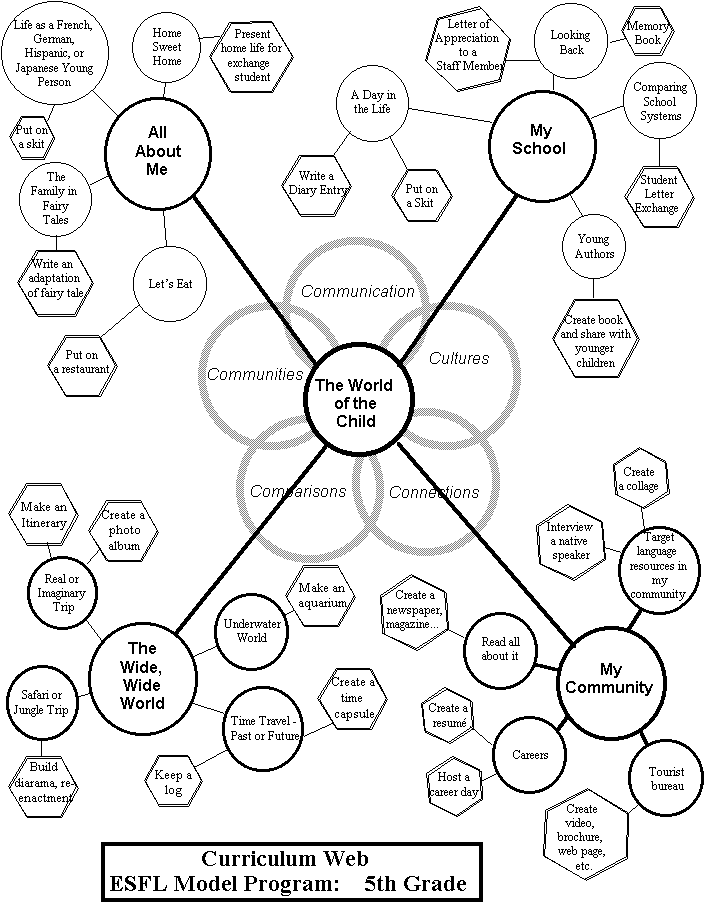
Objectives for Students Completing Grade 5
in the
Georgia Elementary School Foreign Languages Model
Program
These objectives make the following assumptions:
· Student performances are supported by appropriate
scaffolding and guidance on the part of the teacher.
· Students have been in the program at least from
grades one through five.
· Accommodations must be made for special needs
students and for students who have been in the program less than five years.
· Some objectives may appear later for Japanese
students.
Note: Numbers in parentheses are references to the
Standards
for Foreign Language Learning: Preparing for the 21st Century.
By the end of Grade 5, students will be able
to:
5.1 Read for enjoyment using the second language. (1.2,
5.2)
5.2 Read linguistically and developmentally appropriate
passages including, but not limited to articles, stories, and other texts.
(1.2)
5.3 Read to find needed information. (1.2, 3.2)
5.4 Write using sentences or clusters of language. (1.3)
5.5 Write short texts on topics of personal interest,
such as letters and illustrated stories. (1.3, 5.2)
5.6 Summarize personal information or research that they
have done, based on templates or models in the target language. (1.3)
5.7 Demonstrate comprehension of extended written and
oral discourse. (1.2)
5.8 Begin self- or peer-editing for a variety of purposes.
(1.3)
5.9 Retell or paraphrase main elements of a story or
passage. (1.2, 1.3)
5.10 Use the target language for a variety of extended
spoken activities, such as skits, dialogues, plays, poems, research reports
for a variety of audiences. (1.3)
5.11 Share information of their choice with audiences
outside the classroom. (1.3, 5.1)
5.12 Ask for information and make requests of teachers
and other language speakers. (1.1)
5.13 Provide information and respond to requests from
teachers and other language speakers. (1.1)
5.14 Communicate orally and in writing using sentences,
as appropriate, with some use of extended discourse. (1.1)
5.15 Follow and give complex instructions. (1.1)
5.16 Demonstrate an understanding of a variety of speech
sources (teacher, peers, native speakers, other target language speakers,
tapes, CD-Roms, and videos). (1.2, 5.2)
5.17 Recognize the target language when spoken in a variety
of dialects and respond with efforts to communicate. (1.2, 4.1)
5.18 Identify geographic areas where the target language
is spoken. (3.1)
5.19 Identify examples or influences of the target language
and cultures in their own community. (4.1, 4.2)
5.20 Identify, compare and contrast diverse cultural
practices and products, including language, emphasizing similarities as
well as differences. (4.1, 4.2)
5.21 Begin to recognize underlying cultural perspectives
reflected in the products and the practices of the target culture. (2.1,
2.2)
5.22 Identify selected works of art, music and literature
of the target culture. (3.1, 3.2)
5.23 Use culturally appropriate language and behavior
in both formal and informal target language situations (greeting, leave-taking,
eating customs, travel, school, etc.). (1.1, 2.1)
5.24 Use the target language in appropriate content-related
areas including, but not limited to, mathematics, social studies, science,
literature and fine arts. (3.1)
5.25 Maintain simple conversations in the present tense
at the sentence level on a variety of familiar topics, with some efforts
at expressing past and future tense. (1.1)
5.26 Participate actively in classroom experiences with
music, sports, games, songs, dance, or musical instruments from the target
culture, and extend these experiences into their personal lives. (2.1,
5.2)
5.27 Use information obtained through the target language
and cultures to satisfy personal needs and interests. (5.2)
5.28 Identify work-related applications of language proficiency.
(5.1)
5.29. Create with language at the sentence level, making
attempts at circumlocution and elaboration. (1.1, 1.3)
5.30 Draw from a basic vocabulary that permits discussions
of a personal nature and on simple academic topics. (1.1, 1.3)
5.31 Demonstrate understanding of natural classroom speech
at a normal rate of speed, without artificial nonverbal support. (1.1,
1.2)
5.32 Recognize linguistic patterns that occur in the
foreign language and compare them with native language patterns. (4.1)
5.33 Use linguistic patterns in limited monitoring of
speech and writing. (1.1, 1.3) NOTE: This does not imply analytical treatment
of grammar, or a focus on grammatical drill.
Foreign Language Assessment Recommendations
Fifth Grade
FL.5.1
Read books produced by other groups of students or share
them with younger grades.
FL.5.2
Read and discuss target culture cartoons or brief articles
from children's magazines and then share with class.
FL.5.3
Scan newspaper articles to summarize information.
FL.5.4
Write a book using a familiar fairy tale as a template.
FL.5.5
Share information about how to perform a certain task
at home.
FL.5.6
Compare information gained from analyzing school schedules
and report cards, and write brief summaries of findings.
FL.5.7
Listen to a story or fairy tale on tape and answer comprehension
questions.
FL.5.8
Write and revise a rough draft of a composition following
teacher guidelines.
FL.5.9
Outline a story and retell it to a group.
FL.5.10
Create dialogues for specific scenes from a fairy tale
or story and act them out in front of the whole class, another grade or
the entire school.
FL.5.11
Create display boards with information on school subjects,
schedules and grading in target country schools and exhibit them in the
media center.
FL.5.12
Create a survey on a topic such as teacher likes and
dislikes and produce the results.
FL.5.13
Follow a series of directions given by the teacher or
a fellow student and arrive at a final destination. Oversized floor maps
of a community may be used for this activity.
FL.5.14
Present the main idea from a newspaper story and the
main points in the story.
FL.5.15
Provide directions from their home to school or how to
do a particular task from beginning to end.
FL.5.16
Answer questions about a video.
Listen to a song and paraphrase the main ideas.
FL.5.17
Hold a conversation with an exchange student from the
target country.
FL.5.18
Give a geographical description of areas and countries.
FL.5.19
Create a poster showing certain products from the target
country and compare them to native products.
FL.5.20
Inspect a target culture catalog or brochure and compare
to a similar item from the native culture.
FL.5.21
Play Jeopardy game using questions about the products
and practices of the target language and culture.
FL.5.22
Identify a work of art from a target language culture,
and describe orally or in writing.
FL.5.23
Act out a scene at a travel agent.
FL.5.24
Estimate how much a trip to a target language country
would cost in dollars and in the target currency and calculate the distance
to the destination in miles and kilometers.
FL.5.25
Draw conversation cards from a box and improvise short
conversations.
FL.5.26
Present a sport from the target culture to the class
and explain the rules.
FL.5.27
Examine travel brochures and select a place to vacation.
FL.5.28
Invite language speaking guests to speak about their
professions to the class.
FL.5.29
Create original fairy tale stories and adapt them to
contemporary times.
Use complete sentences during class activities.
FL.5.30
Draw topics from a hat and speak for one minute about
each one. .
FL.5.31
Discuss topics of interest pertaining to various current
news articles.
FL.5.32
Formulate sentences and discuss how they differ from
native language patterns.
FL.5.33
Edit compositions in small groups.
Suggested Scenarios
Scenario 1: Let's Eat
(All About Me)
Culminating Project: Restaurant reenactment
-
Review food vocabulary by comparing and contrasting foods
from our culture and target cultures. Describe foods. Graph likes and dislikes.
Have blindfolded taste tests. Use descriptive words for foods such as sweet,
sour, bitter, salty, etc. Categorize foods as being healthy or not healthy
and into the food pyramid groups.
-
Have the students discuss the variety, quantity, and types
of foods that can be found at each meal. Students will discuss cultural
aspects of different eating times in target countries.
-
Discuss the table manners acceptable in the target countries,
incorporating place setting vocabulary. Discuss which fork to use first,
which hand to cut with, where to place the napkin. . .
-
Teach expressions to compliment the cook, show appreciation,
make toasts, ask for additional food, etc. Also teach language necessary
for resolution of problems like "I need another fork" or "This soup is
cold"
-
Individuals or groups create menus to be used for the restaurant
reenactment. Students vote on the best menu and then create the restaurant,
including an entrance sign and decorations. The menus will describe, illustrate
and price various foods. Additionally, students will make comment cards
to be filled out after the reenactment.
-
Students will submit applications as employees in the restaurant.
Needed are cashiers, servers, cooks, hostesses, busboys, a general manager
and translators. Students will submit applications for these positions
and perform corresponding tasks during the reenactment.
-
For the restaurant grand opening students will make invitations
for teachers, administrators, and students from other grade levels. The
students will be responsible for performing their duties as outlined in
their job descriptions.
-
Restaurant guests will be given play money for their dining
experience. Each table will also be provided a translator for the administrators
and other teachers who do not speak the language.
-
Dining guests will be given comment cards to provide feedback
about the dining experience.
Scenario 2: The Family in Fairy Tales
(All About Me)
Culminating Project:
Write and present an original fairy tale, or an adaptation
of one from the target culture, which centers on the family. The presentation
could take the form sharing the story with another class, placing the completed
book in the library, presenting a skit based on the new story, etc.
-
Students listen to fairy tale either narrated by the teacher,
students or audio tape. Students demonstrate comprehension by arranging
pictures of characters or scenes in correct sequential order.
-
Students will complete worksheet with scrambled sentences
from fairy tale after listening to fairy tale for a second time.
-
Students will complete cloze sentences about the fairy tale
with the aid of a word bank.
-
Students will discuss important components of fairy tale:
title, setting, problem, solution events - then chart together as a class.
-
Students will discuss the typical elements of a fairy tale
(good and evil, elements of magic, etc.) - then find specific examples
in the fairy tale
-
Using a word bank of attributes and a chart with several
columns, students will work together in cooperative groups to describe
the personal attributes of the characters in the family
-
Discuss the importance of the family unit as a whole. Class
sings target culture song relating to the family theme.
-
Students will act out the fairy tale. Then they will act
out the story again either adding or omitting a family member. The teacher
can lead a discussion of how the story line changes as a result of changes
in the structure of the family, relationships among family members. Class
will diagram similarities and differences in these relationships.
-
Class outlines possible story lines and characters from the
family unit and creates sentence and word banks for use with each of the
possible story lines. Students can then begin the writing process.
-
Students write final draft of original fairy tale with appropriate
illustrations and present to class.
Scenario 3: Creating a Book
(My School)
Culminating Project: Students will write and illustrate
their own storybook and read it to younger children in the school.
-
Explain to the students that they will be studying children's
books in order to write their own book that they will read to the lower
grades. This creates the context and motivation for them to want to study
children's literature.
-
Share a book with the class that follows a repetitive pattern,
simplifying the text as necessary. Culturally authentic stories are ideal.
Children should become very familiar with the story. Suggested ways to
do this are by assigning parts and rereading the story several times, acting
it out, video taping the students acting it out and watching the tape,
putting TPR motions to the main vocabulary or ideas, or playing charades.
-
Have the students identify the pattern, charting it out on
the overhead, a large sheet of paper or on sentence strips. Do sequencing
activities with the parts of the pattern. Assign a part of the pattern
to different students and have them stand when their part is read.
-
Discuss the parts of a story (title, setting, characters,
problem, solution, events...) and have the students list them for the book
the class is working on and for other stories/fairy tales that all are
familiar with. This can be done orally or written, as a class, in pairs,
groups, or individually.
-
Teach the students to change one element of the story in
order to create a new version of the story. Rewrite the story together
as a class. After modeling the process, partners or groups rewrite the
story again, changing one or more elements.
-
Repeat steps 2 through 5, with variations, with a second
and perhaps third book. This reinforces the idea of patterns in stories,
practices the identification of the parts of a story, and gives students
a choice of patterns to follow when they begin to write their own book.
-
Students select a pattern to follow and decide on the title,
setting, characters, events, etc. for their own book, outlining them for
the teacher to review. Students write the text for their book, turning
it in for corrections before copying it onto the actual pages of the book.
-
Hand back corrected texts and give explicit instructions
for creating the book. You might want to give the students class time to
work on their book. Set deadlines. Set a date to share books.
-
Students read books to younger foreign language students.
Scenario 4: Looking Back
(My School)
Culminating Project:
A memory book, complete with photos and text (ask your
yearbook staff for old school photos)
-
Students share their memories from their school career, and
the teacher compiles a list of the most memorable events. The teacher may
offer suggestions to get them started i.e. working on computers a specific
science experiment, singing in the chorus...)
-
Of those listed students tell their favorite and the teacher
graphs the information to show the most popular aspects of school life.
-
To practice the vocabulary students illustrate the activities
and make caption labels for them. Do activities and games involving matching
the
captions to the drawings.
-
Begin activities necessary for creating each page of the
memory book. Pages could include Favorite Teachers, Best Friends, Most
Exciting Field Trips, Popular PE Games, Favorite Art Projects and more.
-
Sample activities for creation of the Teacher page could
include a review of personality characteristics and school subjects. Students
could write a letter of appreciation to their all-time favorite teacher.
(You can translate it for the teacher after school!)
-
The Best Friends page could include a written description
of the friends and an elaboration of WHY they are good friends. use past
tense to describe a fun experience the friends shared.
-
Each page created should have pictures (brought from home,
form old yearbooks, yearbook leftovers, from magazines or hand drawn) and
captions or a cumulative paragraph telling about the photos on the page.
-
Students may leave blank spaces or pages for friends to sign
their book.
-
Have students create a cover page as well. If possible laminate
them.
-
Students take turns orally sharing their books with each
other.
Scenario 5: Employment Agency
(My Community)
Culminating Project:
Write an ad for a job opening
Apply for a job
(Optional extension) conduct an oral job interview
-
Students and teachers generate a list of professions
-
Teacher provides practice on what the responsibilities of
the jobs are (i.e. the veterinarian takes care of pets, the dentist cleans
your teeth, etc.).
-
Class and teacher generate a word bank of personal characteristics
necessary for jobs (industrious, mathematical, etc.).
-
Students use various sources to get information on job qualifications
for the profession they have chosen for their ad (education, training,
experience)
-
Students look at ads in help wanted/classified section of
a target country newspaper or magazine.
-
Each student writes an ad for a job opening (may include
type of opening [i.e. system analyst, chef, nurse], qualifications [professional,
educational, personal], responsibilities, salary, starting date, location,
to whom to apply, application deadline, etc.).
-
Students peer edit ads. Teacher corrects ads. Students rewrite
ads in correct form. Students or teacher compiles the ad on the computer,
or other format.
-
Students pair up, each student will apply for other's job
ad.
-
Teacher provides model of simple letter of reference and
provides oral practice in generating the letter.
-
Students interview partners to get information for letter
of reference.
-
Students write simple letter of reference for partner (peer
edit, teacher checks, students rewrite).
-
Teacher provides computer form letter outline in second language
(address, salutation, cloze body of letter, ending) and students fill out
the letter.
-
Students send cover letter and letter of recommendation to
person in ad.
-
Teacher and students generate list of questions appropriate
for interview, followed by oral practice with each.
-
Teacher and students generate list of possible answers, followed
by oral practice with each.
-
Students interview each other for their jobs using cover
letter and reference letter as guide. May be in form of skits and video
taped.
Variation: Class could focus on more teacher centered activities
and create their own process for hiring a teacher. Students could choose
their own qualifications, design ads for the search, look at teacher made
resumés and cover letters, choose candidates, and prepare imaginary
interviews. Depending upon how this ends up, they may actually be able
to share concrete results with their principal, superintendent, or other
people who actually hire teachers.
Scenario 6: Tourist Bureau
(My Community)
Culminating Project:
Video, Brochure, Web Page to advertise the interesting
attractions in your city (the students are hired by the local tourist bureau
to prepare literature for tourists from the target cultures).
Prepare ahead of time: Obtain samples of brochures in
target language (write to tourist bureaus in cities of target cultures),
travel videos (from local libraries, Teacher's Discovery, etc.), and web
sites for other cities (search at "http://www.yahoo.com", or other search
engines).
-
Brainstorm to produce list of possible places to include
on big map created by the teacher or the class depending upon complexity.
-
Use photos or drawings to place landmarks and tourist attractions
on the class map.
-
Do directional activities following extended directions using
class map and points of interest to go from point A to point B.
-
Discuss possible modes of transportation for getting around
the city, their availability, cost, etc.
-
Give pairs or groups of students the task of creating a section
for final product (brochure, video script, web page) on how to get around
the community.
-
Brainstorm any additional places kids would like to see and
place them on the map.
-
Play guessing games about the places using descriptives.
-
Give groups the task of creating a section on places of interest
for the final product.
-
Historical landmarks - things to consider might include "what
happened here," getting there (directional activities), time line showing
age of historical landmarks or events, summary for final project.
-
Where to eat - Dining out -possible topics to cover include:
Southern cuisine (compare/contrast culture specific foods), cost, tips
and tax, cultural practices, favorite and least favorite places of the
children.
-
Where to stay - possible topics include getting there (directional
activities), type of room, ratings (four star, or other).
-
Other sections you might choose to include could be "Places
to avoid/Things not to do", "Safety tips for the smart traveler", "Important
phrases".
Scenario 7: Aquarium
( Wide Wide World)
Culminating Project:
3-D aquarium following a budget and containing aquatic
life forms that can function together
list of aquatic animals in aquarium
description of the aquarium
creative writing, story about the animals in the aquarium
(how they got there, who likes whom)
-
Students learn a song about sea life (from Visages 3) and
then discuss what they would expect to see if the were to take a trip to
the Caribbean and go snorkeling in a coral reef.
-
Kids bring in pictures or videos of underwater excursions/dive
trips, or else show teacher video (Jacques Cousteau/National Geographic).
Students identify names of fish they already know, or see if the can figure
out the names that are cognates or something similar (clown fish, anemone,
coral, etc.).
-
Kids have pictures of fish with a description of their personalities/traits.
Teacher describes a fish and the students guess which fish is being described.
Then the students write their own riddles and present them to the class.
-
Students make up their own fish, describe its personality
traits and present it to the class.
-
Students look at example aquariums, determine if the fish
and other animal life forms are compatible and discuss what to add or remove
and why.
-
Students take imaginary trip to fish store and examine aquariums.
Students discuss why prices are the way they are.
-
Discuss important aspects of establishing and maintaining
an aquarium. Students could gather information from outside sources (encyclopedias,
media center, pet stores, friends, relatives, etc.) and report back to
the class. Perhaps there is someone in the community who is a specialist
and speaks the target language.
-
Students make a list of fish they would like in their aquariums
keeping in mind traits and cost. They need to stay within the budget determined
by the class.
-
Students (in groups, pairs, or individually) create a three
dimensional aquarium (boxes are very useful). It may be useful to have
the students sketch out a possible layout and then create a list of materials
needed.
-
Students write a description of their aquarium and its contents.
-
As an extra assignment, students could make up a creative
story about the animals in their aquarium describing how they ended up
there, or a description of the social make-up of the aquarium (who is related
to whom, who is in charge, who dislikes whom, etc).
-
Students present their aquariums to the class, describing
which animals are there and why they made their choices.
-
Students evaluate each others projects (could be done based
on the artistic merit, the compatibility of the animals, following the
budget, language used in the presentation or written description, etc).
Scenario 8: Time Travel
(Wide Wide World)
Culminating Project:
Daily log of experiences
-
Students select items to place in a time capsule to take
along on a journey to another time. Tell students to be thinking of things
during their visit to bring back in a time capsule.
-
Select as a class what epoch to visit. What do they expect
to see/find? Make Venn diagram of predicted similarities/differences between
present day culture and past/future culture.
-
Brainstorm possible methods of transportation to get you
there (ie. time machine, speeding shuttle). Discuss advantages and disadvantages
of each then choose preferred method.
-
The arrival becomes the 1st log entry. Students will write
a journal entry about their first impressions (ie. people, landscape, weather).
-
Students will tour the community with the "tour guide." Teacher
or students describe the sites - As a listening activity have students
take notes to incorporate into their log entries. Also have students create
a map of area from oral descriptions. What buildings do they "see?" What
are they for?
-
Students will create questions in pairs or groups for interviews
of host family/hotel staff members about daily life. What are their customs
and traditions?
-
Students will create a menu which includes their favorite
foods they have tasted; the log entry may also deal with mealtime etiquette
they have observed.
-
Students study leisure activities/hobbies/sports in the culture
they are visiting. Their log entry could be a poster advertising an upcoming
sporting event.
-
Other entries in log might include references to holidays,
forms of greeting, shopping, types of and attitudes towards pets, government
structure, or historical figures/heroes.
-
Brainstorm, select and make cultural items to take back home
in the time capsule.
Scenario 9: Time Travel: Past or Future
(Wide Wide World)
Culminating Project:
Students keep a log of events that take place on their
journey
-
Introduce time capsule concept - students select items to
put in time capsule to take on journey with them
-
Log entry - arrival, 1st impressions, describe weather, season,
What do you see around you? landscape, etc., What do the people look like?
What do they wear?
-
Tour the locale - What buildings do you see? What are they
for? (pyramid --> worship, sacrifice; dwellings --> communal living; sports
arena --> can't remember the name of the game) Draw a map of the layout.
-
Go to your hotel/home stay - interview employees/host family
about way of life / customs / cultural traditions. What do you learn?
-
Food - Host family makes dinner - Go down to hotel restaurant
- What food is served? Does the family all eat together? Do they sit on
chairs or floor? Do they eat with their fingers or utensils? Menu - list
what you ate.
-
Log entry - Leisure activities - students brainstorm activities
they think the community members would participate in. Categorize activities
for different ages (teens, adults, elderly). Students write log entry on
what they "did" that evening. Students could create a poster for a sporting
event taking place.Interview political leader - is it a king, president,
chief, council? What is the hierarchy of the society? What position would
you like in that society - warrior? farmer? priest?
-
Conclusion - time to go home, what can we take back with
us in a time capsule? Students will do art projects to make the items for
the time capsule (arrowhead, wheat, etc.).