Introduction Topic : 4th Grade FL
Objectives for Students Completing Grade 4
in the
Georgia Elementary School Foreign Languages Model
Program
These objectives make the following assumptions:
· Student performances are supported by appropriate
scaffolding and guidance on the part of the teacher.
· Students have been in the program at least from
grades one through four.
· Accommodations must be made for special needs
students and for students who have been in the program less than four years.
· Some objectives may appear later for Japanese
students.
Note: Numbers in parentheses are references to the Standards for Foreign Language Learning: Preparing for the 21st Century.
By the end of Grade 4, students will be able
to:
4.1 Read for enjoyment using the second language. (1.2,
4.2)
4.2 Read linguistically and developmentally appropriate
passages including, but not limited to articles, stories, and other texts.
(1.2)
4.3 Read to find needed information. (1.2, 3.2)
4.4 Write using sentences or clusters of language. (1.3)
4.5 Write short texts on topics of personal interest,
such as letters and illustrated stories. (1.3, 5.2)
4.6 Summarize personal information or research that they
have done, based on templates or models in the target language. (1.3)
4.7 Demonstrate comprehension of extended written and
oral discourse. (1.2)
4.8 Begin self- or peer-editing for a variety of purposes.
(1.3)
4.9 Retell or paraphrase main elements of a story or
passage. (1.2, 1.3)
4.10 Use the target language for a variety of extended
spoken activities, such as skits, dialogues, plays, poems, research reports
for a variety of audiences. (1.3)
4.11 Share information of their choice with audiences
outside the classroom. (1.3, 4.1)
4.12 Ask for information and make requests of teachers
and other language speakers. (1.1)
4.13 Provide information and respond to requests from
teachers and other language speakers. (1.1)
4.14 Communicate orally and in writing using sentences,
as appropriate, with some use of extended discourse. (1.1)
4.15 Follow and give complex instructions. (1.1)
4.16 Demonstrate an understanding of a variety of speech
sources (teacher, peers, native speakers, other target language speakers,
tapes, CD-Roms, and videos). (1.2, 5.2)
4.17 Recognize the target language when spoken in a variety
of dialects and respond with efforts to communicate. (1.2, 4.1)
4.18 Identify geographic areas where the target language
is spoken. (3.1)
4.19 Identify examples or influences of the target language
and cultures in their own community. (4.1, 4.2)
4.20 Identify, compare, and contrast diverse cultural
practices and products, including language, emphasizing similarities as
well as differences. (4.1, 4.2)
4.21 Begin to recognize underlying cultural perspectives
reflected in the products and the practices of the target cultures. (2.1,
2.2)
4.22 Identify selected works of art, music, and literature
of the target cultures. (3.1, 3.2)
4.23 Use culturally appropriate language and behavior
in both formal and informal target language situations (greeting, leave-taking,
eating customs, travel, school, etc.). (1.1, 2.1)
4.24 Use the target language in appropriate content-related
areas including, but not limited to, mathematics, social studies, science,
literature and fine arts. (3.1)
4.25 Maintain simple conversations in the present tense
at the sentence level on a variety of familiar topics, with some efforts
at expressing past and future tense. (1.1)
4.26 Participate actively in classroom experiences with
music, sports, games, songs, dance, or musical instruments from the target
cultures, and extend these experiences into their personal lives. (2.1,
5.2)
4.27 Use information obtained through the target language
and cultures to satisfy personal needs and interests. (5.2)
4.28 Identify work-related applications of language proficiency.
(5.1)
4.29. Create with language at the sentence level, making
attempts at circumlocution and elaboration. (1.1, 1.3)
4.30 Draw from a basic vocabulary that permits discussions
of a personal nature and on simple academic topics. (1.1, 1.3)
4.31 Demonstrate understanding of natural classroom speech
at a normal rate of speed, with limited artificial nonverbal support. (1.1,
1.2)
4.32 Recognize linguistic patterns that occur in the
foreign language and compare them with native language patterns. (4.1)
4.33 Use linguistic patterns in limited monitoring of
speech and writing. (1.1, 1.3) NOTE: This does not imply analytical treatment
of grammar, or a focus on grammatical drill.
Foreign Language Assessment Recommendations
Fourth Grade
FL.4.1
Select and read a simple book from library or language
teacher.
FL.4.2
Read a simple book or magazine article and complete a
brief checklist.
FL.4.3
Find selected information using class schedules.
FL.4.4
Pick a subject and draw or cut out pictures from magazines.
Write simple sentences describing illustrations to make a book (e.g. sports,
food, etc.)
FL.4.5
Select a main character from a familiar fairy tale in
groups and compose a letter to this character asking interesting questions.
FL.4.6
Summarize main attributes of a character in a fairy tale.
FL.4.7
Watch a video and answer questions.
FL.4.8
Trade papers with neighboring students and correct as
a class.
FL.4.9
Act out the main elements of a fairy tale.
Make a story board containing the main elements of a
book the teacher has read to the class.
FL.4.10
Write and act out a scene in a restaurant.
FL.4.11
Choose a simple lesson to teach to a sibling, cousin,
or neighbor.
FL.4.12
Prepare a simple list of questions and interview a teacher
of their choice.
FL.4.13
Teach a phrase a week to another student or teacher.
FL.4.14
Write letters to a penpal.
FL.4.15
Follow directions in a treasure hunt.
FL.4.16
Complete questions after listening to a tape, video,
etc.
FL.4.17
Identify main idea in a target language video.
FL.4.18
Make a simple booklet containing information about countries
where the target language is spoken.
FL.4.19
Brainstorm examples of the use of the target language
in their own communities.
FL.4.20
Compare selected holidays and list differences and similarities.
FL.4.21
Watch a video on food or meals in the target culture
and identify which items are typical products of the culture.
FL.4.22
Listen to and identify a current popular song from a
target language culture.
FL.4.23
Prepare a short skit of a scene and present it in both
a formal and informal situation.
FL.4.24
Research and prepare a brief report on any topic.
FL.4.25
Take turns relating personal experiences, and answering
simple questions.
FL.4.26
Perform a song or a sport from the target culture.
FL.4.27
Find their way out of simple scenario predicaments by
asking the appropriate questions.
FL.4.28
Identify jobs where a foreign language is useful and
explain why.
FL.4.29
Create an ending to a simple story which the teacher
begins.
FL.4.30
Prepare a simple report on a topic, such as favorite
animal.
FL.4.31
Perform a series of increasingly complex directions and
tasks.
FL.4.32
Practice converting answers to questions, play Jeopardy.
FL.4.33
Students are given simple sentences with mistakes and
correct them in groups.
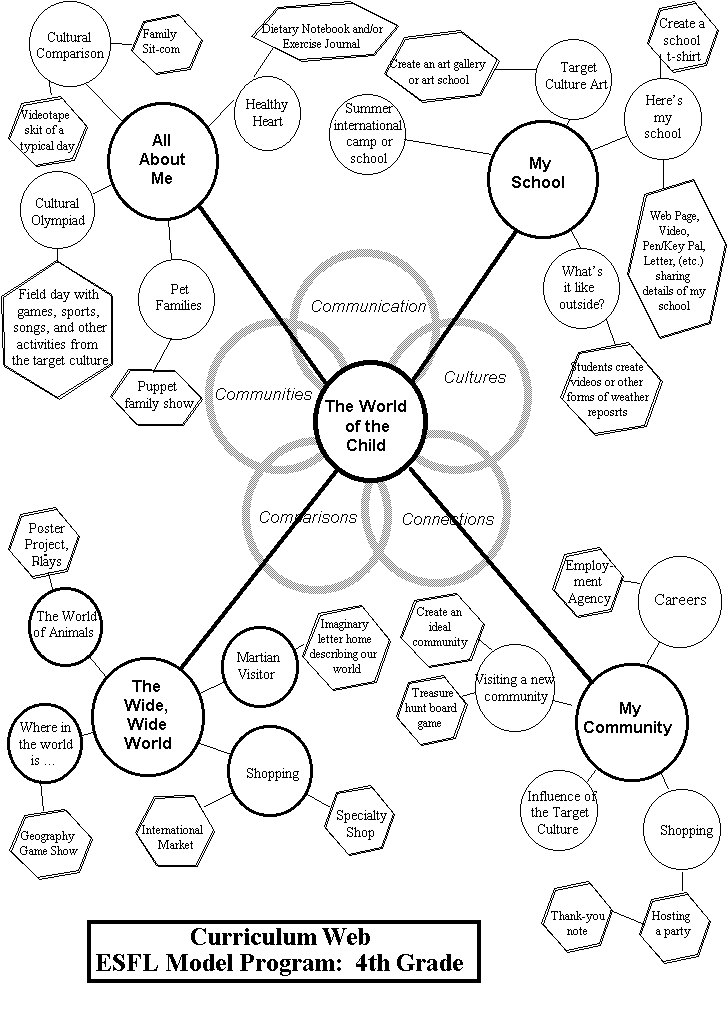
SUGGESTED SCENARIOS
Scenario 1: Cultoons
(All About Me)
Culminating Project:
Cultoon book*
1. Teacher offers culture topics that have a critical
difference. Teacher and students discuss the topics. Students vote on three
broad areas (treatment of pets, school customs, eating habits, vacation
time/activities, politeness in shops, transportation, sports and after
school activities).
2. Teacher helps students compile a list of customs in
the US and then adds in the comparison with the target cultures.
3. Each student chooses a critical difference to draw
a cultoon to and writes a caption from model.
4. Teacher or students compile cultoons into a book for
sharing with others (other classes, in the library, etc.).
? Examples:
Pets:
Names
Where we take our pets
Pet food
Vacation:
How much time do people get?
How often is there a vacation?
Where do people go?
What do people do?
Serge in Atlanta Trent in France
Houston's Restaurant Restaurant Chez Daniel
* A cultoon is a cartoon that illustrates a cultural difference.
You might want to be more artistic than the example above.
Scenario 2: This is My Life
(All About Me)
Culminating Project:
Giant Personal time line about each student's life, marking
highlights (such as first steps, first words, first friend, favorite toy,
worst accident, etc.)
Scenario 3: Here's My School
(My School)
Culminating Project:
Create a school T-shirt
Scenario 4: What's It Like Outside?
( My School)
Culminating Project:
Mock TV weather report and conversation between "anchor"
and "meteorologist."
Scenario 5: Let's Throw a Party
(My Community)
Culminating Project:
Party simulation
Thank you note
Recipe Book
Students could create a cook book using the recipes collect
in preparation for the party.
Scenario 6: Treasure Hunt Board Game
(My Community)
Culminating Project:
Treasure hunt board game in created city
Scenario 7: The World of Animals
(Wide Wide World)
Culminating Project:
Habitat murals
Video puppet show
Endangered species flyer
Scenario 8: Cultural Olympiad
(Wide Wide World)
Culminating Project:
Plan a field day in the target culture
Variations:
Students could plan a cultural olympiad in a more broad
sense i.e. including songs, dances and culturally authentic activities
that are not necessarily sports. Groups of students choose the activities
that they are most interested in to teach to others (parents, administrators,
other classes, etc.) at the field day. This could turn into a cultural
festival that could be a fund raiser for the school, PTA, or foreign language
department. These activities could also be incorporated into the school's
regular field day.