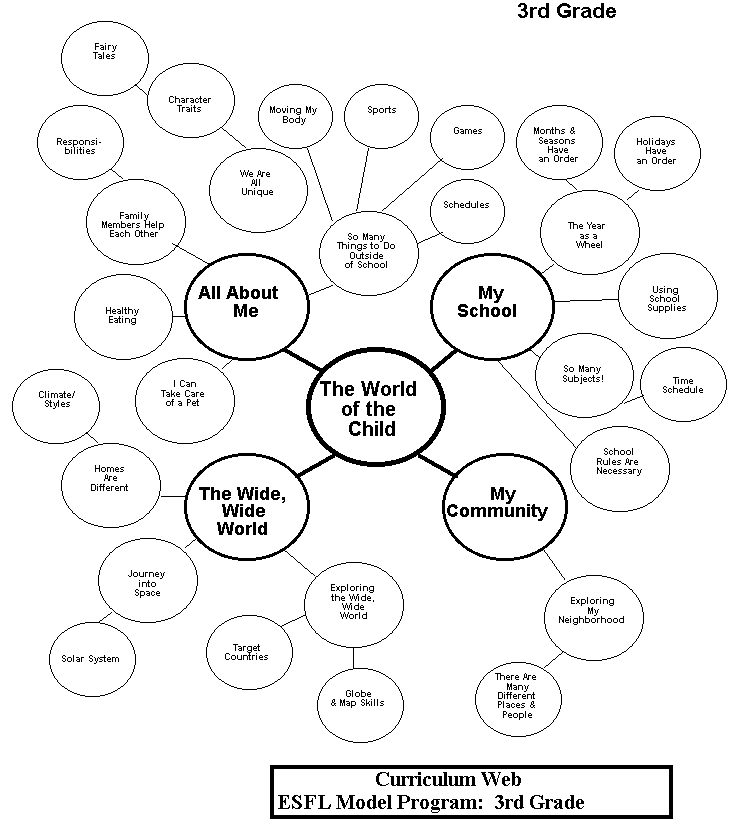
Introduction Topic : 3rd Grade FL
Objectives for Students Completing Grade 3
in the
Georgia Elementary School Foreign Languages Model
Program
These objectives make the following assumptions:
· Student performances are supported by appropriate
scaffolding and guidance on the part of the teacher.
· Students have been in the program at least from
grades one through three.
· Accommodations must be made for special needs
students and for students who have been in the program less than three
years.
· Some objectives may appear later for Japanese
students.
Note: Numbers in parentheses are references to the Standards for Foreign Language Learning: Preparing for the 21st Century.
By the end of Grade 3, students will be able
to:
3.1 Read for enjoyment using the second language. (1.2,
4.2)
3.2 Read linguistically and developmentally appropriate
passages including, but not limited to articles, stories, and other texts.
(1.2)
3.3 Read to find needed information. (1.2, 3.2)
3.4 Write using sentences or clusters of language. (1.3)
3.5 Write short texts on topics of personal interest,
such as letters and illustrated stories. (1.3, 5.2)
3.6 Summarize personal information or research that they
have done, based on templates or models in the target language. (1.3)
3.7 Demonstrate comprehension of extended written and
oral discourse. (1.2)
3.8 Begin to self-edit for a variety of purposes. (1.3)
3.9 Retell or paraphrase main elements of a story or
passage. (1.2, 1.3)
3.10 Use the target language for a variety of extended
spoken activities, such as skits, dialogues, plays, poems, research reports
for a variety of audiences. (1.3)
3.11 Share information of their choice with audiences
outside the classroom. (1.3, 4.1)
3.12 Ask for information and make requests of teachers
and other language speakers. (1.1)
3.13 Provide information and respond to requests from
teachers and other language speakers. (1.1)
3.14 Communicate orally and in writing using sentences,
as appropriate, with some use of extended discourse. (1.1)
3.15 Follow and begin to give complex instructions. (1.1)
3.16 Demonstrate an understanding of a variety of speech
sources (teacher, peers, native speakers, other target language speakers,
tapes, CD-Roms, and videos). (1.2, 5.2)
3.17 Recognize the target language when spoken in a variety
of dialects and respond with efforts to communicate. (1.2, 4.1)
3.18 Identify geographic areas where the target language
is spoken. (3.1)
3.19 Identify examples or influences of the target language
and cultures in their own community. (4.1, 4.2)
3.20 Identify, compare, and contrast diverse cultural
practices and products, including language, emphasizing similarities as
well as differences. (4.1, 4.2)
3.21 Identify selected works of art, music, and literature
of the target cultures. (3.1, 3.2)
3.22 Use culturally appropriate language and behavior
in both formal and informal target language situations (greeting, leave-taking,
eating customs, travel, school, etc.). (1.1, 2.1)
3.23 Use the target language in appropriate content-related
areas including, but not limited to, mathematics, social studies, science,
literature and fine arts. (3.1)
3.24 Maintain simple conversations in the present tense
on a variety of familiar topics. (1.1)
3.25 Participate actively in classroom experiences with
music, sports, games, songs, dance, or musical instruments from the target
cultures, and extend these experiences into their personal lives. (2.1,
5.2)
3.26 Use information obtained through the target language
and cultures to satisfy personal needs and interests. (5.2)
3.27 Begin to identify work-related applications of language
proficiency. (5.1)
3.28. Attempt to create with language at the sentence
level. (1.1, 1.3)
3.29 Draw from a basic vocabulary that permits exchanges
of a personal nature and on simple academic topics. (1.1, 1.3)
3.30 Demonstrate understanding of natural classroom speech
at a normal rate of speed, with limited artificial nonverbal support. (1.1,
1.2)
3.31 Recognize linguistic patterns that occur in the
foreign language and compare them with native language patterns. (4.1)
3.32 Use linguistic patterns in limited monitoring of
speech and writing. (1.1, 1.3) NOTE: This does not imply analytical treatment
of grammar, or a focus on grammatical drill.
Foreign Language Assessment Recommendations
The following are only suggested assessment strategies.
Teachers are encouraged to develop additional strategies.
Third Grade
FL.3.1
Read books produced by other groups of students, or share
them with younger grades
FL.3.2
Read and discuss target culture cartoons or brief articles
from children's magazines working in groups and then share them with whole
class
FL.3.3
Read school schedules and report cards from target countries
in pairs to determine type of school subjects, grading system and number
of contact hours typical for peers abroad. Compare information gained with
other students.
FL.3.4
Create big books by writing brief summaries of familiar
stories, fairy tales, or topics of personal interest and illustrating them
FL.3.5
Share information about pet care as a whole class, as
teacher records student contributions. Write and illustrate personalized
pet care manuals for a pet of choice.
FL.3.6
Compare information gained from analyzing school schedules
and report cards, and write brief summaries of findings.
FL.3.7
Listen to a story or fairy tale on tape and answer comprehension
questions
FL.3.8
Write and revise a rough draft of a composition according
to a teacher's checklist
FL.3.9
Outline a story and retell it to a group
FL.3.10
Create dialogues for specific scenes from a fairy tale
or story and act them out in front of the whole class, another grade or
the entire school
FL.3.11
Create display boards with information on school subjects,
schedules and grading in target country schools and exhibit them in the
media center.
FL.3.12
Play a game using humorous commands directed towards
other students and teacher.
FL.3.13
Follow a series of directions given by the teacher or
a fellow student and arrive at a final destination. (Oversized floor maps
of a community may be used for this activity.)
FL.3.14
Present orally the main ideas found in a story or short
text and create sentence strips to convey important elements.
FL.3.15
Construct an object of cultural significance by following
teacher's directions. Instruct students in younger grades to complete similar
project.
FL.3.16
View a video segment and fill out a rubric regarding
specified information about the characters.
FL.3.17
Hold a basic conversation with an exchange student from
a target country.
FL.3.18
Color in countries where the target language is spoken
on a map of the world.
FL.3.19
Identify in the yellow pages target language businesses
and restaurants.
FL.3.20
Inspect a target culture catalog or brochure and compare
to a similar item from the native culture.
FL.3.21
Listen to and identify a current popular song from a
target language culture.
FL.3.22
Act out a restaurant scene which incorporates correct
table manners.
FL.3.23
Estimate how much a trip to a target language country
would cost and convert from dollars to target language currency.
FL.3.24
Draw a conversation card from a box and improvise a short
conversation in pairs.
FL.3.25
Present a lip sync to a current popular target culture
song.
FL.3.26
Examine travel brochures and select a place to vacation.
FL.3.27
Invite guests who use the target language to "Career
Day."
FL.3.28
Write 3-5 sentences about a familiar picture.
FL.3.29
Dictate multiplication problems to one another.
FL.3.30
Identify the object or action that the teacher has described/performed.
FL.3.31
Use column choices to formulate original sentences.
FL.3.32
Peer edit a brief composition.
ALL ABOUT ME
THIRD GRADE
LANGUAGE STRUCTURES USED BY STUDENTS
| It is _____ or/and _____ .
It is _____ not _____ . I am (verb). He/She is (verb). We/They are (verb). I like to/don't like to (verb) (objective). (subject) always/sometimes/never(verb). Who is _____? Who does _____? Who (verb)? I (verb) and/or (verb). My _____ is _____ . My _____ is _____ not _____ . I have _____ (and _____). He/She has _____ (and _____). We/They have _____ (and _____). My _____ likes to (verb). My _____ needs _____ . |
He/She needs _____ .
I like to (verb expressing sport or activity) . In (activity) I use/exercise my ____ I am ___. I am going to do _____ . I am good at/strong in (activity/ subject). The/A/An (subject) (verb) (object). What do you like? very I want _____ . This/That/It is... yes/no I/me my/mine you/your the/a/an |
PROGRESS INDICATORS
1. The students will describe, compare, and contrast
the responsibilities of different family members at home.
2. Students will identify and summarize various components
of pet care.
3. Students will provide autobiographical information
in oral and written form.
4. Students will report on activities outside of school.
5. Students will determine which body parts are exercised
in certain games and/or sports activities.
6. Students will identify selected foods in the native
and target cultures and categorize them according to mealtimes.
7. Students will describe and discuss a balanced meal
using the food pyramid.
8. Students will contrast positive and negative character
traits in real and fictional characters.
9. Students will use knowledge of character traits to
discuss fairytales.
10. Students will compare and contrast fairytales from
the U.S. and the target culture.
THEMATIC VOCABULARY USED IN TEACHING SECOND LANGUAGE
| FAMILY MEMBERS HELP EACH OTHER
responsibilities to describe to compare to contrast to cook meal to wash dishes to wash clothes |
to clean
to make the bed to iron clothes to set the table to cut the grass to work to have to to care for |
| I CAN TAKE CARE OF A PET
to feed to wash/to bathe veterinarian shot bone leash collar toys basket |
cage
dish tank to buy full empty to exercise to need to want |
| SO MANY THINGS TO DO OUTSIDE OF SCHOOL
schedule baseball/softball soccer karate dance gymnastics swimming tennis music board games evening |
night
video games always muscle heartbone to use to be about to/going to do to go to morning afternoon |
| WE ARE ALL UNIQUE
characteristics/traits selfish to lie liar nice friendly mean/unfriendly to share attentive/helpful |
intelligent
shy/timid quiet (in nature) lazy hard-working loud rude polite outgoing |
| FAIRYTALES
fairytale character magic to transform/to change opposites to act out beginning |
middle
end beautiful ugly "once upon a time" "and they lived happily ever after" to tell |
| HEALTHY EATING
breakfast lunch dinner food pyramid sweets breads and cereals group fats serving |
vegetable group
fruit group dairy products group meat, fish and eggs group fats, oils and sugars group oils more of less of |
MY SCHOOL
THIRD GRADE
LANGUAGE STRUCTURES USED BY STUDENTS
| What time is it?
It is (time). I like to (verb) (noun). I am going to (verb). I am good at/strong in (subject). The/A/An (noun) (verb) (noun). We/They have(subject) at (time). _____ is in _____ . It is/They are for (verb). I like/don't like (subject). What do you like? After school I(verb). I have (subject). I have to _____ . |
He/She has to _____ .
We/They have to _____ . I want/need _____ . He/She needs _____ . What is...? Where is...? ___ and/or ___ ___ not ___ This/That/It is... I/me my/mine you/your the/a/an |
PROGRESS INDICATORS
11. Students will arrange in chronological order a series
of experiences.
12. Students will tell time to the hour, half hour, quarter
hour and in digital format.
13. Students will classify selected daily activities
according to time of day (morning, afternoon, evening, night).
14. Students will count, idenitify and manipulate numerals
0-100 and count by hundreds to one thousand.
15. Students will identify and describe uses for classroom
objects.
16. Students will estimate and measure length of selected
objects using the metric system.
17. Students will identify their school subjects and
compare a sample schedule with one from the target culture.
18. Students will list the months of the year in correct
order and organize them by seasons.
19. Students will identify holidays of American and the
target and native culture and attribute them to the respective months of
the year, including annual school events.
20. Students will recognize rules at school.
THEMATIC VOCABULARY USED IN TEACHING (ENGLISH)
| SO MANY SCHOOL SUBJECTS
mathematics science spelling handwriting social studies language arts music physical education foreign language schedule |
subject
quarter hour quarter to the hour quarter after the hour report card grade intercom conduct/behavior participation |
| USING SCHOOL SUPPLIES
to paint to fold to tear to sharpen to erase to place to remove to turn off to turn on to read to measure |
to estimate
to staple to collect to underline to cross off to fill in to circle centimeter meter thousand |
| THE YEAR AS A WHEEL
festival annual selected United States holidays word |
selected target culture holidays
letter alphabet order |
MY COMMUNITY
THIRD GRADE
LANGUAGE STRUCTURES USED BY STUDENTS
| The (noun) is (directional term
indicating location).
The (community worker) works at/in (location). He/She (verb) (the) (objective). I should/should not (verb). One should/should not (verb)S. We/They have _____ (also). We/They don't have _____ . I have to _____ . He/She has to _____ . I want/need _____ . He/She wants/needs _____ . How much is _____? This/That/It costs _____ . |
I want to (verb).
May I (verb), please? What is _____? Where is _____? There is/are _____ . The/A/An _____ is _____ . Who is _____? ___ and/or ___ ___ not ___ This/That/It is... I/me my/mine you/your the/a/an |
PROGRESS INDICATORS
21. Students will identify and locate neighborhood places
on a map.
22. Students willl identify examples of types of workers
in the community and describe what they do.
23. Students will compare and contrast types of businesses
in the U.S. and in the target country.
24. Students will identify, describe, and manipulate
the currency of a target country.
THEMATIC VOCABULARY USED IN TEACHING (ENGLISH)
| EXPLORING MY NEIGHBORHOOD
community map west south north east beside behind in front of to locate to deliver to cut/butcher to cut hair to sell to bake barber shop butcher shop bakery |
flower shop
drug store butcher baker florist barber/hairdresser store waiter/waitress salesclerk to serve to protect to care for |
| RULES ARE NECESSARY
rules to have to may to forbid to allow to fight |
to talk
to raise hand to follow a rule to behave to respect |
WIDE, WIDE WORLD
THIRD GRADE
LANGUAGE STRUCTURES USED BY STUDENTS
| This/That/It is (a/an) _____ .
It has _____ . There is/are _____ . It is _____ because _____ . It needs _____ . What is _____? Where is _____? I want/need _____ . |
He/She wants/needs _____ .
___ and/or ___ ___ not ___ I/me my/mine you/your the/a/an |
PROGRESS INDICATORS
25. Students will identify celestial bodies and their
locations.
26. Students will compare and contrast planets according
to their basic characteristics.
27. Students will compare homes in the United States
with those in the target countries.
28. Students will interpret information about climate
and determine how it affects the homes people live in.
29. Students will name and locate the continents and
oceans on a globe and map.
30. Students will identify and describe flags and symbols
of selected target countries.
31. Students will recognize and locate on a map selected
countries where the target language is spoken.
THEMATIC VOCABULARY USED IN TEACHING (ENGLISH)
| HOMES ARE DIFFERENT
roof basement story/floor wall high-rise building to construct fence crowded |
chimney/fireplace
climate balcony wet dry |
| EXPLORING THE WIDE WORLD
continent ocean |
near/close to
far |
| JOURNEY INTO SPACE
moon sky planet star sun Mercury Venus Earth Mars Jupiter Saturn Uranus |
Neptune
Pluto close to far from volcano ring orbit solar system space rocket astronaut |