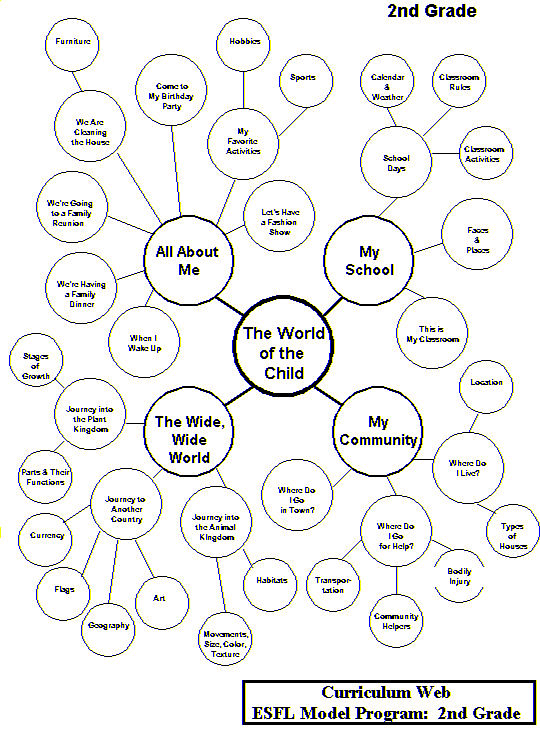
Introduction Topic : 2nd Grade FL
Objectives for Students Completing Grade 2
in the
Georgia Elementary School Foreign Languages Model
Program
These objectives make the following assumptions:
· Student performances are supported by appropriate
scaffolding and guidance on the part of the teacher.
· Students have been in the program at least from
grades one through two.
· Accommodations must be made for special needs
students and for students who have been in the program less than two years.
· Some objectives may appear later for Japanese
students.
Note: Numbers in parentheses are references to the Standards for Foreign Language Learning: Preparing for the 21st Century.
By the end of Grade 2, students will be able
to:
2.1 Read for enjoyment using the second language. (1.2,
4.2)
2.2 Read linguistically and developmentally appropriate
passages. (1.2)
2.3 Begin to read to find needed information. (1.2, 3.2)
2.4 Write using sentences or clusters of language. (1.3)
2.5 Write short texts on topics of personal interest,
such as letters and illustrated stories. (1.3, 5.2)
2.6 Summarize personal information based on templates
or models in the target language. (1.3)
2.7 Demonstrate comprehension of some extended written
and oral discourse. (1.2).
2.8 Retell or paraphrase main elements of a story or
passage. (1.2, 1.3)
2.9 Use the target language for a variety of spoken activities,
such as skits, dialogues, plays, poems, for a variety of audiences. (1.3)
2.10 Share information of their choice with audiences
outside the classroom. (1.3, 4.1)
2.11 Ask for information and make requests of teachers
and other language speakers. (1.1)
2.12 Provide information and respond to requests from
teachers and other language speakers. (1.1)
2.13 Communicate orally and in writing using sentences,
as appropriate. (1.1)
2.14 Follow complex oral instructions and give simple
commands. (1.1)
2.15 Demonstrate an understanding of a variety of speech
sources (teacher, peers, native speakers, other target language speakers,
tapes, CD-Roms, and videos). (1.2, 5.2)
2.16 Recognize the target language when spoken in a variety
of dialects and respond with efforts to communicate. (1.2, 4.1)
2.17 Begin to identify geographic areas where the target
language is spoken. (3.1)
2.18 Identify examples or influences of the target language
and cultures in their own community. (4.1, 4.2)
2.19 Identify, compare and contrast diverse cultural
practices and products, including language, emphasizing similarities as
well as differences. (4.1, 4.2)
2.20 Identify selected works of art, music and literature
of the target cultures. (3.1, 3.2)
2.21 Use culturally appropriate language and behavior
in both formal and informal target language situations (greeting, leave-taking,
eating customs, travel, school, etc.). (1.1, 2.1)
2.22 Use the target language in appropriate content-related
areas including, but not limited to, mathematics, social studies, science,
literature, and fine arts. (3.1)
2.23 Use a limited number of words and phrases on a variety
of topics. (1.1)
2.24 Participate actively in classroom experiences with
music, sports, games, songs, dance, or musical instruments from the target
cultures, and extend these experiences into their personal lives. (2.1,
5.2)
2.25 Use the target language to obtain information to
satisfy personal needs and interests. (5.2)
2.26 Attempt to create with the language at the sentence
level. (1.1, 1.3)
2.27 Draw from a basic vocabulary that permits exchanges
of a personal nature on simple topics. (1.1, 1.3)
2.28 Demonstrate understanding of natural classroom speech
at a normal rate of speed, with nonverbal support. (1.1, 1.2)
2.29 Recognize linguistic patterns that occur in the
foreign language and compare them with native language patterns. (4.1)
2.30 Use linguistic patterns in limited monitoring of
speech and writing. (1.1, 1.3) NOTE: This does not imply analytical treatment
of grammar, or a focus on grammatical drill.
Foreign Language Assessment Recommendations
The following are only suggested assessment strategies.
Teachers are encouraged to develop additional strategies.
Second Grade
FL.2.1
Read a story, fairy tale or fable with the class
FL.2.2
Read simplified instructions, recipes, advertisements,
comics
FL.2.3
Read short descriptions and create a drawing
Read short texts and answer simple comprehension questions
FL.2.4
Write brief descriptions of picture or drawing
Write sentences about themselves for use in secret identity
activities
Write daily routines
Write simple Gouin series
FL.2.5
Write an invitation to a party
FL.2.6
Create Venn diagram comparing two fictitious characters
or famous people
FL.2.7
Listen to a short text and identify mistakes
Find mistakes in a text description correlating to a
picture
FL.2.8
Use a storyboard to present main parts of story
FL.2.9
Create and present a dialogue for a mock family dinner
FL.2.10
Share information about their day with their classmates
after school, at lunch, on the school bus, or at recess.
Share information with members of extended family, teachers
or neighbors
FL.2.11
Ask permission to carry out activities in the classroom
Ask questions to describe a picture or drawing
FL.2.12
Describe favorite foods, pet, sport, or hobby
FL.2.13
Write cloze sentences to create a book.
Read final draft of individual book to class
FL.2.14
Follow simple directions to a specific location in the
community
Create a series of TPR commands for classmates
FL.2.15
Participate in a dialogue or scene recreated from a tape
or video
FL.2.16
Listen to songs from different regions from the target
country or different target countries.
FL.2.17
Play map games with target countries
FL.2.18
Identify cultural traditions occurring in the community
Identify cultural products found in the community
FL.2.19
Create illustrated posters contrasting segments of daily
life such as family ties, schedules and clothing.
FL.2.20
Reproduce a cultural work of art using the style of that
artist.
Create a new work of art using the style of the target
language artist
FL.2.21
Role play in different simple social situations
FL.2.22
Solve simple mathematical problems using a number line
Categorize healthy and unhealthy foods and place them
on a food pyramid
FL.2.23
Write simple cloze passages in a daily journal
Discuss or describe picture of things or situations
FL.2.24
Teach a song from the target cultures to others
FL.2.25
Ask questions about pictures in order to match pictures
to words
FL.2.26
Create short messages or notes for their classmates
FL.2.27
Create pamphlets with illustrations and short descriptions
of favorite foods or clothes
FL.2.28
Follow instructions of teacher in class on a variety
of activities
FL.2.29
Use geometric figures to identify simple nouns or verbs.
FL.2.30
Unscramble the words in a sentence and put them in the
correct order.
ALL ABOUT ME
SECOND GRADE
LANGUAGE STRUCTURES USED BY STUDENT
| I am _____ years old.
I/he/she am/is... I/he/she have/has... I would like.../I want... Do you want...? I like/don't like to (verb). I/he/she (verb). I/he/she (verb) (objective). This/That/It/There is... This/That/It (verb). _____ is ___er. (comparative) |
_____ is ___est. (superlative)
_____ is in _____ . _____ is not _____ . *negation when applicable _____ is too _____ . for/in/from yes/no I/me my/mine you the/a/an |
PROGRESS INDICATORS
1. Students will recognize and produce extended family
member names.
2. Students will use names, qualities, and descriptors
to give information about family members and peers.
3. Students will use emotional descriptors and feelings
to describe family, self and peers.
4. Students will employ common courtesy expressions used
at mealtimes and social occasions.
5. Students will classify and describe fruit, vegetables,
beverages and cultural foods in terms of color, shape and texture.
6. Students will compare and contrast a family dinner
from the native culture and the target culture.
7. Students will classify objects that float, sink, repel
or attract.
8. Students will respond to and use personal data: name,
city, age, telephone number and birthday.
9. Students will classify furniture according to rooms
of the house.
10. Students will use descriptive phrases to evaluate
clothing from a fashion show.
11. Students will categorize, compare, and contrast clothing
according to different seasons.
12. Students will observe social customs of ethnic and
seasonal celebrations in America and in the target language country.
13. Students will state personal daily routines.
14. Students will relate favorite activities.
THEMATIC VOCABULARY USED IN TEACHING SECOND LANGUAGE
| GOING TO A FAMILY REUNION
aunt uncle boy cousin girl cousin child tall/taller than/tallest short/shorter than/shortest young/younger than/youngest old/older than/oldest I have. . . brothers/sisters. He/she is called. . . I have blond hair. |
He/she has blond hair.
I have brown hair. He/she has brown hair. I have black hair. He/she has black hair. I have red hair. He/she has red hair. I am skinny. He/she is skinny. I am large. He/she is large. |
| A FAMILY DINNER
I am full. Pass me... I would like... Do you want...? No, thank you. Excuse me. Pardon me. Enjoy your meal. Bless you. Asparagus rice eggs rough smooth hard soft float sink |
hot chocolate
tea turkey chicken beef fork knife spoon pork ham salty sweet sour/bitter It tastes good. It tastes bad. Yummy!/Yum-Yum! to eat to drink |
| CLEANING THE HOUSE
garden patio/balcony roof curtains mailbox furniture telephone radio sofa bed bathtub |
oven
toilet dresser dishes lamp refrigerator sink dirty clean to clean |
| COME TO MY BIRTHDAY PARTY
When is your birthday? My birthday is... How old are you? I am...years old. He/she is...years old. invitation to invite Happy Birthday! |
birthday party
birthday card birthday cake telephone number What's your telephone number My telephone number is... My friend's called... Will you be my friend? |
| MY FAVORITE ACTIVITIES
What do you do like to do? to play to sleep to watch TV to listen to music to swim |
to run
to walk to visit... I like to ... I do not like to ... to collect |
| DAILY ROUTINES
soap toothbrush toothpaste comb shampoo I wash my hands. |
I wash my face.
I take a shower/bath. I brush my teeth. I comb my hair. I wake up. I go to sleep/bed. |
| LET'S HAVE A FASHION SHOW
My School sweatshirt sweatpants raincoat slippers umbrella tie shorts long-sleeves short-sleeves swimming suit glasses jacket/coat |
cap
pajamas fashion show clothes He/she wears... to put on/wear to take off ... is pretty. ... is not pretty. ... is too big. ... is too small. |
MY SCHOOL
SECOND GRADE
LANGUAGE STRUCTURES USED BY STUDENTS
| I (verb). *negation when applicable
May I...? I (verb) (adjective) . This/That/The _____ is on/under/above/below/over/beside/in front of/behind _____ . It is (preposition) the (object). What _____ is _____? (calendar) _____ is/was/will be _____ . |
Where is _____?
_____ is in _____ . How does one say _____ in _____? This/That/It is... yes/no I/me my/mine you the/a/an |
PROGRESS INDICATORS
15. Students will recognize and use the days of the week,
the months of the year and the seasons.
16. Students will describe the basic weather conditions.
17. Students will demonstrate understanding of telling
time by using hours and half hours.
18. Students will demonstrate understanding of classroom
rules and routines.
19. Students will identify and use vocabulary for relevant
school personnel and places.
20. Students will apply vocabulary for relevant classroom
supplies and furniture.
21. Students will name and organize letters and target
language vocabulary in alphabetic order.
THEMATIC VOCABULARY USED IN TEACHING (ENGLISH)
| THIS IS MY CLASSROOM
pen marker yarn poster board computer desk map globe clock ruler construction paper handout/worksheet overhead projector floor carpet bulletin board |
cabinet
bookshelf to fold to cut to paste to copy heart pencil sharpener school supplies folder chalk to erase to draw to give out to pick up |
| FACES AND PLACES
teacher student principal secretary librarian custodian cook |
cafeteria
office library hallway classroom playground gym |
| SCHOOL DAYS
ordinal #'s 1st-31st day week year cool warm stormy foggy Today is... Yesterday was... What time is it? It is ____ o'clock. It is ____thirty. in the morning |
Tomorrow is...
to talk May I...? May I sharpen my pencil? May I go to the bathroom? May I get some water? Please repeat what you said. I understand. I do not understand. I have a question. in the afternoon after school recess lunch time |
MY COMMUNITY
SECOND GRADE
LANGUAGE STRUCTURES USED BY STUDENTS
| There is/are ____ in ____.
I ____ in _____. Where...? My ____ is broken. My ____ hurts What...? I need ____. I need to ____. |
I go to ____ by/in/on ____.
(transportation) This/That/It is... yes/no I/me my/mine You the/a/an |
PROGRESS INDICATORS
22. Students will describe different types of homes and
their locations.
23. Students will identify and describe bodily injuries.
24. Students will determine the role of community helpers
and the means of transportation that respond to various emergencies.
25. Students will compare and contrast common places
in communities.
THEMATIC VOCABULARY USED IN TEACHING (ENGLISH)
| WHERE DO I LIVE?
house apartment trailer |
in the country
in the city |
| WHERE DO I GO IN TOWN?
school bank supermarket church/synagogue/mosque restaurant park post office |
store
subway police station fire station hospital doctor's office dentist's office |
| WHERE DO I GO FOR HELP?
siren back (body part) throat tongue forehead cheeks |
lips
chest ice My...is broken. Can you help me? Help! |
WIDE, WIDE WORLD
SECOND GRADE
LANGUAGE STRUCTURES USED BY STUDENTS
| What . . ?
___ needs ___. They/There/Those are___. It (verb). (animal)lives in (habitiat). Where. . .? ___ is here/there. ___ is/are ___. ___ is made/created/painted by |
in
for from/of This/That/It is... yes/no I/me my/mine you the/a/an |
PROGRESS INDICATORS
26. Students will identify main parts of plants and their
needs.
27. Students will recognize the stages of a plant's development.
28. Students will classify animals according to their
habitat.
29. Students will describe size, color, texture and movements
of animals.
30. Students will locate selected countries of the target
language on a map or globe.
31. Students will recognize flags and names of selected
countries where the target language is spoken.
32. Students will recognize and use currency from target
language countries.
33. Students will identify artists and recognize works
of art from the target culture.
34. Students will observe important holidays and celebrations
from the target language countries.
THEMATIC VOCABULARY USED IN TEACHING (ENGLISH)
| JOURNEY INTO THE PLANT KINGDOM
plant stem leaf root flower petal grow sunlight What does a plant need? |
A plant needs....
rain oxygen soil seed bud It grows. It dies. |
| JOURNEY INTO THE ANIMAL KINGDOM
mouse goat donkey penguin frog goldfish hamster nest desert forest ocean to walk to run fast |
slow
to fly to swim to crawl to slither to live fur skin hair scales feathers slimy enormous tiny |
| JOURNEY TO ANOTHER COUNTRY
flag symbol (on flag) painting sculpture artist .... painted . . . ... is a ... speaking country. direction north inexpensive coin |
south
east west to pay to exchange equals to cost price expensive bill |