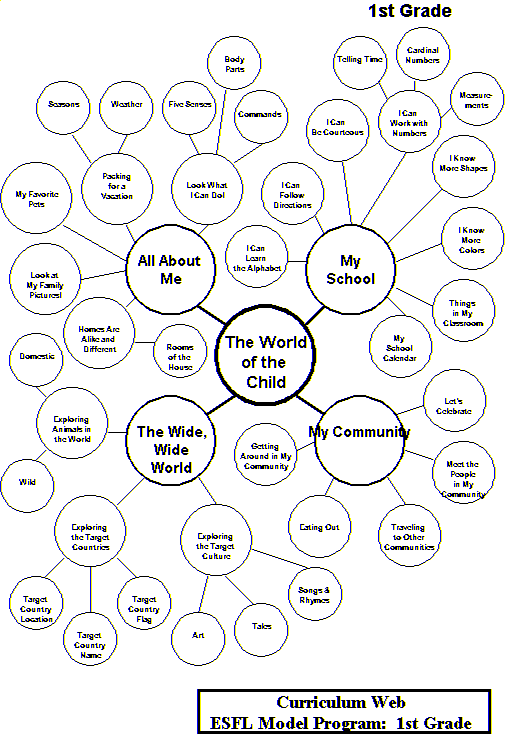
Introduction Topic : 1st Grade FL
Objectives for Students Completing Grade 1
in the
Georgia Elementary School Foreign Languages Model
Program
These objectives make the following assumptions:
· Student performances are supported by appropriate
scaffolding and guidance on the part of the teacher.
· Students have been in the program at least from
kindergarten through first grade.
· Accommodations must be made for special needs
students and for students who have been in the program less than one year.
· Some objectives may appear later for Japanese
students.
Note: Numbers in parentheses are references to the Standards for Foreign Language Learning: Preparing for the 21st Century.
By the end of Grade 1, students will be able
to:
1.1 Begin to read for enjoyment using the second language.
(1.2, 4.2)
1.2 Read linguistically and developmentally appropriate
materials. (1.2)
1.3 Demonstrate an understanding of the written language.
(1.2, 3.2)
1.4 Write to complete linguistically appropriate tasks.
(1.3)
1.5 Give personal information based on templates or models
in the target language. (1.3)
1.6 Begin to demonstrate comprehension of some extended
written and oral discourse. (1.2)
1.7 Begin to retell or paraphrase main elements of a
story or passage. (1.2, 1.3)
1.8 Use the target language for a variety of spoken activities,
such as skits, dialogues, plays, poems, for a variety of audiences. (1.3)
1.9 Share information of their choice with audiences
outside the classroom. (1.3, 4.1)
1.10 Ask for information and make requests of teachers
and other language speakers. (1.1)
1.11 Provide information and respond to requests from
teachers and other language speakers. (1.1)
1.12 Communicate orally using sentences, when appropriate.
(1.1)
1.13 Follow complex oral instructions and give simple
commands. (1.1)
1.14 Demonstrate an understanding of a variety of speech
sources (teacher, peers, native speakers, other target language speakers,
tapes, CD-ROMs, and videos). (1.2, 5.2)
1.15 Recognize the target language when spoken in a variety
of dialects and respond with efforts to communicate. (1.2, 4.1)
1.16 Identify examples or influences of the target language
and cultures in their own community. (4.1, 4.2)
1.17 Identify, compare, and contrast diverse cultural
practices and products, including language, emphasizing similarities as
well as differences. (4.1, 4.2)
1.18 Identify selected works of art, music and literature
of the target cultures. (3.1, 3.2)
1.19 Use culturally appropriate language and behavior
in both formal and informal target language situations (greeting, leave-taking,
eating customs, travel, school, etc.). (1.1, 2.1)
1.20 Use the target language in appropriate content-related
areas including, but not limited to, mathematics, social studies, science,
literature, and fine arts. (3.1)
1.21 Use a limited number of words and phrases on a variety
of familiar topics. (1.1)
1.22 Participate actively in classroom experiences with
music, sports, games, songs, dance, or musical instruments from the target
cultures, and extend these experiences into their personal lives. (2.1,
5.2)
1.23 Use the target language to obtain information to
satisfy personal needs and interests. (5.2)
1.24 Attempt to create with the language at the sentence
level. (1.1, 1.3)
1.25 Draw from a basic vocabulary that permits exchanges
of a personal nature and on simple topics. (1.1, 1.3)
1.26 Demonstrate understanding of natural classroom speech
at a normal rate of speed, with nonverbal support. (1.1, 1.2)
1.27 Begin to recognize linguistic patterns that occur
in the foreign language. (4.1)
Foreign Language Assessment Recommendations
The following are only suggested assessment strategies.
Teachers are encouraged to develop additional strategies.
First Grade
FL.1.1
Match picture or item to word
Make and illustrate books
Help read a book to the class
FL.1.2
Sequence pictures and words
Match pictures with words
FL.1.3
Pick correct words that answer questions
Pick correct words that describe picture
Find item after reading word
Place labels on objects
Find incorrect labels
FL.1.4
Complete a simple cloze text
Use word bank to describe pictures
FL.1.5
Guided conversation
Patterned responses to questions
FL.1.6
Correctly respond to questions related to written/oral
discourse
Predict what might come next
FL.1.7
Act out or retell story using pictures, hand motions
or props
FL.1.8
Put on a short skit for the PTA
Memorize a short poem/line
FL.1.9
Share with their parents what they have learned
Use of the language during playtime, recess or outside
time
FL.1.10
Ask questions of pen pals or key pals
Conversation with native speakers or other teachers
FL.1.11
Answer questions posed by native speakers or other language
teachers
Respond to commands posed by native speakers or other
language teachers
FL.1.12
Ask simple sentences (to use bathroom, etc.)
Play phone game using sentences
Respond to teacher questions in complete sentences
FL.1.13
Follow teacher's directions for classwork.
Play "Simon Says".
Give commands to one other.
FL.1.14
Use interactive computer software
Select correct picture as described on an audio tape
FL.1.15
Converse with other target language teachers
Listen to songs from the target countries
FL.1.16
Visit trip to marketplace where target language is spoken
Find foods from target country at marketplace
FL.1.17
Discuss daily routines of target language culture and
compare to own
Discuss and practice cultural greetings, handshake, wave,
bow, etc.
Try different foods from target culture
FL.1.18
Visit bookstores containing target language and culture
literature
Visit museum with target language art
Native speakers visit classroom with cultural works
FL.1.19
Perform skits, games and imaginary trips in target language
FL.1.20
Play dice game by rolling dice and counting
Draw plants and label in target language
Role play of community helpers
FL.1.21
Play games using variety of vocabulary
FL.1.22
Sing and dance to target language music
Play target language instruments
Play culturally appropriate games and sports
FL.1.23
Play the "who are you" game, guessing the description
of the student
Use target language to meet special needs (need to use
bathroom)
Use a target language picture dictionary to find the
names of 5 plants
FL.1.24
Create sentences from pictures, using word banks
FL.1.25
Discuss likes and dislikes
Use pictures to describe family
Describe teacher or other students
FL.1.26
Respond to TPR commands
Follow teacher's directions
FL.1.27
Use repetitive phrases in classroom
Oral cloze activities, skits, dialogues
ALL ABOUT ME
FIRST GRADE
LANGUAGE STRUCTURES USED BY STUDENTS
| How are you?
My name is _____ . _____'s name is _____ . There is/are... _____ has _____ . _____ is _____ . ___ and ___ ___ or ___ for with |
in/on
I am... I have... I like/don't like. This/That/It is... yes/no I/me my/mine you the/a/an |
PROGRESS INDICATORS
1. Students will identify and name family members and
describe their physical qualities.
2. Students will appropriately use certain expressions
of emotion.
3. Students will inquire about someone's feelings.
4. Students will identify and name the rooms of the house.
5. Students will describe similarities and differences
of homes.
6. Students will identify and name different pets.
7. Students will describe similarities and differences
of various pets.
8. Students will identify and name types of clothing.
9. Students will describe different types of clothing.
10. Students will categorize clothing by color, size,
weather, and gender.
11. Students will express likes and dislikes.
12. Students will describe weather conditions.
13. Students will categorize weather conditions by seasons.
14. Students will describe and distinguish the seasons.
15. Students will demonstrate comprehension by physically
responding to commands.
16. Students will identify and name the parts of the
body.
17. Students will describe physical characteristics of
a person.
18. Students will identify and name the senses.
19. Students will distinguish the differences between
the senses.
THEMATIC VOCABULARY USED IN TEACHING SECOND LANGUAGE
*asterisks denote vocabulary new to first grade
| FAMILY
Productive *family mother father brother sister boy girl |
Receptive
baby *grandmother *grandfather *He/She is tall. *He/She is short. *He/She is medium height. *This is my... |
| EMOTIONS
Productive *emotions I am happy/content I am angry. I am frightened. I am tired. |
Receptive
I am sad. I am surprised. *How are you? *He/she is... |
| HOUSE
Productive House *room living room kitchen bedroom bathroom *same |
Receptive
*different *dining room *Where is... *in *big *small *medium |
| PETS
Productive *pets dog cat bird rabbit fish |
Receptive
*turtle *snake *What is your favorite pet? *My favorite pet is... *My ______'s name is... |
| CLOTHING
Productive *clothing shirt pants skirt dress shoes socks hat/cap |
Receptive
*sweater *coat *boots *shorts *scarf *jacket *What are you wearing? * I am wearing....____ |
| PREFERENCES
Productive *Do you like? I like... |
Receptive
I do not like... |
| WEATHER
Productive It is sunny. It is windy. It is raining. *It is cloudy. It is hot. It is cold. *It is snowing. *It is good weather *It is not cold. *It is not snowing. |
Receptive
*It is bad weather. *thunder *What is the weather like? *It is not sunny. *It is not windy. *It is not raining. *It is not cloudy. *It is not hot. *Lightning *storm |
| SEASONS
Productive *seasons *winter *spring *summer |
Receptive
*fall *What season are we in? *We are in_____. |
| COMMANDS
Productive Sit down! Stand up Raise your hand Listen Repeat Come here Look Be quiet/Silence Close Open Pay attention Wait Turn Touch |
Receptive
Hop Pull Push Clap Run Swim Fly Show Fold/Bend Place Take Throw/Toss Go ahead |
| BODY PARTS
Productive *body head hand foot arm leg stomach mouth nose eyes |
Receptive
Ears Hair *Shoulders *Knees *Tooth *Fingers elbow *Elbow *Face *Neck |
| SENSES
Productive *five senses I see. I hear. I smell. I taste. I touch. See!/Look! Hear!/Listen! |
Receptive
Taste! Touch.! *touch *sight *taste *smell *hearing *with |
MY SCHOOL
FIRST GRADE
LANGUAGE STRUCTURES USED BY STUDENTS
| How are you?
What is your name? My name is _____ . What (day,month,season) is today? What time is it? The time is/It is... There is/are... (noun) is _____ . (noun) has _____ . ___ and ___ ___ or ___ |
For
With in/on I am... I have... This/That/It is... yes/no I/me my/mine you the/a/an |
PROGRESS INDICATORS
20. Students will use and respond to courtesy expressions
in proper context.
21. Students will demonstrate comprehension by physically
responding to commands.
22. Students will employ selected classroom commands.
23. Students will demonstrate comprehension by responding
physically to directional terms.
24. Students will name and identify classroom objects.
25. Students will name and identify days of the week
and months of the year.
26. Students will respond to selected questions related
to the calendar.
27. Students will identify and name numbers 0 to 100.
28. Students will count by 10's from 0 to 100.
29. Students will add and subtract using single digits
in theme-related activities.
30. Students will recognize and use ordinal numbers first
through fifth to sequence objects in context.
31. Students will tell time to the hour.
32. Students will measure objects using non-standard
units.
33. Students will recognize and name the letters of the
alphabet.
34. Students will recognize, describe, and classify objects
by shape, color, and size.
THEMATIC VOCABULARY USED IN TEACHING (ENGLISH)
*asterisks denote vocabulary new to first grade
| COURTESY EXPRESSION
How are you? Fine, thank you. Badly So-so Hello/Good day Hi Good evening Goodbye. Thank you You're welcome |
Please
See you tomorrow What is your name? My name is... Mr. Mrs. Miss Excuse me Sorry |
| CLASSROOM EXPRESSIONS
Yes No I like... I don't like... Good/Very good. Good job/Good work! English Spanish |
What is...?
Bathroom Don't worry. It's worry. It's all right. |
| CLASSROOM COMMANDS
Sit down Stand up Raise your hand Listen Repeat Come here Look Be quiet/Silence Color Glue |
Close
Open Pay attention Wait Fold/bend Place Take Cut Write Read |
| DIRECTIONAL TERMS
Productive *Left *Right *Inside *Outside *On *Under up |
Receptive
Down *In front of *Behind *Next to *Where is______? *It is________? |
| CLASSROOM OBJECTS
Pencil Paper Crayons Glue Scissors *book *chalkboard |
*Chalk
*Flag *Table *Door *Window *Chair |
| DAY OF THE WEEK
Monday Tuesday Wednesday Thursday |
Friday
Saturday Sunday |
| MONTHS OF THE YEAR
January February March April May June |
July
August September October November December |
| CALENDAR
*Calendar *day *month *What is the date? *What day is tomorrow? *Tomorrow will be _____. |
*What day is today?
*Today is _____? *What day was yesterday? *Yesterday was ______. Birthday How old are you? |
| NUMBERS
0-100 (*32-100) *Plus *Minus *Equals |
*More
*Less *How many? *Count |
| ORDINAL NUMBERS
*First *Second *Third |
*Fourth
*Fifth |
MY COMMUNITY
FIRST GRADE
LANGUAGE STRUCTURES USED BY STUDENTS
| What do you like (to eat)?
What is...? There is/are... (noun) has _____ . ___ and ___ ___ or ___ for with by/in/on |
I have...
I like/don't like... This/That/It is... yes/no I/me you the/a/an Selected informal commands |
PROGRESS INDICATORS
35. Students will experience traditions related to American
and target culture holidays.
36. Students will recognize the names of target culture
holidays.
37. Students will name community helpers and recognize
their responsibilities.
38. Students will recognize and name modes of transportation.
39. Students will classify modes of transportation by
land, air, or water travel.
40. Students will identify and name foods and beverages.
41. Students will classify foods and beverages.
42. Students will express likes and dislikes.
THEMATIC VOCABULARY USED IN TEACHING (ENGLISH)
*asterisks denote vocabulary new to first grade
| HOLIDAYS
*holidays New Year's Day St. Patrick's Day Mother's Day |
Father's Day
Valentine's Day Christmas |
| COMMUNITY HELPERS
policeman fireman doctor nurse teacher mailman dentist |
*police car
*fire truck *ambulance *mail truck *Who is he/she? *He/She is ______. |
| TRANSPORTATION
car boat airplane bus *train *bicycle *truck *motorcycle |
*helicopter
*air *land *water *What goes by land/air/water? *How do you go to ______. *by |
| FOODS
fruits apple orange grapes banana pear *strawberries *pineapple *lemon *watermelon vegetables milk water juice coffee bread ice cream |
Tomato
Lettuce Potato Carrot Corn *onion *green beans *chicken *fish *meat *beverages/drinks *candy *cookie *cake *What do you like to eat? *I like ______. |
WIDE, WIDE WORLD
FIRST GRADE
LANGUAGE STRUCTURES USED BY STUDENTS
| There is/are...
(noun) has _____ . ___ and ___ ___ or ___ for with by/in/on |
I have...
This/That/It is... yes/no I/me you the/a/an |
PROGRESS INDICATORS
43. Students will identify and name zoo and farm animals.
44. Students will recognize and describe similarities
and differences of animals.
45. Students will match young animals with their parents.
46. Students will recognize the names, locations, and
flags of selected target countries.
47. Students will recognize and discuss selected cultural
traditions.
48. Students will recognize selected works of art from
the target culture.
49. Students will sing selected songs and recite selected
rhymes from the target culture.
50. Students will listen to selected short narrative
fairy and folk tales from the target language.
THEMATIC VOCABULARY USED IN TEACHING (ENGLISH)
*asterisks denote vocabulary new to first grade
| ANIMALS
*animals *farm dog cat rabbit fish bird turtle snake pig cow rooster chicken sheep |
horse
duck *turkey *zoo elephant tiger lion bear giraffe monkey *gorilla *zebra *hippopotamus *What do ______ say? |
TARGET COUNTRIES
Selected Samples:
(language specific)
WORKS OF ART
Selected Samples:
(language specific)
SONGS/RHYMES
Selected Samples:
(language specific)
FAIRY AND FOLK TALES
Selected Samples
(language specific)