"due South" Episode #110,
"The Gift Of The Wheelman"
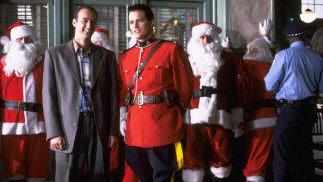
Faithful readers, please take note. This OneTrueView
(TM)
contains MAJOR plot spoilers. If you haven't seen this episode
within the last month, go back and watch it before you read this.
Thank you.
contains MAJOR plot spoilers. If you haven't seen this episode
within the last month, go back and watch it before you read this.
Thank you.
What an amazing episode.
Apart from the memorable features of this episode -- the first ghost appearance of Fraser Sr., and some of the most exacting comedy in the series (which is why I LOVE the Haggis-written eps), plus the always wonderful layers of injokes and artifice that make the series so endearing to me -- apart from all that, there's something else that sticks with me.
I haven't noticed this the other times I've watched this ep, but it seems clear as day this time. The show is an allegory for the Christmas story. A Father plans to sacrifice himself to save his child, just like (as Christianity teaches us -- and also appears in the story of Odin, and countless other religions and myth systems) God the Father sacrificed Himself (in the form of Christ) to save our souls. But what's interesting here is the atheist turn of the allegory*. If you'll indulge me, I'm going to dig around through it for a bit.
The son in this episode (at the age of six, as kids tend to do) believed that his father went away (to prison) because of his own wrongdoing. In the Old Testament, men wrote the story of how they distanced themselves from God through their own sin -- that if only Eve hadn't succumbed to that fleshly temptation (represented in this episode by toys and bikes), God would still dwell close to man, and vice versa.
But the Father returned. He had a PLAN. He would sacrifice Himself in order to leave a legacy for his child. The child didn't want to hear about it. Like the biblical Pharisees, the child was so afraid to actually call on the Father for help that the Father had nothing to offer. Or, actually, the Father believed he had nothing to offer that the child would want.
All the Apostles wanted from Christ was to be in his presence. (Well, okay -- one or two continually ask for miracles, but they're just fools.) They wanted to feel His love and His power, to listen to His teachings. They gave freely of themselves to Christ (as the son does in this episode), just out of gratitude for His company.
The Apostles were, biblically speaking, short-sighted. Those who wanted Christ to escape His only true destiny couldn't see the big PLAN. But here, in this silly cop show, we see through the eyes of the Apostles. We see that, hey, Jesus can do what he wants. He's in charge! Just as William Sydney Porter holds complete power over all his pursuers at the climax of this episode, Jesus held all the cards.+ Jesus was GOD! He made the rules! God could have chosen to live FOREVER on earth, in human form. To walk beside us, to listen to our complaints, to touch us. To heal us, to wash our feet, to reprimand us when we went astray.
But that's not as dramatic a story. It's hard to found a religion on the story of one man just doing everything he can for others, every minute of every day. Think about it -- Mother Theresa has STILL not be canonized by the Catholic Church, but there are dozens of recognized saints who did less good but died of flaming arrows or being stoned.
A father who doesn't fight to stay with his child is no father, this episode says. Even when he can only provide bad examples, like Ray's father (also here in ghost form), he still stays. Because that's what fathers do.
If I'm reading the subtext of this episode correctly, Fraser's father provides the perfect example of this. Fraser Sr. dies. After a short period (granted, more than three days), he returns to teach his child more than was possible in life.
Many Christians would say that the point of Christ's life was not His life, or even His death. They say Christ is important because of His resurrection: that after He rose from the dead, he taught more in that short period than the 33 years before that. Fraser Sr. certainly is a better father, and better teacher, after his death than he was before. (Now, never mind if he's all a figment of Fraser's imagination. This comes down to a topic of personal choice, with lots of "evidence" on either side of the argument. Kind of like belief in the Resurrection of Christ.)
But here's where Fraser Sr. differs from Christ. He doesn't say, okay, I taught you to be a man, see you on the other side. He STAYS with Fraser, counsels and guides him (and annoys him too, obviously, which is the other main difference between Fraser Sr. and Christ -- Jesus couldn't be maddeningly, insanely, loudly WRONG on most issues. The fact that Fraser Sr. can is what makes him human.**)
Now there's other evidence of all this in the episode (the writer-as-God metaphor is quite the cliché ++). But you can watch the episode and decide for yourself. I know this will be too much for some of you to swallow -- after all, it's got car chases and reindeer and {COMEDY SPOILER} Elvis impersonators. It's just a buddy cop show with a weird sense of humor.
But, at times, it can be so much more. And that's why I love it.
~~~~~~~~~~~~~~~~~~~~~~~~~~~~~~~~~~~~~~~~~~~~~~~~~~~~
* I'd like, just for the
fun of it, to tell you about the first Christmas allegory I figured out,
all by myself. It's Stan Freberg's record "Yulenet
(Christmas Dragnet)." It exists largely because Freberg's "Saint George and the Dragonet"
was such a big hit, but Freberg (a minister's son) added such a rich layer
of allegory that it exists on its own terms -- one need not even know "Dragnet" to enjoy the record. Two police
detectives investigate a man who doesn't believe in Santa Claus. They take
him to the North Pole, but he spouts science and refuses to believe what
his eyes see. He writes off the big workshop and the reindeer. Finally, he
notices a large pile of presents. They belong to the one man who simply won't
claim them, the man who doesn't believe in Santa Claus. The nonbeliever asks
if there's any way he can, you know... He's told, sure, he can claim his
reward, just as soon as he believes. And, this is sad but true, this is one
of two times since my loss of faith that I've wished I could believe again.
(The other: a moment in Kevin Smith's Dogma,
honestly.)
+ The child says, no! Don't
go. You don't have to leave to save me. Staying can save me. Staying will
save me. And for the purposes of this episode, the child is right.
The Father says, no, of course I could stay, but I won't. It isn't the PLAN...
Matthew 26:53-54: "Do you think I cannot call on my Father, and he will at once put at
my disposal more than twelve legions of angels? But how then would the Scriptures be
fulfilled that say it must happen in this way?"
The Father intends to follow the PLAN. No matter the logic presented to one by Fraser and his son, no matter the pleas of the Other's Apostles, the Father is determined.
But one father listens. One father evolves his plan, and lets go of the reins. One father has the serenity to accept the things he cannot change (at least for the better). And for the purposes of this episode, that father is right.
** Of course, it's probably not really fair to even mention most of this. I assume that Paul Haggis didn't comb through every subsequent script, trying to extend the allegory throughout the series. I haven't watched any of those later eps yet with this in mind, but off the top of my head I can't think of another single case wherein Fraser Sr. shares any characteristics with Jesus.
The Father says, no, of course I could stay, but I won't. It isn't the PLAN...
Matthew 26:53-54: "Do you think I cannot call on my Father, and he will at once put at
my disposal more than twelve legions of angels? But how then would the Scriptures be
fulfilled that say it must happen in this way?"
The Father intends to follow the PLAN. No matter the logic presented to one by Fraser and his son, no matter the pleas of the Other's Apostles, the Father is determined.
But one father listens. One father evolves his plan, and lets go of the reins. One father has the serenity to accept the things he cannot change (at least for the better). And for the purposes of this episode, that father is right.
** Of course, it's probably not really fair to even mention most of this. I assume that Paul Haggis didn't comb through every subsequent script, trying to extend the allegory throughout the series. I haven't watched any of those later eps yet with this in mind, but off the top of my head I can't think of another single case wherein Fraser Sr. shares any characteristics with Jesus.
++ The first instance that comes
to mind -- thank you, Paul
Rudnick! -- is the poster for
the Broadway My Fair Lady -- George Bernard Shaw, bearded, in the
clouds, pulling the strings on Rex Harrison and Julie Andrews. But then that
kind of goes back to the original Pygmalion myth, and let's face it, we're
WAAAAAY off topic here.