 |
|
|
|
|
|
|
|
|
|
|
|
|
|
|
|
|
|
|
|
|
|
|
|
|
|
|
|
|
|
|
|
|
|
|
|
|
|
|
|
|
|
|
|
| LAMARCK |
|
|
|
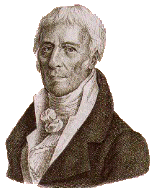
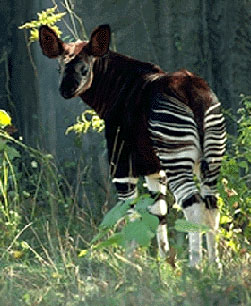
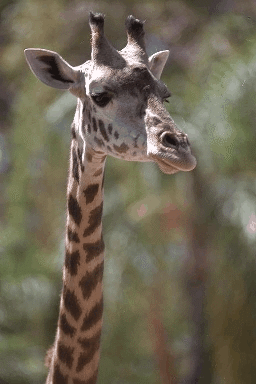
As you have probably figured, Jean Baptiste Pierre Antoine de Monet, Chavalier de Lamarck is a a key figure in Chi Square. Though we have only encountered him as a vision, we have decided to honor the memory of this man, oft mocked in introductory biology courses, by posthumously naming him a member of Chi Square Alpha Chapter. An 18th century Frenchman, Lamarck proposed a form of evolutionary theory years before Darwin, yet he and his hypotheses are the subject of constant ridicule. "Why is this?", you may ask. Well, Lamarck believed in the inheritance of acquired traits was the key mechanism in the evolution of life. Perhaps the most famous (and hackneyed) example is that of the ancestral giraffe, who streched its neck to reach leaves, thus increasing its length. This longer neck was supposedly passed on to the next generation for the process to repeat itself again. However, any modern student with even the most cursory knowledge of genetics will scoff at such a proposal, as the inheritance of such acquired traits is wholly incompatible with modern biology. However, we choose not to remember this error in Lamarck's ways. Instead, we have decided to honor the man for his conjectures on the very concept of evolution, which were, in and of themselves, revolutionary. His mechanism may have been incorrect, but we should praise Lamarck for favoring the view that life has not been static through time. Why must we remember Lamarck for what he got wrong? Why not for what he got right? LAMARCK WAS RIGHT. |
|
 |
|
|
|
|
|
 |
|
|
|
|
 |
|
|
|
|
|
The Okapi (left), although extant, can serve as a hypothetical ancestral giraffe. According to Lamarck, after generations of Okapi stretching their necks, they would effectively evolve into giraffes, with greatly lengthened necks (right). Why must we remember the incorrect mechanism rather than the spirit of Lamarck's evolutionary theory? |
|
|
|
|
| PTOLEMY |
|
|
|
 |
|
|
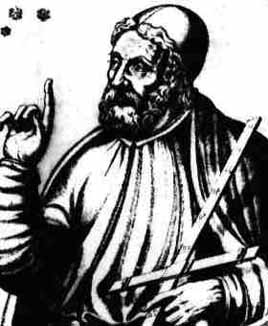
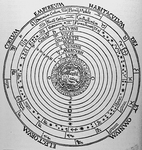
No, not the Macedonian kings of ancient Egypt. This is Claudius Ptolemaeus, the great classical astronomer/astrologer. He is perhaps best known for his stationary model of the Earth. Ptolemy proposed that the Earth was the center of the Universe, about which all other celestial bodies revolved. Ptolemy proposed that each of the planets orbited about the Earth in aetherial crystal spheres. Wacky, eh? This Earth-centered view of the cosmos dominated Western thought for centuries, until a Polish astronomer proposed his heliocentric model (well, sort of . . . Aristarchus of Samos, another Greek, proposed that the Earth is one of the planets and orbits about the Sun; Copernicus heard of Aristarchus' views but decided against mentioning him in his final draft). At any rate, Ptolemy was wrong, but we applaud him for . . . well . . . we don't know. Merely being a scientist who was proven wrong is cause enough for his honorary induction into Chi Square. |
|
|
|
|
|
|
 |
|
|
|
|
|
The man himself, Ptolemy (top), along with a diagram of his conception of the Universe (bottom). |
|
|
|
|
| CUVIER |
|
|
|
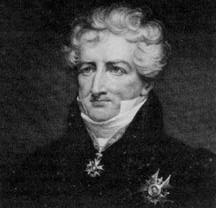
Ahh yes. One of Matt F.'s heroes no doubt. Baron Georges Leopold Chretein Dagobert Cuvier, the father of modern comparative anatomy and paleontology was a revolutionary 18th century scientist. Apart from his crucial role in the development of two sciences, Cuvier also made great contributions to the understandings of the history of life. He established that species could and have gone extinct, a concept that was foreign to many contemporary naturalists. Of course, since the Baron is an honorary member of Chi Square, he must have forumlated some egregious theories. Very much a philosophical child of the violent French Revoultion, Cuvier the catasrophist proposed that the sequences of faunal successions seen in the sedimentary record represented separate creation events by a divine creator, each ending with a violent extinction event. Ha! Like the extinction part, but a separate creation each time? Come on Georges! Oh well, he still was a great guy, even though he was dead wrong on these separate creations. |
|
|
|
 |
|
|
|
|
|
Good old Georges. He was wrong on a few things, but the revolutionary things that he got right makes him one of Matt F.'s idols. |
|
|
|
|
|
PALEY |
|
|
|
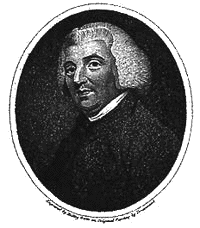
Wrong, wrong, and wrong. Perhaps the most pithy summary of William Paley's seminal work, Natural Theology, ever written. In this book, the 18th century theologian suggested that the intricacies of the biological world could only be explained by the existence of a divine creator. The most famous argument used by Paley, still used as ammunition against evolution by modern-day creationists, is that of God the watchmaker. If one were to find a pocket watch in a field, one would assume that there was an intellegence behind the complex design -- a watchmaker if you will. The simplest microbe is by far a more elegant and wonderful machine than the most finely crafted watch. Clearly there must be a watchmaker, or so Paley thought. However, modern science has provided us with a far more captivating way of explaining the complexities of biology, namely the fact of evolution by the means of natural selection. To borrow from the British evolutionary biologist Richard Dawkins, natural selection is the watchmaker, albeit a blind one. |
|
|
|
 |
|
|
|
|
|
William Paley, who constucted one of the most elegant and concise arguments for the Divine Creation of the species we see today. Modern science has rendered his views moot. |
|
|
|
|
|
THE AETHER |
|
|
|
Well, quite obviously, the aether is not a person. However, this disproven concept sounds sufficiently "neat" to be permanently enshrined as an honorary member of Chi Square. As many appreciate, waves that we are used to dealing with (water waves, sound waves, etc.) need a medium through which they propigate. During the early 19th century, scientists grappled with the problem of the transmission of light through a vacuum. Light still propigated despite the apparent lack of a meduim that would allow for such behavior. To explain this apparent paradox, it was proposed that light traveled through a "luminiferous aether." However, several attempts to measure or observe the proposed properties of the aether failed. However, as we now know (thanks to Maxwell's work!), light is a actually a series of self propogating magnetic and electric fields normal to one another. Even though all members of Chi Square are aware of the tremendous amounts of information which suggests that the aether was a construct of 19th century physics, we all know that THE AETHER IS REAL! |
|
|
| PILTDOWN MAN |
|
|
|
 |
|
|
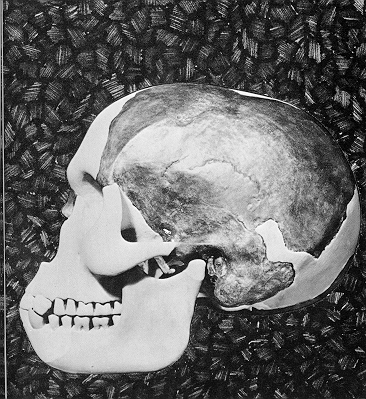
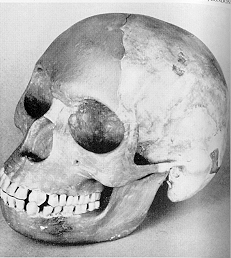
The Piltdown Man is one of the most notable hoaxes ever perpetrated in the history of science. The story of this supposed fossil hominid began in 1912, when Charles Dawson discovered skull material in the Pitldown (go figure) Quarry, in England. The skull was surprsingly human with a large cranium, but also had apelike features (most notably in jaw architecture and dentition). This was in accordance with the then favored theory that the missing link evovled greater cranial capacity first, and was subsequently followed by other more human traits in anatomy (such as in dentition and gait). Furthermore, the discovery of such a "missing link" in Europe was quickly accepted in athropological circles, which at the time was a field of study plagued by rampant ethnocentrism and scientific racism. However, as the 20th century progressed, discoveries made in Africa (such as the Taung child, a juvinile austalopithicine discovered by Raymond Dart in South Africa) sketched out a different family tree for humanity -- one originating in Africa and one on which the Piltdown Man did not apparently fit. In 1943, chemical tests (the fluorine content test) indicated an age for the Piltdown fossils far younger than proposed. In the 1950's, more chemical tests clearly demonstrated that the Piltdown fossils were far to young to be genuine remains of a human ancestor. The fragments of skull were shown to be human, with the jaws being from an orang-utan. The bones were stained with tea (these are the British we are talking about here) to give the appearance of age, and the canines of the orang-utan jaw were filed down (as shown by microscopic wear patterns on the enamel). It is still a matter of contention who perpetrated this scam, but there is no question that it was one of the "greatest" hoaxes in the history of science. |
|
|
|
|
|
|
 |
|
|
|
|
|
|
|
|
|
To Return Home, Click on Lamarck |
|