 AP CALCULUS

AP CALCULUS
Background of the project: The rules and procedures keep on changing from year to year. They have evolved from the first projects in 1998 when all the students had to do was to build a working catapult, to the current project where students have to launch a baseball projectile, hit a small target and have various safety features added to their catapult. The rules that follow are for the 2002 project.
Purpose: To build a catapult type (or member of the catapult family) device
that will launch a projectile (baseball) to a target at least 25 meters away.
(i.e. from second base to home plate).
Timeline: We
will discuss the timeline as the event gets closer. We traditionally spend our last week with the seniors launching
things. (Yes, it is after the final exam.)
SO… What do
the experts say???
Experts say that the hardest part of the project is the essay. The essay must describe each of the
following points in detail:
1) Why you built the catapult the way you did. (Make sure that you list all
modifications that you did to your original design and why you made those
changes.)
2) Where you did your research. (List Internet sites and any books in the
bibliography section of your essay.
Remember to cite your references correctly.)
3) Were there prototypes and why did you made changes.
4) A discussion as to the CALCULUS of catapults. (Must include how you know
where the projectile will land, and equation(s) of flight path).
5) A scale drawing showing the catapult and how it works.
6) The essay must be in a folder with the catapult's name and team member names
on the front cover.
Basic Rules:
1.
The catapult must be movable by the team members. (There is a
maximum of three students per team).
This includes all pieces including projectile(s) and weights (if any).
2.
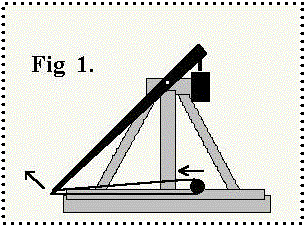 You
are trying to create a catapult that is as realistic as possible. But it is understood that modern materials
will have to be used. The project will
score better if it does not use an energy source other than weight (mass). Energy sources, (such as elastic strings,
rubber bands, springs, and "bungee cords") may be used, but the
project will loose (a couple of) points for lack of realism.
You
are trying to create a catapult that is as realistic as possible. But it is understood that modern materials
will have to be used. The project will
score better if it does not use an energy source other than weight (mass). Energy sources, (such as elastic strings,
rubber bands, springs, and "bungee cords") may be used, but the
project will loose (a couple of) points for lack of realism.
3.
The target will consist of three sections and be located at
home plate of the softball field. The
"A" section will be a circle with a diameter of 0.50 meters, the
"B" section, 1.50 meters, the "C" section, 3.00 meters.
4.
Each catapult will be allowed 10 official shots (5 shots in
each of 2 shooting periods) and teams will be assigned a random number to
determine the initial shooting order.
The most accurate shot will be recorded as the "official"
shot.
5.
Students in the class must do the majority of the work on this
project. Outside help is acceptable (and expected).
6.
Each catapult must be ready for competition when called. If you are not ready/ prepared to launch,
you will forfeit your turn (5 shots), and be assigned 0 points for that
attempt.
7. Catapults may be repaired and/or modified between shooting periods. Shooting periods will be non-consecutive. The catapult may be moved during the shooting period, as long as it does not move within the 25-meter minimum distance.
8.
The catapult must be able to lock in the ready to fire
position. The catapult must be
completely stable with a launching pin on a string restricting the launch. At
this time, the launch master (team member responsible for the safety of the
other students in the class) shall indicate to the judge (Mr. H) that the
catapult is in the ready position. Only
after the judge gives all clear may the student pull the string that removes
the pin that allows the catapult to fire. Catapults that do not have a
locking mechanism will not be allowed to fire and will be disqualified.
9.
Should no team hit the "A" section during the first
2 shooting periods, additional shooting periods will be scheduled (as time
allows).
Scoring:
 Catapults will be scored in
the following manner.
Catapults will be scored in
the following manner.
1. 20 points will be awarded for having a
catapult ready when it is called for its first shot.
2. 20 points will be awarded for a shooting a
projectile at least 15 meters. (Irregardless of accuracy) (Distance is measured
from the point of the launching arm that is closest to the target at the time
of projectile release)
3. 10 points will be based on the catapult's
realistic/mechanical design.
4. 30 points will be based on the discussion
(essay) on how the catapult came about.
The essay must describe:
1) Why you built the catapult the way you did. (Modifications and such)
2) Where you did your research. (List Internet sites and any books and such)
3) Were there prototypes and why did you made changes.
4) A discussion as to the CALCULUS of catapults. (Must include how you know
where the projectile will land, and equation(s) of flight path).
5) A scale drawing showing the catapult and how it works.
6) The essay must be in a folder with the catapult's name and team member names
on the front cover.
5. 20 points will be based on the accuracy of
the catapult. ("A" section 20 pts., "B" section 15 pts.,
"C" section 10 pts. Miss the
target completely - 00 pts.)
Bonus Point opportunities |
||
|
Title |
Task |
#
Bonus points |
|
Farthest
projectile distance: |
Points
will be awarded for the catapult(s) that shoot a projectile the greatest
distance. |
3
points. Note: every team that launches at least 40 meters will be awarded
points. |
|
Realism: |
Most
realistic catapult |
3
bonus points |
|
Creativity: |
Unique
design/ingenious use of materials. |
3
bonus points (maximum) |
|
Veggie
launcher: |
After
all official shootings have been completed, extra points will be offered to
students who can accurately launch (i.e. Hit the target anywhere (A, B, or
C)) with fresh fruit or vegetables. |
9
points maximum, up to 3 points for each different type of fruit or vegetable. |
Questions:
Contact ACME Tool and Die, catapult division…
The catapult division can be reached by e-mail at the
following address…
Good luck… Matt
Hungerford