Neill's Geology:
Paleontologists
b
Home / Glaciologists / Marine Geologists / Gemmologists / Seismologists / Vulcanologists
Paleontologists are really cool!
They study fossils:
Fossils are animals that died a long time ago.When animals die, they get buried by sedimentary rocks, which are little bits of sand and dirt that build up until they get compressed and solidify into rock.
The animal remains get trapped under the sediments and s-l-o-w-l-y, their skin and muscles break down into dust.
All that is left after that is the skeleton of the animal, and that is its fossil.
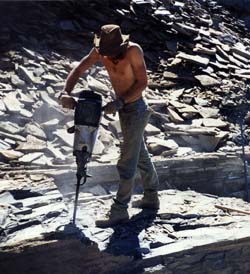
Hey! What's this scientist DOING?
This is Kevin.
He's a super-cool paleontologist, and he's doing what paleontologists do a lot: digging. Actually, he's using the 'Cobra' gas-powered jackhammer to smash up rocks!
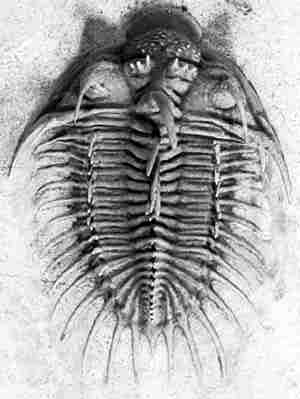
Kevin studies trilobites, a type of fossil found in the Mid-Cambrian rocks here.
Some triolobites are 500 MILLION years old!
That's a HUGE amount of time, I mean, just a whole lot!!
There are tons of different types of fossils. Dinosaurs, trilobites, plants; even humans! And it all starts with blue-green algae. What, you ask, is that...?
Well, I'll tell you.
break
But blue-green algae is DIFFERENT! It's UNIQUE! It's BACTERIA!
See, most living things have cells, and each cell has a nucleus.
Except... blue-green algae!!!
This algae has cells, but it doesn't have a nucleus, so it's called a prokaryote.
That's a huge word!
But from that prokaryote, all life on earth formed. You, me, dinosaurs, clams, sea squirts, everything.
It all comes from blue-green algae!
All life on the whole planet is organized into 6 Kingdoms:
break break
1.Kingdom Archaebacteria
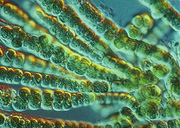 This Kingdom includes all ancient bacteria.
That's easy to remember, because archae = ancient! The bacteria in this Kingdom are prokaryotes (there's that word again!) and mostly live in extreme temperatures and conditions. In fact, most scientists believe that archaebacteria formed on the edge of a volcano to protect
tiny, teeny, terribly small, ALMOST INVISIBLE pieces of genetic material.
Most of these bacteria are abiotic, which means they couldn't survive in oxygen. That makes scientists think that the earliest air on the planet was made up of methane and ammonia, two things humans can't breathe!
break
2.Kingdom Eubacteria
 The Eubacteria kingdom includes all advanced bacteria.
 Eubacteria is mostly biotic, which means that, unlike archaebacteria, bacteria in this group CAN breathe oxygen.
This includes bacteria that makes you sick, like cold viruses.
It also includes good bacteria that inhabits your stomach and helps you digest your food.
Bet you thought your stomach did that all by itself, didn't you?
But it doesn't! It needs bacteria! And not that ancient, archaebacteria stuff, either, I'm talking
new, improved EUBACTERIA!!!!
break
3.Kingdom Protista
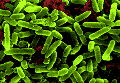 Kingdom Protista is made up of single-celled or really simple multi-celled eukaryotes. Unlike procaryotes, eukaryotes HAVE a nucleus. Tiny procaryotes (blue-green algae!) evolved into simple eukaryotes, which evolved into advanced eukaryotes, which evolved into plants!
Most protista are little algeas, but there are also
FORAMINIFERA!!
Or Forams, as I like to call them. Forams and Radiolaria are the two types of non-algae Protista.
These are tiny organisms that make their own skeletons.
You can only see them well using a microscope or hand lens!
break
4.Kingdom Mycota
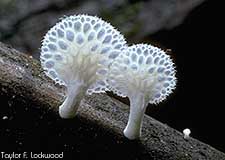 Kigdom Mycota is actually the mushroom kingdom! Mycota are eukaryotes that break down dead organic material and eat it!!!
Fungi help break down dead leaves and trees in the forest.
This includes yeasts, slime molds, mushrooms, molds, and true fungi.
Mycota comes in millions of shapes and sizes.
These two little wispy growing things ---->
are actually mushrooms!
Can you believe it??
break
5.Kingdom Plantae
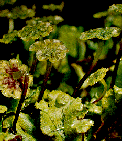 The Plantae Kingdom is composed of organisms (plants) that get their energy from photosynthesis: that is, taking in sunlight and turning it into FOOD!
Some scientists are doing experiments where they grow plants WITHOUT soil!!
The plants sit on little plastic sheets with holes cut out of it, and the roots just hang down in the air!
These plants have to be watered a lot.
Paleontologists find lots of plant fossils. Sometimes, the plant itself is found, but more often, we find a mold of a plant. Sometimes, paleontologists find carbonized plants, or a black film on a rock in the exact shape of the original leaf!
break
6.Kingdom Animalia
 The Kingdom Animalia includes all animals that live on the earth. That means
not just us, our dogs, cats, and cows, but also dolphins, bees, frogs... even sea squirts!
Kingdom Anamalia is huge. Think of all the animals you can that have fur. Then, think of all the animals you can that live in the ocean. Now add all the animals that fly. Now add all the animals that live in the ground (even worms!). Now add all the animals that live in the desert. Now add your Mom and Dad and Uncle Bob.
They're all animals!!
Amazing!!!
b
b
Is Paleontology So Cool You Just Can't Stand It?!?
Well, check out these places!
Stewart Wright's Paleo PageGigantosaurus: Biggest Meat-Eating Dinosaur Ever!
The Academy of Natural Sciences
Strange Science
Kevin's Trilobite Page
Electronic Prehistoric Shark Museum
|
This
Paleo Ring
site is owned by [ Next Site | Previous Site | Next 5 | Problems? ] Want to apply for membership? |
|

Pictures Courtesy Of:
Ms. Olsen: Biology Teacher extraordinare | Kevin Brett: Wicked Cool Paleontologist | Taylor Lockwood: Amazing Photographer | Cells Alive!
Geology Contest / Disasters! / Ask-A-Geologist / Links
About the Author / Contest Winners! / What can YOU do?
Do you have any questions, or ideas on how to make this a better site?
If so, please e-mail me here.