
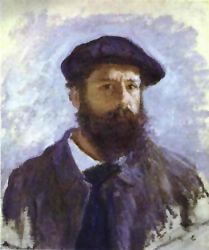
 Claude Monet (1840-1926) |
Claude Monet is generally considered to be the most outstanding figure among Impressionists. He was born in Paris on the 14th of November, 1840. When he was five years old, he moved to the port town of Le Havre. The only subject which seemed to spark any interest in the child was painting. He developed a decent reputation in school for the caricatures he was fond of creating. By the age of 15, he was receiving commission for his work. At Le Havre, at the age of 16, Monet met a man, who played a critical role in his life - the painter Eugene Boudin. At first Monet resisted Boudin�s offer to pay tuition to an art school, but he eventually relaxed his protestations and before long, the two had forged a relationship that was to last a lifetime. In 1859, having begun to feel the limitations of Le Havre, Monet left for Paris. He soon found himself disillusioned by the confines of long-since established principles. He rejected the formal art training that was available in Paris. Bored and frustrated, Monet was to do more painting at the very relaxed Academie Suisse than in the formal schools for which he had left Le Havre. Despite failing eyesight, Monet continued to paint almost to the time of his death, on December 5, 1926, at Giverny. | 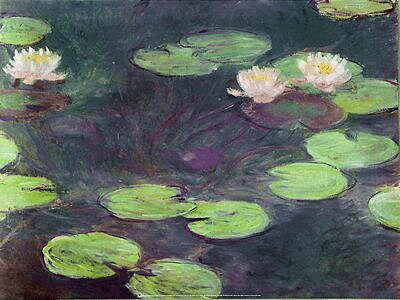 |
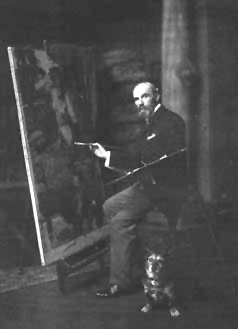 John William Waterhouse (1849-1917) |
John William Waterhouse was born in 1849 in Rome, where his father worked as a painter. He was referred to as "Nino" throughout his life. In the 1850s the family returned to England. Before entering the Royal Academy schools in 1870, Waterhouse assisted his father in his studio. His early works were of classical themes in the spirit of Sir Lawrence Alma-Tadema and Frederic Leighton, and were exhibited at the Royal Academy, the Society of British Artists and the Dudley Gallery. Early in his career Waterhouse established his style. It changed little, but he continually refined it, and his beautiful ladies were recognisable flesh and blood, with superb skin tones. He also painted a few excellent portraits of women, some of them being of the members of the Henderson family of Lord Faringdon, of Buscot Park fame. After a period inspired by the classic subject matter (Greece and Rome were the favorite ones), from 1880, he initiates a creative stage based on purely literary topics. In his last works a clear influence of literature and mythology Greeks is evident. | 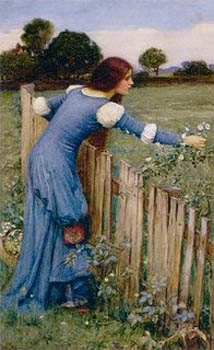 The Flower Picker |
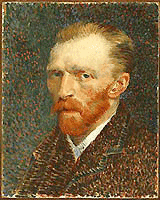 Vincent Van Gogh (1853-1890) |
Vincent Van Gogh's painted works were produced in the very short time span of only 8 years. Indeed, his total output of over 2000 drawings and paintings originate from the period 1880-1890. Alongside these runs his great published correspondence of 800 letters, mainly to his brother Theo, and it is through this that we learn much about, although never fully understand, the tormented spirit of this eccentric genius. They reveal how, having been unable to enter the ministry of the church, he gradually became taken over by his work. Van Gogh`s emotional turmoil bear artistic fruits in the form of a remarkable gift for perception - seeing powerfully what most others did not observe at all - "sad but always cheerful" he described himself and he turned to the religious scriptures for solace, secretly harbouring the ambition to become a clergyman like his father. | 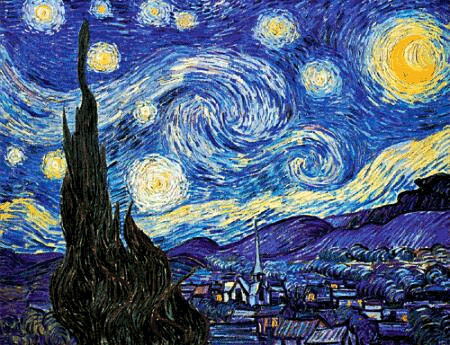 Starry Night |
 Godspeed |
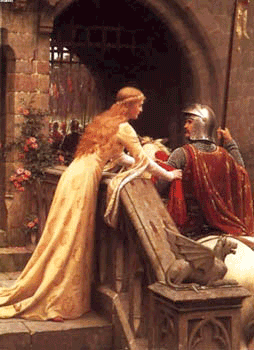
Edmund Blair Leighton was born in London, son of the portrait painter Charels Blair Leighton. A historical genre painter, his pictures of elegant ladies in landscapes or interiors have a similar kind of charm to those of J.J.J. Tissot. He was a painter of historical genre pictures, mainly of medieval times, but also regency. |