
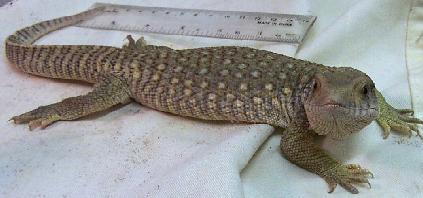
Group: Varanid
Origin: Central to Southern Africa
Average life span: Average of 10 years
Disposition: Babies can be agresive, they usually hiss, open their mouth alot (sometimes bite or try to) may tail whip your hand and so on. The best thing to do is leave them alone. They are being agresive because they think your a predator. Wait for them to get use to you. If you grab at them all the time and take them out of their hides you'll increase their stress. They will eventually get curious of you and come to check you out. Once they do, then you can try to handle them. Once there bigger they are less scared of humans and most likely you because you're the feeder. Large savannahs will usually let you do just about any thing to them without a care. Just have alot of patience with babies.
Size: Average around 3.5 feet
Heating/Humidity: The basking spot should be 135 degrees. Other end up cage should be about 90 degrees. Humidity should be low but not too low or sheding problems can occur. Monitors do not require UVB rays
Housing: The cage for a baby should be large because babies grow very fast (they can grow up to 2 feet in their first year if cared for properly)
-A large savannah needs a cage atleast 6 feet long, 3 feet wide and 4 feet tall.
-The cage should not have any screen top, for ventilation holes should be drilled on the top. The basking light should be inside the cage so the heat is high and can not escape. The little ventilation helps hold the heat in and the humidity.
-Savannahs are diggers and need to be provided alot of dirt. A large savannah should have atleast 2 feet of dirt to burrow in. The dirt shouldn't be wet but needs to be some what moist in order for the monitor to dig in and the burrows will not colapse.
-Hide boxes are needed even though they can hide in their substrate. One on the cool side and one on the hot side is needed. One in the middle is preferd.
-They dont climb alot so branches are not needed, there can be rocks to climb on and they are recomended so the monitors claws rub on the rocks and arn't as sharp.
-A large water bowl is best. They love soaking in water and the large amout of the water will help the humidity.
Feeding: Baby monitors need to be fed alot of crickets, superworms, earth worms, pinkies, earth worms, and wax worms. They can move up to larger rodents and can also be fed cock roaches. Large monitors can be fed rats.
-Babies need to be fed daily. There should always be crickets in the cage. Be sure to feed them other insects-variety in diet is great.
-Be sure not to feed them rodents that are much larger than their head. I have found that young monitors want to swallow every thing whole and if the food is too big they will regurgitate it. Older savannahs will learn to rip their foot apart if its too large.