
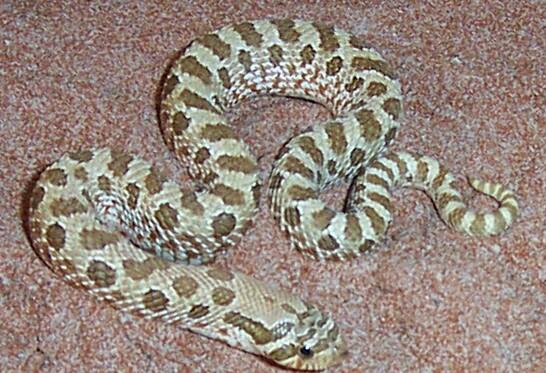
Group: Colubridae (Colubrids)
Origin: Southern Central United States
Average life span: 15 years
Disposition: All over they are very docile snakes. They may be very wiggly and jumpy when young but usually calm down when older. If they are stressed, sick, or accidetnly scared they may put on their defence displays. If they feel threatend they may play dead at first, rolling over on their back with their tongue haning out hoping the predator will not want to eat somethig that is dead. Many times they will hiss, pick their head up and flatten their neck mimicing a cobra. They may even strike although they usually strike with their mouth closed. If the predator (or you) will not leave them alone they may pull out the play dead trick for last.
Size: Average males are very small and rarely grow over 12 inches. Females usually get much bigger, they have been known to reach 35 inches.
Heating/Humidity: Temperatures in the 70's and 80's with low humidity. At night the temperature should drop about 10 degrees.
Housing: A cage about as long as the snakes length is best. The cage doesn't have to be very wide or tall.
-These snakes love to dig so i would hate to use newspaper. I use sand, you can also use aspen and some other things. It should be atleast an inch deep, deeper is better.
-Hiding is very importand, a hide box very close to the substrate is best. They will also burrow and hide in the substrate alot.
-water bowls should not be large, if there is too much water the humidity could get too high. A small and bairly deep bowl is best.
-These snakes do not climb so no branches will be needed except for decoration, plants as well (plants such as cacti is best so as to not raise humidity).
Feeding: Many hognose babies will refuse food. Mine for example didn't eat for 5 months when i got him. If you also run into the same problem it is usually quite simple to fix, here are some things to try...using lizard maker, covering the caze and making it dark, offering dead pry and leaving it for a day or 2, offer live, braining (the process of cuting open the rodents head) and some others.
They are usually refusing food because they naturaly eat amphibians, especialy toads. It is best not to offer amphibians are they will get hookd on them and refuse rodents even more.
Venom: Yes, western hognose snakes do have venom. They are rear fangd snakes meaning, the fangs are in the back of the mouth. It should not be worried about though. They may show signs of agresion but theres a 99% chance you'll never get bit by one, let alone invenomated. I was bit once but it was a quick "i'm very angry at you" bite and he did not inted to use his fangs. They use the venom for eating amphibians. Because amphibians dont have too much to use as a defence they can be consumed live by hognose snakes. The fangs are use to hold the prey and the venom is used to make the prey weaker and easier to eat. There has been one case of a person invenomated by a hognose. It was an accidental bite while he was feeding the snake. His hand swelled but hours later he was fine, there was no need for seeing a doctor. Saftely, we can say a hognose bite is alot like a bee sting-it will hurt and swell but no real need to get medical atention. A weaker person may get sick from the venom and you may be in more trouble if you happen to be alergic to it. But again, there really isn't any thing at all to worry about, i would say theres a 100% chance you will never get invenomated and again a 99% chance you wont get bit at all.