
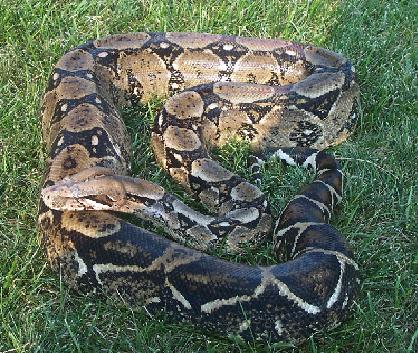
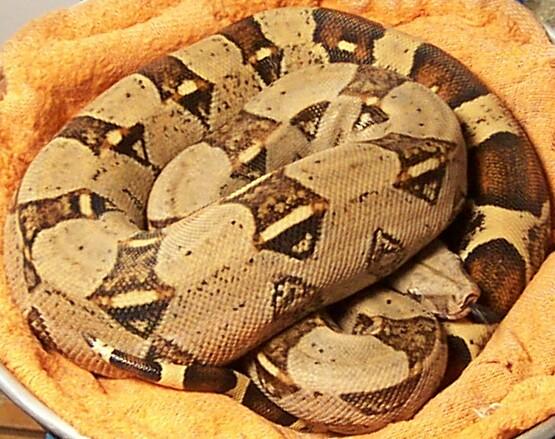
Group: Boinae (Boas)
Origin: South America, the rainforests of Colombia
Average life span: 30 years
Disposition: With the proper care and handeling, these snakes can be one of the calmest, most tame and docile snakes you may ever see. CB snakes will definetly be easier to tame than a WC. Handeling them twice to atleast once a week for a few minutes to no longer than a half hour when they are first aquired is best. Less handeling is needed once the snake is use to its home and you. These snakes have a very high feeding response and should not be handled when hungry. They are also very cranky around sheding time and should be left alone to avoid stressing them and you geting bit.
Size: Average around 6 feet. Females usually get larger than males
Heating/Humidity: Basking spot should be about 95 degrees, the whole cage should be about 85 degrees. Humidity should be over 50%. Temperature at night should drop about 10 degrees.
-Humidity is usually hard to get perfect but it isn't hard at all to get about 50%. Usually having the water bowl on the warm side of the cage is enough. If not, the cage could be sprayd, misted, heat source above or under the bowl, and plants.
Housing: Young boas should be housed in a cage close to the size of its own length. They are much more active than older boas and should be given more room and branches to climb on. By the time the snake is full grown it will do fine in a cage atleast 4x2x2 feet.
-Newspaper is my preferd substrate because it is easy to change. They also do well on reptile dirt, reptile carpet, aspen, bark and some other materials.
-One of the most important parts of the cage is the snakes hide. They need to be able to hide or they will become very stressed. Atleast one hide box on the cool side is fine but i like to put one on the warm and cool side. It needs to be big enough that all the snakes sides touch the insides of the box. You could use regular boxes and when it is soild on find another or buy a nice natural looking hide that you'd be able to wash.
-These snakes will very rarely soak in water, I have only seen them submerge when highly stressed. Therefore large water bowls are not needed. If should be heavy though, while geting a drink a boa can easily tip the bowl.
-Again, branches are great for younger snakes. Make sure the branches you use are clean, especialy if there from outside. Soap and bleach are great to use for killing off any possible parasites. If you plan to heat the cage with a bulb, make sure not to get the branches very close to the bulb or the boa could more likely get burnd.
-Plants are a nice decoration for cages, they also help the humidity go up and young snakes like to hang out him them. Potted plants will probably be tipped over by larger snakes though.
Feeding: Preferd food items for these snakes are mice and rats. If the snake gets larger it can be put on guinea pigs/small rabbits. Very large boas can be fed larger rabbits.
-New borns can easily take hoppers (the stage right before being adult mice)
-Once the snake is large enough to eat adult mice, the number of the mice can be raised (for example-my very young boa would eat one mouse a week, soon went up to 2 mice a week and will soon go up to 3 mice)
-Once the snake can eat 4 mice a week it should be moved up to small rats.
-Instead of feeding more than one rat, you can just bump up to the larger sizes or rats.
-Because they average at 6 feet they probably won't need bigger than a jumbo rat, but its very possible they will need larger food.