
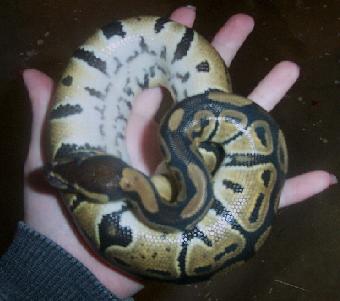
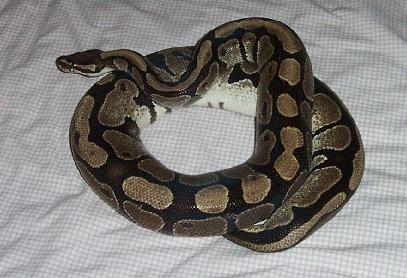
Group: Pythonae (Pythons)
Origin: West and West Central-Africa
Average life span: 20-30 years
Disposition: Can be extremly shy, jumpy snakes when young. If given the proper care and handeling they can become very tolerate of being handled. Wild Caught snakes can be extremly agresive and will mostly strike and bite very often. If they do not do so they will usually ball up in a tight ball to hide. Very stressed snakes will act this way also.
Size: Average at 3.5 feet but females usually go well over. You will usually never see one over 5 feet.
Heating/Humidity: Basking spot of 90 degrees. Rest of cage should be about 80 degrees. Atleast 60% humidity, when in shed, it should be raised 70-80%. The best thing to do is to make a humidity box. Put wet paper towls, moss, so on under one of the hide boxes.
-Puting the water bowl on the warm side of the cage should make the humidity around 60%. Spraying the cage, a heat source under the water bowl and plants also help it go up.
Housing: A cage about as long as the length of the snake is best for young snakes. They are a bit more active than older snakes. When the snake is larger, the cage shouldn't be much more than a foot less than the length of the snake.
-The best substrate is newspaper. Reptile dirt is also commonly used for them.
-One of the most important parts of the cage is the hide box. It should be big enough so the snakes sides touch the inside of the box. Two hide boxes should be in the cage, one of the warm side and one on the cool side. You can use any regular box and throw it away when it is soild and get another or buy nice natural looking hides you can wash.
-The water bowl should be big enough for the snake to fit its whole body in but it needs to be heavy so the snake can't tip it over.
-Young snakes will climb a bit more than larger snakes so branches are great to have in the cage. If they are taken from outside soap and bleach kill off all potention parasites that can hurt snakes.
Feeding: These snakes can eat mice and rats. They will probably not get big enough to eat any thing bigger than a large rat.
Feeding ball pythons is usually not very simple, somtimes a challenge. Many young snakes will not want to eat at first and you may need to try different things such as...offering live, not feeding for about 3 weeks, feeding at night, feeding a live gerbil, and some others. They usually wont eat because they are either WC, stressed, or perhaps sick. Sometimes even older snakes will stop eating but they will usually pick back up soon enough.