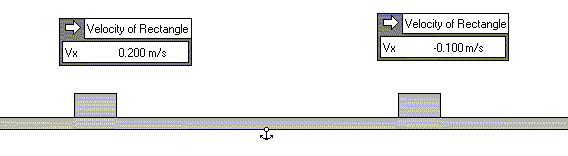
Figure 10
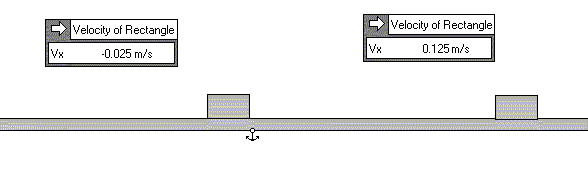
Figure 11
Conservation
of Momentum
Using the physical world simulator, Working
Model we have attempted to verify the law of conservation of momentum
using
different types of collisions. The law
states that whenever two or more particles in an isolated system
interact, the
total momentum of the system remains constant. In other words the total
momentum of an isolated system at all times equals its initial momentum. This
law can be extended to any number of particles in an isolated system
but for
the sake of simplicity we have decided to use only two objects in one
dimensional collisions. By definition
the momentum of an object is its mass times its velocity (P=mv). In this report we will show the results we
obtained from each collision as well as the momentum values we
calculated from
the law itself. Using cases with
different initial velocities, masses and coefficients of elasticity, we
will
show that these factors do not affect the momentum and prove once and
for all
that the momentum is conserved if no net external force is acting on
the
system.
*Note that friction was turned off for this
simulation.
Our first case is a perfectly
inelastic collision. This means that the
final velocity of both objects is the same.
In other words both objects stay stuck together.
To do this we put the coefficient of
elasticity to zero. In this case the
lighter block is given an initial velocity and collides with the
heavier block
that is stationary. The end result is
that both objects continue to move in same direction as the lighter
block. The precise values for this
collision can be
read off of data table 1. Note that this
is the data taken from the simulation itself.
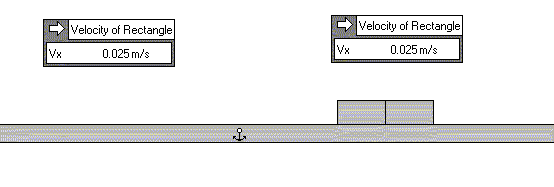
Below, figure 1 is a caption of the initial state of the objects
before
the collision and figure 2 represents the objects after the collision. Also the experimental values for the momentum
are shown and accompanied by the formulas and calculations needed to
obtain
them. Notice that in this case the
momentum is conserved.
Ptf = Pti
M1V1f + M2V2f
= M1V1i + M2V2i
(0.25kg)(0.025m/s) + (0.75kg) (0.025m/s) =
(0.25kg) (0.1m/s) + (0.75kg)(0m/s)
0.025 =
0.025
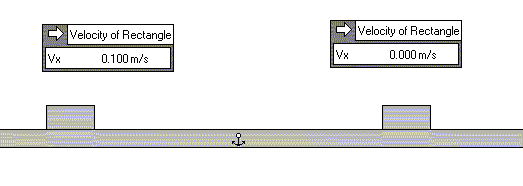
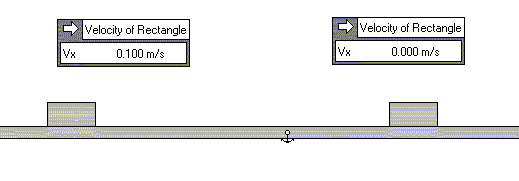
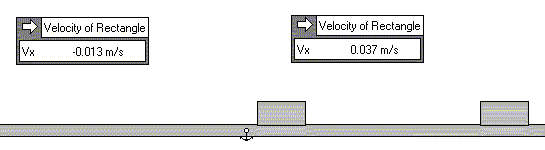
Case two describes an elastic collision. During this type of collision the objects collide and bounce, finishing with different velocities. To produce this, the coefficient of elasticity is changed to 0.500. The lighter object is given a velocity while the heavier object is stationary just like the previous case. The difference is shown at the end when the blocks do not stick together. The block that was given a velocity bounced back and went in the opposite direction while the one that had no initial velocity was given some forward momentum. Figure 3 below illustrates the situation before the collision has occurred. Figure 4 is a caption taken after the collision. The mathematical experimental result proves that momentum is conserved in this case.
Ptf = Pti
M1V1f + M2V2f
= M1V1i + M2V2i
(0.25kg)(-0.013m/s) + (0.75kg) (0.037m/s) =
(0.25kg) (0.1m/s) + (0.75kg)(0m/s)
0.0245=
0.25
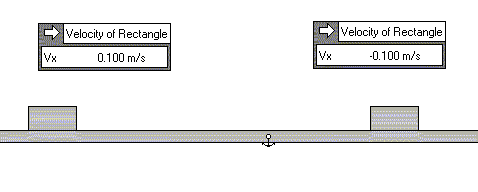
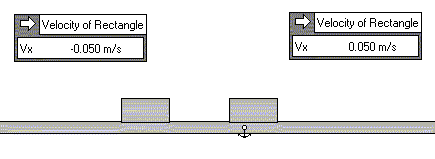
Case three is another elastic collision however this time both objects are given the same velocity in opposite directions. Also in this case both objects have the same mass. After the blocks collide they both end up moving in the opposite direction from what they were doing initially. Figure 5 shows the initial situation before the collision and Figure 6 shows it after the collision. Again the calculations for the momentum are shown and the momentum is seen to be conserved.
Ptf = Pti
M1V1f + M2V2f
= M1V1i + M2V2i
(0.50kg)(-0.050m/s) + (0.50kg) (0.050m/s) =
(0.50kg) (0.1m/s) + (0.50kg)(-0.1m/s)
0 = 0
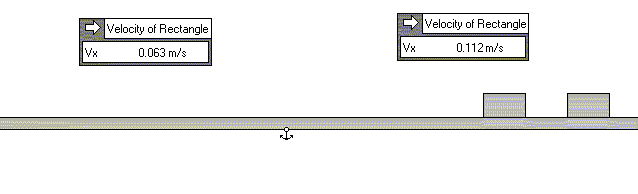
Case four is an elastic collision. In this situation the first object has a velocity and a mass three times larger than the other object. The second object is not given a velocity. When the two objects collide, they will both continue in the forward (positive) direction because of the mass differences. In the cases shown before this one, the mass of the second object was larger than the first. The consequence of this was that the first object would bounce off the second and have a velocity in the opposite direction. In this case they both have final velocities in the same direction. Figure 7 shows the situation after the collision. The initial situation is the same as the first and second cases.
Ptf = Pti
M1V1f + M2V2f
= M1V1i + M2V2i
(0.75kg)(0.063m/s) + (0.25kg) (0.112m/s) =
(0.75kg) (0.1m/s) + (0.25kg)(0m/s)
0.07525=
0.075
Case five
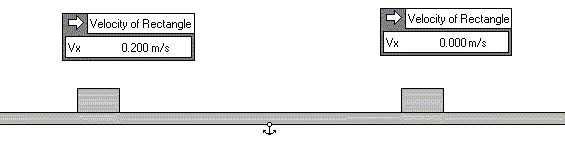
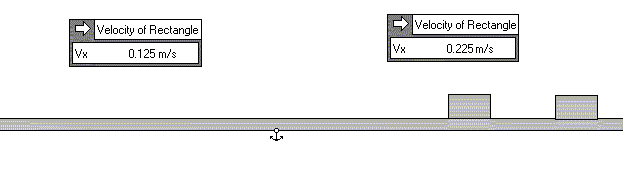
is yet another elastic collision where the heavier block is given an
initial
velocity twice as large as in the previous case and hits the lighter
block
which is stationary. After they collide
they both continue to move in the forward direction like in case four. Figure 8 shows the initial situation and
Figure 9 is a caption of the final situation.
Below are the momentum calculations.
Ptf = Pti
M1V1f + M2V2f
= M1V1i + M2V2i
(0.75kg)(0.125m/s) + (0.25kg) (0.225m/s) =
(0.75kg) (0.2m/s) + (0.25kg)(0m/s)
0.15 =
0.15
Ptf = Pti
M1V1f + M2V2f
= M1V1i + M2V2i
(0.50kg)(-0.250m/s) + (0.50kg) (0.125m/s) =
(0.50kg) (0.200m/s) + (0.500kg)(-0.1m/s)
0.05 = 0.05
Figure 10
Figure 11
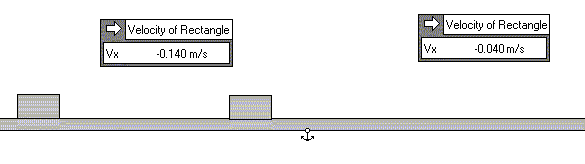
Case seven is another case of elastic collision similar to case six. This time the objects are given the same velocity in opposite directions. The mass of object two is made to be four times larger than the mass of object one. During the course of this collision the two objects hit and continue in the same direction as that of the heavier object. Their final velocities do not end up being the same however this has no effect on the overall conservation of momentum. As calculation below illustrates, the momentum is conserved in this situation. Figure 12 shows the final state of this case. The initial state is the same as case three.
Ptf = Pti
M1V1f + M2V2f
= M1V1i + M2V2i
(0.25kg)(-0.140m/s) + (1.0kg) (-0.040m/s) =
(0.25kg) (0.100m/s) + (1.0kg)(-0.100m/s)
-0.075
= -0.075
Ptf = Pti
M1V1f + M2V2f
= M1V1i + M2V2i
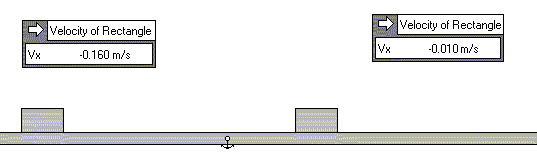
(0.25kg)(-0.16m/s) + (1.0kg) (-0.010m/s) =
(0.25kg) (0.20m/s) + (1.0kg)(-0.10m/s)
-0.05 =
-0.05
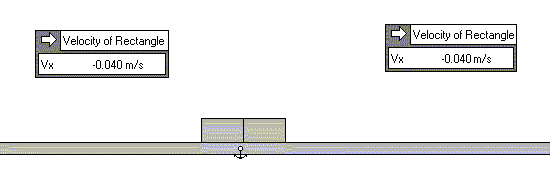
Case nine is exactly the same as case eight except that the coefficient of elasticity is zero and so it is a perfectly inelastic collision. After the blocks make contact they stick together and therefore have the same final velocity. Figure 14 illustrates the final state of the objects and the initial state is the same as in case six. The values for initial and final momentum calculated below, show that momentum is conserved.
Ptf = Pti
M1V1f + M2V2f
= M1V1i + M2V2i
(0.25kg)(-0.040m/s) + (1.0kg) (-0.040m/s) =
(0.25kg) (0.20m/s) + (1.0kg)(-0.10m/s)
-0.05 =
-0.05
|
|
m1 (kg) |
m2 (kg) |
v1i (m/s) |
v2i (m/s) |
v1f (m/s) |
v2f (m/s) |
Ptf |
Pti |
|
Case 1 |
0.25 |
0.75 |
0.1 |
0 |
0.025 |
0.025 |
0.025 |
0.025 |
|
Case 2 |
0.25 |
0.75 |
0.1 |
0 |
-0.013 |
0.037 |
0.0245 |
0.025 |
|
Case 3 |
0.5 |
0.5 |
0.1 |
-0.1 |
-0.05 |
0.05 |
0 |
0 |
|
Case 4 |
0.75 |
0.25 |
0.1 |
0 |
0.063 |
0.112 |
0.07525 |
0.075 |
|
Case 5 |
0.75 |
0.25 |
0.2 |
0 |
0.125 |
0.225 |
0.15 |
0.15 |
|
Case 6 |
0.5 |
0.5 |
0.2 |
-0.1 |
-0.025 |
0.125 |
0.05 |
0.05 |
|
Case 7 |
0.25 |
1 |
0.1 |
-0.1 |
-0.14 |
-0.04 |
-0.075 |
-0.075 |
|
Case 8 |
0.25 |
1 |
0.2 |
-0.1 |
-0.16 |
-0.01 |
-0.05 |
-0.05 |
|
Case 9 |
0.25 |
1 |
0.2 |
-0.1 |
-0.04 |
-0.04 |
-0.05 |
-0.05 |
|
|
coefficient of elasticity |
m = mass |
|
Case 1 |
0 |
m/s = metres per second |
|
Case 2 |
0.5 |
Pt = total momentum |
|
Case 3 |
0.5 |
f = final |
|
Case 4 |
0.5 |
i = initial |
|
Case 5 |
0.5 |
v = velocity |
|
Case 6 |
0.5 |
1 = object on left |
|
Case 7 |
0.5 |
2 = object on right |
|
Case 8 |
0.5 |
|
|
Case 9 |
0 |
|
If you look carefully at the table you will notice all the combinations of different masses, initial velocities and coefficients of elasticity. The conclusion at which we must arrive is that these factors do not affect the conservation of momentum because in all the cases the momentum was conserved.
A case when
momentum would not be conserved would be if a net external force were
applied
to the system. Just to see if this is
really true we tested it on Working Model.
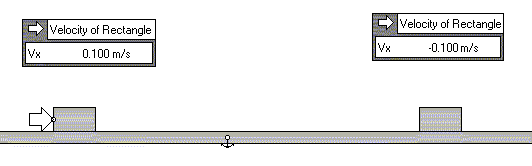
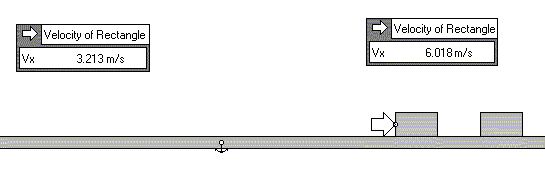
We took a simple case where two objects of the same mass heading
towards
each other at the same initial velocity.
It is like case three except one object is pushed forward with
an
external force. Figure 15 shows the
initial situation and Figure 16 is a caption after the collision. The calculation this time shows that the
momentum is not conserved.
Ptf = Pti
M1V1f + M2V2f
= M1V1i + M2V2i
(0.50kg)(3.213m/s) + (0.50kg) (6.018m/s) =
(0.50kg) (0.10m/s) + (0.50kg)(-0.10m/s)
4.616 = 0
In conclusion, this experiment has proved that The Law of Conservation of Momentum is valid. Using the definition of momentum (P = mv), we calculated the initial and final momentum and then compared the two values in the equation Ptf = Pti. In each example the variables (mass, velocity, coefficient of elasticity) were changed to prove that they had no effect in conserving the momentum. The last example established that a net external force did not allow for conservation of momentum.