 |
|
The Leaping Hope
A Literary Journal
of the Students and Faculty of
The Korean Minjok Leadership Academy
Some thoughts and times of our lives...
Some reflections ...
Volume 2 -- No. 1... Winter 2001-2002
previous Online Issues...
Religious Minorities and Intolerance of Society;
A case study of the governmental raid on Branch Davidians
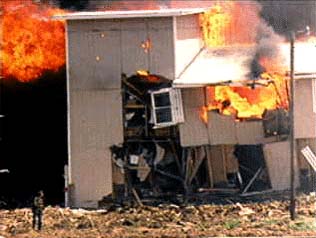
By Kim Ki-Chul -- Ivy 5th wave (Sophomore)On April 19, 1993, Bureau of Alcohol, Tobacco, and Firearms (ATF) raided a complex in Waco, Texas, inside of which a cult was said to be stockpiling heavy weaponry. Cult-leader David Koresh and his Branch Davidians allegedly resisted the agents with gunfire, but, in the end, most of the Davidians, including the leader, died in an inferno of disputed origins. The ATF Bureau attributed the cause of the inferno to the suicidal impulse of the eighty 'mentally ill fanatics.' Davidian survivors of the raid and their advocates, however, have questioned the constitutionality of the governmental attack itself. For those who believed that every religion has certain inalienable Constitutional rights in exercising religious freedom, the raid (not to mention the incredibly high number of casualties) was hardly an acceptable for an operation of that nature.
Discrimination against Unpopular Religious Groups
On September 21, 2000, the Supreme Court ruled "Bureau of Alcohol, Tobacco, and Firearms agents and others were not responsible for the deaths on the final day of a 51-day standoff." It also accused David Koresh of setting fire and thus causing the tragedy. This ruling implies that the ATF was free from any allegation made that the Bureau was essentially in charge, and therefore responsible for the high number of casualties. There is evidence, however, that the decision of the Supreme Court may have been biased against the Branch Davidians. Walter S. Smith, the Texas District Court judge in the Waco case, said that "the ATF was justified in using a 'dynamic raid and entry' to serve the warrants . . . because the government has sovereign immunity from those who would second-guess such discretionary decisions." This judge hereby understated the Davidians' plea for their rights of religious freedom as a "second-guess," a simplistic remark that shows a lack of understanding of the minority religious group.
If one of the duties of the United States government is to create an egalitarian society where all citizens can live without unjust discrimination, then it failed to serve this purpose in the Waco case. It has an obligation to protect the freedom of all religious establishments and therefore should have found a way to protect the religious freedom of the Davidians. Unable to understand Davidian practices, the majority of Americans, moreover, gave a tacit approval to the unconstitutional raid, and the ATF was justified in pushing the eighty fanatics to their death. Consequently the Davidians fell prey to the unwarranted discrimination of both the ATF and the court system - or even, seemingly, of the tyranny of the majority of the nation.
Dick J. Reavis, the author of The Ashes of Waco, questions, in fact, the right of the government to restrict practices of unpopular religions:
The line between churches, which Americans believe should be protected from government interference, and cults, which most Americans hold in disdain, has nothing to do with the Constitution - whose First Amendment in theory shields both - and everything to do with the prejudices of a nation that has grown fearful of the diversity that made it nearly unique.
Reavis argues here that government policies are likely to favor popular churches, and discriminate against comparatively unpopular "cults" whose establishment seems not as firm as the popular ones. Potentially biased toward the latter, most Americans as well as the government often helps restrict free practices of the "cults."
Stephen L. Carter, in his book God's Name in Vain, suggests a way to explain this national character of general intolerance for unpopular religions. He argues that the nation has a mentality deeply rooted in Christianity. Moral standards, or what Americans think morally desirable, are not very much different from Christian doctrinal Standards.. Since the Puritans from England settled in America, the political majority of the nation has believed in a Christian understanding of God; and the United States government, the representatives of the people, has taken a position that favors Christianity over what it considered heterodox establishments. As a predominantly Christian polity, American society has ostensibly opposed to any religion that is new or different, or which has doctrines different from those of traditional Christians. Given this general atmosphere of religious intolerance, it was almost impossible for the Texas District Court judge to make judgements equitable to both the predominant Christian constituency and to the unpopular Branch Davidians.
Church within State
Thomas Jefferson, one of the Founding Fathers of the new nation, wrote in "A Bill for Establishment of Religious Freedom": that "the opinions of men are not an object of civil government or under its jurisdiction." He argued that church and state must be separate in order that neither establishment outgrows its boundary and dominates the other. Jefferson's statement implies that a civil government must not force religious groups into conforming to secular standards of the government, no matter how unconventional those religions may seem. His contemporary, James Madison--who had played an important role in securing the adoption of Jefferson's bill-also emphasizes objectivity in dealing with unpopular religions within the state.
Whilst we assert for ourselves a freedom to embrace, to profess and to observe the Religion which we believe to be of divine origin, we cannot deny an equal freedom to those whose mind have not yet yielded to the evidence that has convinced us. If this freedom be abused, it is an offence against God, not against man.
As can be inferred from both Founding Fathers' ideas concerning separation of church and state, and concerning the independence of each establishment; the Constitution of the United States had dual goals: to prevent an insidious influence of popular, and therefore powerful, religions on the government - as Catholic church had intervened in European politics - and to protect minor religious groups from any possilble injustice they might suffer at the hands of an opposing, majority government and/or the powerful churches.
The problematic relationship between church and state becomes more perplexing when religious doctrines of a group happen to conspicuously go against certain civil laws of the society. In the Davidians' case, the leader was accused of the statutory rape of teenage girls and of unlawfully keeping children from elementary school. But David Koresh insisted that those allegedly illicit practices were part of their religious obligation, and that they should have freedom to practice those activities within the privacy of their compound. Based on these charges along with the vague allegation that the group was stockpiling illegal drugs and weaponry, the ATF forthrightly attacked the followers of David Koresh. Ironically, this raid apparently went against the Constitutional guarantees of "due process of law" and religious freedom for everyone; and because the Constitution does not make clear whether or not all religious practices deemed illegal must not be allowed within state, the controversy remained unsettled.
Some people have suggested the possibility of reconciliation of the polarity between church and state. Gerry Spence wrote in The Rebirth of Tyranny in America, that people should abide by the law of the state where they live, and this duty of all citizens costs part of their freedom. This is what Stephen Carter explained in his book, The Culture of Disbelief, as the "Faustian Bargain." According to this idea, churches cannot be completely independent of a state, because the complex interrelationships between citizens of a modern society make it virtually impossible for anyone to live totally independent of others. Unfortunately, though, in the case of the Branch Davidians, the bargain could not take place because of the partisan attitudes on both the part of the ATF and the part of the Davidians, a circumstance which made them both intolerable of each other.
People who criticized the Branch Davidians were appalled by the leader's apparent disrespect for the law and the alleged abominable crimes that could threaten stability and peace of the neighborhood. If the Davidians should have the right to so assert their religious freedom, (their detractors argued) then the disgruntled neighbors also should be entitled to a right to demonstrate against the Davidians; as a legitimate bid in order to live without fear -- in this case, without a fear of sexual abuse and stockpiled weaponry. Moreover, opponents warned that rampant crime would ensue if all religious groups were allowed to do whatever they wanted. In fact, the aversion they feel to the Davidians has little to do with gratuitous discrimination, a well-known rhetoric that religious minorities usually resort to when faced social discrimination.
In light of this new light of perspective, the controversies, then, over the constitutionality of the governmental raid can be construed simply as a likely discord between conflicting parts in a society that seeks more and more freedom. The real problem, then, is that covert manipulation of media by the government may have distorted the truth; and people who came to know of the incident through newspapers or television news cannot but believe what was reported - or, what the government wanted reported. Controversies over whether the Davidians resisted with gunfire, as the government said, or whether the ATF attacked the complex with helicopters and tanks and set the fire--as the Davidian survivors testified-suggests that there were certain incidents of underhanded manipulation on the part of the government. Details of the incident are still unclear, and the purpose of the attack itself cannot be clearly known. The only thing that is clear in this Waco case is that the ATF acted with prejudice that antagonized the Davidians and this conflict developed into a military standoff, which ended in the disastrous inferno.
Conclusion
As the report of the ATF Bureau about the raid seems to have been manipulated, and as the public--subject to questionable reports--were rendered all the more biased against the Branch Davidians, then the true image of the Waco incident may not be truely known. The uncertainty around the purpose of the attack and the obscure trace of alleged criminal practices of David Koresh tended to avert people's attention -- from the violation of the Constitution on the part of the government to the possibly forced or exaggerated image of the allgeded immorality of the congregation. The only thing that is certain about the incident is that the majority of the Davidians perished in an inferno without having any chance to justify their stand, publish their written statement or prove their innocence of the alleged charges made against them. Not considering all the intricacies of the case, and for a moment taking a step back, one can see an outline of the narrow-mindedness of the whole nation, and a society that does not easily allow eccentricities to grow; a society which just runs toward a stifling and complete uniformity. This is what exactly the Founding Fathers worried about when they made the Constitution two hundred years ago; and unfortunately, the dangers they have warned against have apparently materialized in the 20th century of the United states.
Kichul Kim
Bibliography
Works Cited
Carter, Stephen L. The Culture of Disbelief. New York: Basic Books, 1993.
--- God's Name in Vain. New York: Basic Books, 2000.
Goodman, Troy. "Judge Clears U.S. in Waco Case." Associated Press
September 21 2000: 1-10. Updated 12 August 2001.
Jefferson, Thomas. "A Bill for Establishment of Religious Freedom." The Portable Thomas Jefferson. Ed. M.D. Peterson. New York: Penguin Books, 1977. 251-253.
Reavis, Dick, J. The Ashes of Waco. New York: Simon & Schuster, 1995.
Sorensen, Theodore C. Kennedy. New York: Harper & Row, 1965.
Spence, Gerry L. From Freedom to Slavery: The Rebirth of Tyranny in America. New York: St. Martin's Press, 1993.
Witherspoon, Tommy. "Judge says David Koresh responsible for Mount Carmel tragedy." Waco Tribune-Herald September 21 2000: 15-18. Updated 12 August 2001.

Kim, Ki-Chul (on the right, with Kim Ji-Hoon)
Other Journals, class by class:
7th Wave Natural Science I ... Minjok (Domestic Track)
7th Wave Natural Science II ... also Minjok (Domestic Track)
Other words from the editor:
A House on a Hill... by Mr. Johnson (Teacher)
 Links to helpful sites
Some useful literary tools: © 2002 [email protected]
Home Winter 2001-2002
Wordsmyth very good online English Dictionary and Thesaurus
A real fine Korean/English/Korean Dictionary... by idic.i-on.net
Definite and Indefinite Articles ... (Outch! Yuk!) by Purdue U. Writing Lab
other "Common Errors in English" ... (Hmmmm?) brought to you by Washington State U.
Korean Proverbs and Sayings by WARE4U.com
zhongwen.com very good online Dictionary of Chinese Characters (Chinese/English)
Introducing a scholarship:
The Virtuous Patriot Integrity Award ... for KMLA students going abroad ...
The Leaping Hope online Editor; and Hard-Copy Editor:
Carlton Johnson (Minjok Academy English Department)
Social Anthropology Major