Selecting quartz crystals for oscillators can be confusing and mysterious. Engineering programs tend to give them only a cursory overview.
Hence, many engineers are unfamiliar with crystal parameters and jargon. A crystal datasheet can appear to be as cryptic as Egyptian hieroglyphics.
In this article, I cover crystal parameters and explain how system design can affect clock accuracy. It should make crystal selection significantly easier.
The quartz crystal integrates mechanical and electrical characteristics. If quartz is stressed, an electric field is generated in the direction perpendicular to the applied stress.
Conversely, if an electric field is applied to a quartz crystal, a mechanical stress appears in the direction perpendicular to the applied stress. This effect, known as the piezoelectric effect, is the basis for quartz being used so extensively in crystal manufacturing.
By placing a quartz crystal between two electrodes and applying a changing voltage, the crystal can be made to vibrate. Maximum vibration amplitude occurs when the frequency of the changing voltage matches the crystal resonant frequency. Oscillator circuits using a quartz crystal vibrate at the crystal resonant frequency.
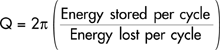
High Q is one of the most desirable features of quartz crystals. It is a measure of how much energy is lost due to vibration. In mechanical terms, Q is:
In electrical terms, Q is the inductive reactance at resonant frequency divided by the equivalent series resistance (ESR).
A crystal with a high Q loses little energy while vibrating. Commercial-grade crystals have Qs ranging between 20,000 and 200,000. High-precision crystals have Qs up to 3 million.
In addition to high Qs, quartz crystals tend to be incredibly stable. The only drift associated with crystals is from temperature fluctuations and aging. Temperature effects are about 100 ppm over the operating range, while aging effects are around ±5 ppm per year.
When selecting a crystal, carefully consider how accurate your system has to be. Crystal selection and oscillator design must be weighed equally.
These factors work together, influencing the system operating frequency and cost. Typically, the more accurate a system is, the more expensive it is to build.
If you’re building a system with an RTC, your target accuracy should be ±2 min. per month. PLL reference clocks, however, can tolerate less accuracy.
Four crystal parameters play a key role in system accuracy. The contribution from each must be added to obtain the total system accuracy.
Each parameter can be adjusted without influencing the others. This parameter independence makes customizing crystals attractive.
However, customization results in increased system cost. Look carefully at your system requirements. Try to use readily available, off-the-shelf crystals.
The frequency tolerance (i.e., calibration effect) is the first of the four accuracy-budget parameters. It is a room-temperature (i.e., 25°C) spec stating how close the actual crystal frequency is to its specified frequency. Like most crystal specs, it is in parts per million.
For example, a 32,768-Hz crystal may have a frequency tolerance of ±20 ppm. At 25°C, the resonant frequency can be anywhere between 32,768.65536 and 32,767.34464 Hz.
The 32768 crystal is known as a watch crystal. This system might sound highly accurate, but when you consider its accuracy impact over a month, this one parameter alone can cause the watch to be off by almost 1 min.
Equation 1 shows that a ±20-ppm frequency tolerance can account for about 52 s per month:
Frequency stability is the second item to add to the timing budget. It is a function of temperature and is related to the crystal cut type.
The most common crystal cut types are AT and BT. Their temperature stability curves are different—a fact that should be considered when you’re designing a system.
The AT curve is cubic [1], as depicted in Figure 1. Note that the curve moves between the +ppm and –ppm areas with temperature.
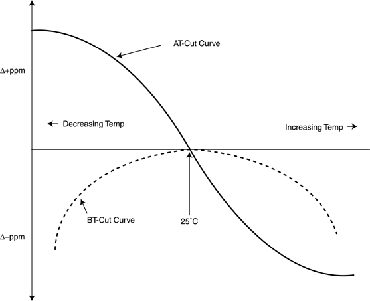 Figure 1—AT-cut
crystals (solid curve) exhibit a cubic temperature stability curve. On
the other hand, BT-cut crystals (dashed curve) exhibit a parabolic
temperature stability curve.
Figure 1—AT-cut
crystals (solid curve) exhibit a cubic temperature stability curve. On
the other hand, BT-cut crystals (dashed curve) exhibit a parabolic
temperature stability curve.
|
If a system using an AT-cut crystal is exposed to temperature fluctuations, the temperature effects tend to average to zero over time. However, an error is introduced from not operating at 25°C (i.e., crystal calibration temperature).
The BT cut, common in low-frequency crystals, is a parabolic form. Increasing or decreasing temperatures both cause a decreasing resonant frequency. Unlike the AT-cut crystal, temperature fluctuation effects do not average to zero.
The third item in the timing budget is aging as it relates to crystal contamination and drive level. Resonant frequency changes as a function of time.
It tends to be related to crystal contamination. That is, particles either drop off or fall onto the quartz surface. Because this happens inside the crystal case, there isn’t anything you can do about it. It’s up to the manufacturer.
However, keeping the drive level low can reduce aging effects as the crystal is not knocked around as much. Choose crystals that are hermetically sealed for best aging characteristics.
The fourth timing budget parameter to consider has to do with load capacitance. For parallel resonant circuits, there is a load-capacitance spec.
If the load capacitance of your circuit doesn’t match the crystal load capacitance, there is a resonant frequency shift. I’ll discuss this effect shortly.
One nice characteristic of quartz crystals is that all of these parameters are independent. Each one can be adjusted without affecting other parameters.
You can request a crystal with 5-ppm frequency tolerance, and keep the other parameters the same or change them. However, you pay a premium for custom-made crystals.
The question of parallel and series resonant crystals often comes up and is occasionally a source of confusion. Let me clarify the situation.
There is no such thing as a series or parallel resonant crystal. Instead, crystals have different parallel and series resonant frequencies.
When a crystal is calibrated at the factory, it is trimmed to hit a particular frequency while operating in the series or parallel resonant mode. The parallel resonant frequency is greater than the series resonant frequency.
Most oscillators operate in the parallel resonant mode (i.e., they see a parallel load capacitance). Some examples of parallel resonant oscillators are the Pierce-, Colpitts-, and Clapp-style oscillators. Series-resonant oscillators, on the other hand, are uncommon.
Transforming mechanical parameters into electrical parameters is known as creating the electrical dual. The equivalent electrical circuit for a crystal is shown in Figure 2. Components C1, L1, and R1 make up the crystal’s motional arm.
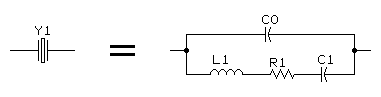 Figure 2—The
mechanical properties of mass, friction, and stiffness are mapped to
inductance, resistance, and capacitance, respectively.
Figure 2—The
mechanical properties of mass, friction, and stiffness are mapped to
inductance, resistance, and capacitance, respectively.
|
Co is the shunt capacitance. It is composed of packaging and lead effects, and is on the order of a few picofarads. Co is also known as the crystal’s static capacitance.
L1 is the crystal’s motional inductance. This value is determined by the crystal’s motional mass during oscillation, and is on the order of thousands of henries.
C1 is the crystal’s motional capacitance. It is determined by the crystal’s stiffness, and is on the order of a few femtofarads.
R1 is the crystal’s ESR when oscillating, and it is related to mechanical loss during oscillation. ESRs range from a few ohms to tens of thousands of ohms.
If the ESR is small, the crystal loses little energy while vibrating. A small ESR helps with startup and continued oscillation.
The series equivalent circuit for a crystal omits the shunt capacitor, Co. The crystal series resonant frequency is:

When crystals are connected to PC boards, they see a circuit that looks like Figure 3.
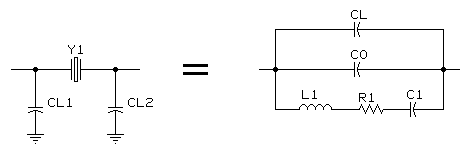
Figure 3—When the external load capacitance CL is taken into account, it appears as a capacitor in parallel with Co. |
Here, CL is equal to the series combination of CL1 and CL2, and is attributed to board parasitics and/or load caps added to the oscillator. The resonant frequency changes from equation 2 to:

In most cases, Fp, the parallel load resonant frequency, is specified in the crystal datasheets. C1 and Co are part of the crystal, but the load capacitance, CL, is not.
At the factory, the crystal is calibrated (frequency-tolerance spec) with a particular load capacitance. This number appears in the datasheet as the load capacitance.
If your load capacitance doesn’t exactly match the load capacitance in the datasheet, your oscillator won’t run at the spec Fp frequency. (I look at the effects of mismatched load capacitance in the next section.) Note that the parallel resonant frequency is greater than the series resonant frequency.
FREQUENCY TOLERANCE AND LOAD CAPACITANCE
When the oscillator circuit load capacitance doesn’t equal the crystal spec load capacitance, the oscillator’s operating frequency is different from the crystal’s frequency tolerance spec.
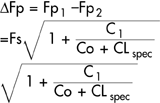
Equation 3, for Fp, shows that as the board attributed load capacitance increases, Fp decreases. The change in frequency as a result of mismatched load capacitance is:
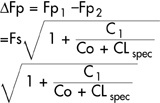
where Fp1 is the spec parallel resonant frequency, Fp2 is the actual parallel resonant frequency, CLspec is the crystal spec load capacitance, and CLsystem is the system load capacitance.
Equation 4 is known as the pullability equation and gives the frequency error of mismatched load capacitances. Often, this error is insignificant. However, it does come into play when there is a cumulative effect. If the crystal is used in a timekeeping application, cumulative effects are important.
If you’re trying to tightly control accuracy, you must consider PCB stray capacitances. Routing to the crystal and socket effects, if used, also add to the load capacitance.
It may be necessary to use a trim cap to hit the target accuracy. If the circuit load capacitance is less than the target load capacitance, add a parallel trim cap to the circuit. Connect the cap between either the crystal pin or ground.
If the circuit load capacitance is greater than the target load capacitance, a series trim cap should be added to the circuit. The trim cap is connected to either crystal pin and the corresponding oscillator pin.
If you take a look at the two temperature coefficient curves for the AT- and BT-cut crystals (see Figure 1), you find that the AT cut is preferable. For the BT, temperature changes always cause a resonant frequency decrease.
Unfortunately, you may not have a choice. For low-frequency crystals below 1 MHz, BT cuts dominate. Oscillators using these style cuts may not perform well in environments with large temperature fluctuations. But, if you have the choice, pick the AT cut.
The crystal mode of operation largely depends on the operating frequency. Up to 50 MHz, the mode of operation is fundamental. Above 50 MHz, the mode is probably overtone.
Note that overtone frequencies are not harmonics of the fundamental frequency, although they are close. Harmonics are exact integer multiples, while the overtones are not.
However, overtone frequencies are always odd multiples of the fundamental frequency. Both AT- and BT-cut crystals are available for overtone use.
Overtone operation is a nontrivial effort. Oscillators that run over 50 MHz must run in the overtone mode.
You don’t see high-frequency fundamental crystals because the crystal becomes too thin. Crystal thickness is inversely proportional to resonant frequency, so high frequencies translate to thin crystals. And, thin crystals are expensive because they’re difficult to manufacture and handle.
With overtone crystals, the thickness is greater than that of the fundamental crystal [3]. The overtone mode multiplies the thickness. As Figure 4 shows, a third overtone crystal is three times thicker than the comparable fundamental crystal.
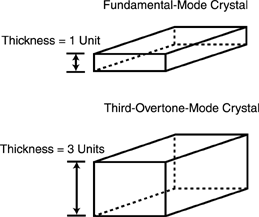 Figure 4—The
thickness of the third-overtone crystal slab is three times that of
the fundamental-mode crystal slab.
Figure 4—The
thickness of the third-overtone crystal slab is three times that of
the fundamental-mode crystal slab.
|
There are a few disadvantages to using overtone crystals. The first is that the oscillator must be designed to specifically operate at the overtone frequency and not the fundamental frequency. Therefore, the oscillator must contain a filter to avoid the fundamental frequency.
Another disadvantage is that overtone crystals tend to be thicker than the fundamentals. This translates into larger ESRs, hence lower Q. Care should be take to ensure reliable oscillator startup and operation.
A third disadvantage is that overtone crystals can contain spurs (i.e., short for spurious mode, an unwanted type). The crystal manufacturer has to make sure that spurious modes are sufficiently suppressed. If they aren’t, the oscillator can run at the wrong frequency.
Crystals are available in a variety of packages. There are many metal-can configurations, plastic packages, and surface-mount plastic.
Unlike ICs, the plastic version is probably the most expensive. This is because the plastic version is the metal version encapsulated in plastic. In other words, you pay for two packages.
Handling considerations should be the only reason to select one package type over another. Performance is the same.
The old real-estate adage "Location, location, and location" applies to crystal placement. Closer to the oscillator is better.
You want to minimize parasitics introduced by long PCB traces. The board traces add to the CL value in the crystal model. Remember, a CL that does not match the CL in the specs causes a frequency shift (see equation 4).
Also, look around the crystal area to see if there are any other clock signals or otherwise frequently changing signals nearby. These signals can introduce noise into the oscillator. A good (quiet) ground plane under the oscillator can help eliminate noise problems, too.
Consider the distance between the two crystal lead traces as well. This distance adds to the Co term in the crystal model. Keep the traces apart by at least the same distance as the crystal width.
Hopefully, terms like BT cuts, third-overtone mode, and parallel resonance no longer send chills down your back. This brief overview of all the crystal specs should give you a bit more confidence when it comes to dealing with them.
As I mentioned, for accuracy, you need to consider four important specs. I discuss them in more detail in the "Crystal Specs" sidebar.
The sum of the errors contributed from each spec is the total system timing error. Since system cost is probably an issue, do not overspecify the crystal. Try to determine how much timing error your system can tolerate. Then, select the appropriate crystal using the information given here [3,4].
The other crystal parameters deal mostly with how the crystal is being used. For high-frequency applications, you’ll almost certainly need an overtone crystal. For very low-frequency applications, it will be fundamental but a BT cut.
Basically, you want to design the best system you can at a particular price. Invest the time in planning for a good system.
[2] T. Williamson, Oscillators for Microcontrollers, Microcontroller Technical Marketing App. note AP-155, Intel, June, 1983.
[3] Ecliptek Corp., www.ecliptek.com.
[4] Cardinal Components, www.cardinalxtal.com.