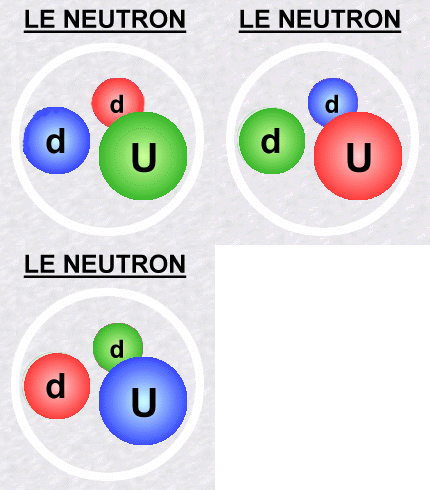
He has some French in him, can't you tell?
Oddly enough, Ned was not found by a talent agency until 1932 when a scientist named James Chadwick finally saw his talent. This English physicist eventually won a Nobel Prize for his work. When Chadwick started searching for the star that would one day light up the silver screen, he relied on Irene Joiliot-Curie's previous work on atoms. He saw great potential in the atomic particles. Chadwick devised an experiment where the nucleus of an atom was bombarded by photons and particles; this may have hurt, but was essential for determining the charge of a particle. The result showed that a neutral particle was present; today we call him Ned, the Neutron. The energy that was emitted because of the bombardments was not consistent like it would be if there were only protons present. To find the mass of the neutron, Chadwick bombarded hydrogen atoms with neutrons, which he had produced in order observe the speed of the protons after the collisions. Chadwick in his discovery prepared the way for the creation of the atomic bomb, a true danger amoung humans. In this way, Ned's friends could be destructive, despite his wieght of only 1 amu.
Along with Protons, neutrons play an important part in construction and the stability of a nucleus. Being neutral and stable, a neutron will not usually decay or assist the atom in being radioactive. This causes the nucleus itself to be stable. However, if the nucleus has too many neutrons, one or more of the neutrons may decay or be lost. Scientists describe the unstable nuclei as being radioactive and describe their changes as nuclear reactions. Isolated from nuclear matter, a free neutron decays into a positively charged proton and a negatively charged electron, releasing nuclear energy in the process. An average free neutron will last only 15 minutes; it was a wonder Ned wasn�t found for so long!
Even before the discovery of neutrons in 1932, physicists realized that atomic nuclei must have an electrically neutral component. Without a neutral component, the mass and the charge wouldn�t equate. The mass of nearly every hydrogen atom is equal to the sum of one proton and one electron, but for any other atom, the atomic mass is larger than the sum of the electron and proton masses. The neutrons are responsible for the remaining mass of the atom. Different atoms of the same element may have different numbers of neutrons, although they always have the same number of protons. These atoms are called isotopes.
Other details:
For a while, physicists thought that protons and neutrons were the smallest particles inside the nucleus. However, after 1947, physicists found other elementary particles, such as the lambda particle and mesons. Scientists though that since the elementary particles appear to be related to each other, they must all be composed of the same smaller building blocks, tiny grain like particles, which they called quarks. The neutron, like the proton, is made of three quarks. The strong nuclear force is actually a force that attracts quarks to each other to make a proton or neutron. The quarks of a neutron or proton will also attract the quarks of another neutron or proton, holding the nucleus together.
By studying the neutron and its physics, physicists can better understand what happens inside and around neutron stars, those stars that are made up entirely of neutrons (like, wow) and have an amazingly dense density of 100 million tons per cubic centimeter. Knowledge of the neutron also aids in the design of nuclear reactors and especially nuclear weapons, mostly by the United States, Russia, China, France and Korea. Nuclear reactions release a tremendous amount of energy. This energy can be used in nuclear weapons or, when the reactions are carefully controlled in nuclear reactors, as a source of electricity. So the study of the neutron remains important, and even useful, which is why physicists continue to research these tiny particles of the atom today. Without their study, and search, perhaps Ned would not be the star of "The Gold Foil Experiment" like he is today!