
I know it's annoying, but at least you will be able to spell "welcome" for the rest of your life.
I know it's annoying, but at least you will be able to spell "welcome" for the rest of your life.
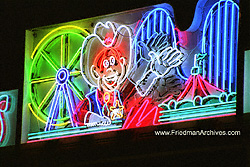
This could be neon, but perhaps it's argon, no?
Either way, he resembles Korin... in an odd sort of way.
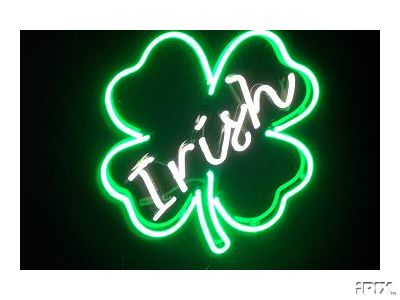
Ok, now that neon�s fraud has been exposed, we�ll go over the chemistry of these impressive glowing signs; after all, it is a kind of chemistry that makes them so lively in color. The gases in these tubes (for now, we�ll just call them neon, or �the gas,� or �the gases�), can last much longer than light bulbs. This is because of the way �the gases� produce their light. Instead of heating a filament, like in light bulbs, neon light is actually produced by passing a high-voltage electric current through a glass tube filled with an inert gas � a good example is (you guessed it) argon and mercury.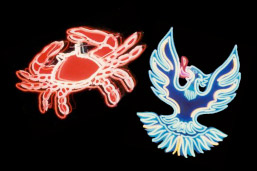
Pretty birdy thingy and crab, eh?
Each different gas has its own color when electrified, but other elements can also be added to the gaseous mixture to produce different colors. A good illustration of a mixture can be found by adding mercury to argon. Instead of glowing dark blue, when argon is mixed with mercury, it tends to be a much lighter brighter blue. Another way you can change the color of the tube lighting is by using different color glass tubes or a power that can be put on the inside of the glass to make it fluorescent. By using a combination of different gases and different glass colors/powders, many different colors can be achieved. The number of different designs can be attributed to the ease in which designs can be made. The glass tubing can be intensely heated, making the glass molecules soft and pliable. From there, the glassworkers can bend the tubing into whatever shape they desire. A multiple colored neon sign is simply a system of various glass tubing with different gases or colored glass on each one. Store owners and sign makers can make the signs blink by making the electric current stop and start at constant intervals. As the electricity stops, the sign goes dark, and as the electricity comes back in contact with the gas, the sign lights up again.
A little history about neon (and the other friendly glowing gases):
Sources: (clicking on the following links will open a new window)
http://www.neonworksusa.com/how.htm
Go back to my homepage!
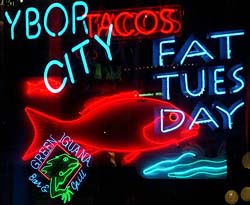
Like, whoa. Doesn't this fish look a lot like Ben Tietze?
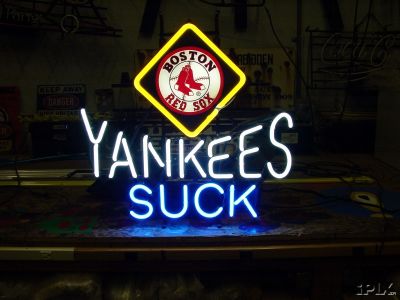
I'm a Red Sox fan, this is just my opinion.
If this is offensive to you, or you are a Yankees fan, I'm sorry. I really am.
New York is a great city, I just hate the Yankees. With a passion.
http://www.neonworksusa.com/history.htm
http://chemistry.about.com/library/blne.htm
http://www.neonmaven.com
http://www.ybortimes.com
Or... you could scroll down more and view the finale.
A few simple things we learned:
Click here to get the time (this is really cool).