New times, new worlds, new
societies.
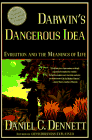 Philosopher of
science Daniel
Dennett has argued that the idea of evolution by natural selection
is "the single best idea anyone has ever had." Even if Darwin
was the first to have the idea of natural selection, he remained
frozen, unable to publish the idea for 20 years. It took the work of Alfred
Wallace, another naturalist who realized the importance of
geographical isolation in evolution, to spur Darwin into publishing and
sharing his great idea. Many biologists have come to take the view that
"nothing in biology makes sense without the idea of evolution." But as
Dennett and others have pointed out, evolutionary processes are not
restricted to the domain of genomic changes through time. Computer
scientists now study the evolution of "artificial
life" and the elements of human culture also evolve within their
own memetic
domain. For all of these domains where evolution occurs, geographical
isolation allows a sub-population to change rapidly in response to
local environmental conditions.
Philosopher of
science Daniel
Dennett has argued that the idea of evolution by natural selection
is "the single best idea anyone has ever had." Even if Darwin
was the first to have the idea of natural selection, he remained
frozen, unable to publish the idea for 20 years. It took the work of Alfred
Wallace, another naturalist who realized the importance of
geographical isolation in evolution, to spur Darwin into publishing and
sharing his great idea. Many biologists have come to take the view that
"nothing in biology makes sense without the idea of evolution." But as
Dennett and others have pointed out, evolutionary processes are not
restricted to the domain of genomic changes through time. Computer
scientists now study the evolution of "artificial
life" and the elements of human culture also evolve within their
own memetic
domain. For all of these domains where evolution occurs, geographical
isolation allows a sub-population to change rapidly in response to
local environmental conditions.
The colonization of the Americas provides us with historical
perspective on how the geographical isolation of a "new world" can
allow for rapid social evolution. When Thomas Paine arrived in
Pennsylvania, it was not clear to North American colonists that they
should abandon the colonial system being exercised upon them by the
English Monarch. England's war with the French in the New World could
be taken as proof that the English colonies needed the military support
of England against other European powers.
Why did Thomas Paine see that the time was ripe for the
colonies to move for independence? Paine, raised as a Quaker in
England, came naturally by his strong anti-authoritarian nature. While
in England he tried his hand (without success) at struggling against
the
government for improved benefits for government workers. Upon arriving
in the new world, he knew just how remote the colonies were from
England and saw that geographical isolation as an opportunity to escape
from institutionalized social anachronisms like slavery (African
Slavery in America, 1775) and the Monarchy. Of course, Paine was
ahead of his time; upon arriving in the new world he joined the first
anti-slavery society that had been created in America.
"Government, even in its best state, is but a necessary evil; in its
worst state, an intolerable one." -Thomas Paine
Paine's celebrated attack on Monarchy (Common Sense, 1776)
starts with a comment about how it is natural for people to fail to
question the social conventions that they grow up with. The antidote to
this basic conservative force is education and broadening of
perspectives. Paine was devoted to being informed and his breadth of
knowledge made it easy to see that there was nothing magical or divine
about Monarchy. The geographical isolation of the colonies made it far
easier to publish an inflammatory anti-Monarchy document, but even
Paine could not risk attaching his name to "Common Sense".
One of Paine's volleys against Monarchy was an argument based upon
information: "it [Monarchy] first excludes a man [the King] from the
means of information, yet empowers him to act in cases where the
highest judgment is required. The state of a king shuts him from the
world, yet the business of a king requires him to know it thoroughly;
wherefore the different parts, by unnaturally opposing and destroying
each other, prove the whole character [of Monarchy] to be absurd and
useless." Paine argues relentlessly that individual men [and we really
must qualify this as "free and educated men"] know how to order their
own society and that a government can only serve people when a
government is put in place by the governed as a tool for serving the
governed.
 "I
fear not, I see not reason for fear. In the end we will be the
victors. For though at times the flame of liberty may cease to shine,
the ember will never expire." -Thomas Paine
"I
fear not, I see not reason for fear. In the end we will be the
victors. For though at times the flame of liberty may cease to shine,
the ember will never expire." -Thomas Paine
The Thomas Paine Reader
(Penguin Classics)
by Thomas Paine, Isaac Kramnick (Editor), Michael Foot (Editor)
Two centuries after Paine, liberals and social progressives continue to
ask: to what extent do we still have a government that is devoted
to
serving special interests rather than to serving the needs of the
governed? We must also ask: do our forms of government tend to improve
with time, and if so, what it is that causes this improvement? The
printing press, the industrial revolution, the right to vote, freedom
of the press, and mandatory public education have been the foundation
upon which improvements in government have been built. All of these
advances rely on technological developments. A recent
example of
special access to the powers of government is the way in
which the
Bush administration established its energy agenda. The special
interests of the energy industry were invited into the policy formation
process while consumer and environmental interests were excluded. The
Bush administration has claimed
the right to closed government,
resisting what has been a growing tide towards more open government.
Can information technologies like the internet continue to empower
individuals and restrict the self-serving secrecy of those who continue
to use government as a tool for personal gain?
Paine realized that the geographical isolation of the colonies provided
an opportunity for liberating the colonists from the distant hand of
the
king and others in the old world who saw the new world only in terms of
a source of wealth to be exploited. Today, we contemplate a future in
which New Worlds in outer space
await human colonization. Just as European nations first saw the
Americas as a source of wealth to be plundered and resources to be
exploited, we are still in a phase during which many people demand to
see
short-term profit in space exploration. Others argue that we should
colonize planets like Mars and do it for the Martians
of the future. The life of Thomas Paine illustrates a less
altruistic reason for space colonies. After Paine helped to secure new
liberties for Americans, he returned to Europe and brought the struggle
for more open and representative government back to his original home.
We should not lose sight of the possibility
that space colonies may provide a critical threshold of isolation from
entrenched power-wielders on Earth. New social experiments such as
an attempt to attain complete transparency in government and the
economy can be tested as
part of humanity's migration into outer space. If such experiments
succeed first in space, the cause of social revolution may ultimately
echo back to
Earth.
"There is no place for mystery. In the representative system, the
reason for everything must publicly appear. Every man is a proprietor
in government, and considers it a necessary part of his business to
understand." -Thomas Paine (1792) "The Rights of Man"
"The culture of secrecy in government is not unlike the culture of
secrecy in many areas outside of government. People know that
information is related to power, and often they want to control
information, in order to enhance their own power."- Ralph Nader
 An increasing number
of people look at Earth and see an inevitable playing out of the Tragedy of the Commons. We
seem powerless to restrain ourselves from over-exploiting our home
planet's natural resources. How dare we exterminate the vast, hard-won
biological diversity of this world? If we examine just our own star
system we can see how rare and valuable a biosphere like that of Earth
is. There are many worlds, but life is rare and clings in a frail crust
to our home world. Thomas Paine felt a responsibility to
defend the officially unrecognized rights of slaves. Today,
revolutionary social forces like the Green
Party movement have taken on the responsibility of protecting otherwise
unrecognized rights of other species. It is not clear by what path we
can avert the Tragedy of the Commons, but one possibility
presents itself in the uncertain opportunities of outer space. The
lifeless expanses of outer space may be the "natural" place for
technologically advanced apes. We may be on the verge of a bifurcation
of humanity into a low-tech fraction devoted to sustainability of
Earth's complex biosphere and a high-tech fraction that is free to
explore the possibilities of advanced technologies in space and on
other, (as yet) lifeless worlds.
An increasing number
of people look at Earth and see an inevitable playing out of the Tragedy of the Commons. We
seem powerless to restrain ourselves from over-exploiting our home
planet's natural resources. How dare we exterminate the vast, hard-won
biological diversity of this world? If we examine just our own star
system we can see how rare and valuable a biosphere like that of Earth
is. There are many worlds, but life is rare and clings in a frail crust
to our home world. Thomas Paine felt a responsibility to
defend the officially unrecognized rights of slaves. Today,
revolutionary social forces like the Green
Party movement have taken on the responsibility of protecting otherwise
unrecognized rights of other species. It is not clear by what path we
can avert the Tragedy of the Commons, but one possibility
presents itself in the uncertain opportunities of outer space. The
lifeless expanses of outer space may be the "natural" place for
technologically advanced apes. We may be on the verge of a bifurcation
of humanity into a low-tech fraction devoted to sustainability of
Earth's complex biosphere and a high-tech fraction that is free to
explore the possibilities of advanced technologies in space and on
other, (as yet) lifeless worlds.
The Mars
Society's Civilization and Culture Group is a forum for the
discussion of the technical, political, economic, social, and
ecological aspects of Martian exploration and settlement. An active
project of the Civilization and Culture Group is the RCC Discussion Group.
The purpose of this subgroup is to discuss Robinsonian
Cooperative
Corporations and how they might be useful for Martian pioneers.