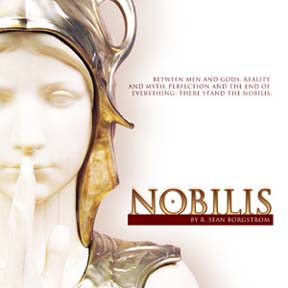
Nobilis:
A Game Of Greater Powers
What Is This?
Nobilis is a diceless roleplaying game that I intend to start running either at the end of 2003 or at the very start of 2004, here in Ithaca, NY. In the game, players take on the roles of the Nobilis, the "sovereign powers" of the world. Each Noble is effectively a demigod who has been given total charge of one aspect of reality, such as Death, Loss, Joy, Worship, Barriers, Kung Fu or Treaties.
The Nobles have within their power the ability to perform all manner of wonders with regard to their chosen domain. So the Noble of Death might be aware of every death occurring on the face of the Earth, while the Noble of Treaties might be able to cause a contract to be annulled, or alter it so that specific provisos were different, and always had been. Beyond being able to open a large personal can of whupass, the Noble of Kung Fu would be able to endow and take away others' ability in that field, and might even be able to extend his abilities to more spiritual matters, depending on how Kung Fu was defined in the game world.
The Nobilis do not exist in vacuo. Instead, each Noble is part of a Familii Celesti - a group of Nobles tied to the service of one of the great Imperators - the Angels of Heaven or the Devils of Hell, or serving the other great forces in the world such as the Light, the Dark, the Wild or even the mysterious Aaron's Serpents. The group of PC's in a "standard" game of Nobilis is taken to be one such Familii Celesti.
For a bit more of a primer on the world of Nobilis, try the following links:
(N.B. - These links are to PDF documents. Depending on how stupid your browser is, you might have to right-click the links and tell it to "Save Link As..." or something. Alternatively, if it opens the source-file as a big pile of hexadecimal, just choose "File > Save As...", save to desktop and sic Acrobat on it....)
- 2-page "flyer" overview
- Introductory chapter to the corebook. Explains things better than I can.
- Example of play, also from the corebook. Demonstrates a wide variety of styles.
The Game
Nobilis is a toolkit game, in that it affords the GM and players the ability to cooperatively design a unique campaign world and develop its moods, themes and conflicts. It is my hope that we'll be able to do this together and produce a highly unique and satisfying game.
I've already mentioned that I am working my way towards leaving Ithaca come the summer of 2004. We aim to be playing Nobilis every other weekend throughout the spring of that year. So I think we should deliberately aim to construct a campaign that tells one complete, satisfying story in about 10-12 chapters. In the last section of this page I go on to outline some of the considerations that we might bring to that story.
The Rulebook
Nobilis is written by Rebecca Sean Borgstrom. The core rulebook is a 304 page 11" x 11" hardback - a massive, beautiful coffee table tome - and is packed with evocative images and excellent writing. I truly think that this is one of the best roleplaying games available and I strongly encourage that you get a copy if you think you can afford one. The best price I can see online is from Gamer's Attic. I've shopped from Robin Parks, who runs that store, a number of times before and have found him to give pretty good service.
(N.B. - If you're buying online with PayPal from Gamer's Attic make sure to enter "paypal" as a discount code on the purchase page. You'll save 5%.)
All that said, you won't need a copy of the rulebook to play in this game. I have one and Matt has one and there's plenty of time between now and Christmas for you to lay hands on one or other of them. Moreover, the nature of the game is such that you won't be flipping through the corebook during play to look up the specifics of this or that Feat or Spell. Buying the book is definitely a luxury, albeit one that I feel is well worth luxuriating in.
Rules Overview
You might be wondering how these so-called "diceless rules" work. I mean, what kind of "game" is this anyway? Well, firstly, it's worth saying that Nobilis is decidedly a different kind of game from Dungeons & Dragons. It's very explicitly assumed by Nobilis that telling a worthwhile story about these characters is the point of the game. This deliberately puts players with a foot in two worlds: At one level, you're empathizing with and relating to your character and you want what the character wants - success, however you would term it, and (probably) an easy life. But on the other hand you're also actively involved with your character from the point of view of an author, and that's going to mean working with the GM to find worthwhile conflicts for your character to be involved with because, let's face it, if the characters could easily get everything they wanted the game wouldn't be much fun, would it?
The above is worth considering in light of the rules, which really serve to meter how much control each character is able to exert over reality at any given point in the narrative. These rules are very simple; it's all done with Miracles:
Charactes in Nobilis have four Attributes:
- Aspect - Defines physical and mental ability, basically all of a traditional RPG character's abilities rolled into one.
- Domain - Reflects the Noble's degree of control over his or her Estate, that portion of reality over which s/he has been given dominion.
- Realm - Reflects a character's standing within the social order of the Nobilis and the amount of resources, both magical and mundane that s/he controls.
- Spirit - The most nebulous attribute. Measures the spiritual strength of the character. Fundamentally, this comes down to three effects: Firstly, higher Spirit characters are more resistant to hostile Miracles being brought to bear on them. Secondly, higher Spirit characters have access to more Anchors (see below). Thirdly, if your Noble practises "mundane" (ie. non-miraculous) magics, high Spirit will help him or her do so.
These Attributes are ranked from 0 (human) to 5 (godly). The Miracles that are possible to achieve with each are ranked from 0 to 9. Characters can automatically succeed at any Miracle up to their Attribute rank. To succeed at higher levels you must spend points out of a pool which refreshes at the end of each story, or at other pre-specified times.
Additionally, Nobles may have Gifts - permanent and unique supernatural abilities which the character has access to. These can range from Immortality, to always looking immaculate and never getting dirty, to Being A Dragon to just about anything you can imagine.
Each Noble is also tightly bound to a select group of humans whom he either loves or hates. These people are known as his Anchors and he may inhabit their bodies, either communicating with them or over-riding them and taking control.
Nobles are also defined in terms of the Code to which they adhere, their limitations and flaws and, most importantly, the way they choose to define the meaning of their Domain and its significance in the game world. However, I don't want to rewrite the entire corebook here, just present a quick overview. So let's move on to....
Putting It All Together
Most RPG's start with character generation. But I want this game to start futher upstream with Campaign Generation. As I said above, this is a toolkit game - not a complete world in a box but rather the opportunity to define many worlds. Since we only have ten or a dozen sessions to play, let's use our "zeroeth" session to sit down and map out the kind of a game we want. Below is a list of some of the issues that we'll need to consider. The list is far from complete, but consider it a kind of teaser to get your brain thinking about what we might want to do with this shiny new toy:
- Overall Aesthetic
You could use Nobilis to simulate any of the following: The Sandman, The Prophecy, Good Omens, The Lord Of The Rings (from the point-of-view of the Istari), The Matrix, The Invisibles, White Wolf's Mage: The Ascension and a whole lot more. What I feel is important is that we don't try and simulate them all at once, otherwise we'll just have a mess. To this end, it's worth people taking a few notes on what they think their impression of this game is and what they would like to see done with it. That way there's a better chance that we'll all be on the same page going out of the gate. - Genre
Tied to the above point, Nobilis can be run in a variety of genre styles: It can be an action movie, a romance, a mythic working, a tale of conspiracy and intrigue, modern horror, a morality play and many other things. You might consider what element(s) you're interested in seeing in play. That way nobody ends up trying to play Hercule Poirot when everyone else is playing Natural Born Killers. - Themes
A large part of the "point", for me, of playing Nobilis is to explore the kinds of themes that generally don't get covered in gaming. There's maybe not such a lot of point in doing another "heroes fight evil and just save the world by the skin of their teeth at the eleventh hour." Most of us have been there, done that and already have an entire closet full of the t-shirts. Instead, how about a really different story - a tragedy, a history, an outright comedy? Let your imagination roam a bit and see if you can think of a new kind of story that you think would make for a satisfying roleplaying experience. Everyone who succeeds in terrifying me with their limitless vision wins a nickel. - World
The default setting for Nobilis is seemingly the modern world, at the start of the 20th Century. Behind this lies the cosmology outlined in Chapter 1 of the corebook (see the link above). This setting has a strong Judaeo-Christian flavour as well as other, more postmodern, elements. However, all of these aspects are up for debate. Maybe we want a world in which Everything is True, or a world where some entirely Other thing is true. Maybe we'd be happier playing set in Medieval France or prehistoric Africa. Maybe we want to set the game in a "fantasy" world stolen from Lord Dunsany, or Roger Zelazny. Or maybe we want to play in 27th Century Tokyo. If you have a good idea for something off the wall then make a few notes and bring them along to the "shakedown". - Chancel & Imperator
Every familia celestus serves an Imperator, and every Imperator has a Chancel - a little pocket reality right next to the "real world" that his Nobles have access to as both sanctum and resource. The interrelationship between the Chancel and the "real" world (as discussed above) can do a lot to colour the nature of a given setting. And the nature of the PC Nobles' relationship with their Imperator, and the goals of that Imperator, will go a long way to colouring the nature of the stories told in that setting. If the Imperator is a magistrate or a spymaster then two very different types of stories will be told. These issues are probably best addressed once we've battoned on a genre and themes, but I felt they were worth noting now.
Enough For Now...
Okay, if all that didn't give you enough to think about in the meantime then may I suggest you get another job? Hoo boy.
Let me just say that I think it's obvious that there's a lot that we can do with this game - way, way, way more than we can hope to in 10-ish sessions. What I'm hoping is that if we all think about it a bit and get together then people will be able to find an approach which appeals to everybody and we can specify some things about the campaign, then all design characters that will work in that campaign, and then knock each other's socks off every other Sunday doing something truly mad and getting some decent RP in to boot.
So get thinkin'!
| Email me. | Back to Main Page. |