 |
|
|
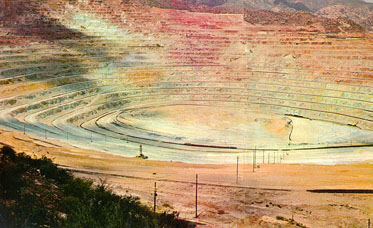
My mother's father, Wenseslado Díaz, came to Morenci in 1908. He was working in the Cananea mine in Mexico when P.D. recruited him along with many other Mexican workers to come and work in the Morenci mine. Atanacio Limón, my grandmother's father, also worked in the mine. His job was hauling ore in a mule-drawn wagon until he was blinded by an overhanging tree branch. No compensation was made by the company for his injury and my great-grandmother, Josefa was forced to support them. She took in laundry like the heroine Juana in "Just Rewards" of my book Suffer Smoke. Grandma Pepa, as we called her, also made food to sell. In those early years the mine was underground and Morenci people dreaded to hear the company whistle blow at an unscheduled time because it meant a cave-in. In 1937 the operations switched from underground to open pit mining and people now worried about blasting accidents or train derailments. When the whistle blew, the whole town stopped their activities, expecting to hear the worst. By the mid forties, My grandfather's two sons and six sons-in-law worked either at the Morenci mine or the smelter. Serapio Herrera, my father's father, worked at the Detroit Copper Company's smelter in Clifton, a town located down the mountain from Morenci. He quit to become a farmer when he married my grandmother. My father, Valentine, and his three brothers worked for Phelps Dodge. My father started working in the underground mine when he was fifteen years old. He and my mother remember what Morenci looked like before the open pit started eating away the mountains. He was paid considerably less than an Anglo for doing the same work and did not receive promotions. During World War II, the union took the company before the National War Board and Mexican-Americans finally earned the same pay as gringos. When my father started to work for Phelps Dodge, he earned $2.68 a day. He retired after working over forty-one years and by then was earning $110 a day. Wage increases didn't happen because of the company's social consciousness. It was because workers, hungry for their rights, declared huelgas; strikes like the ones in "A Christmas Story" and "Please Don't Take the Refrigerator!" The workers fought for issues such as safe working conditions, health care, and retirement benefits. Huelgas were a way of life for us in Morenci. No Chicano raised in Morenci can ever forget our parents' brave struggle to obtain workers' basic rights through strikes, even when it meant deprivation for their families. The union cemented the Chicano community. Only by sticking together were Chicanos able to obtain what P.D. automatically gave to Anglos. The union extended my family to the entire Chicano community and combined with the Catholic Church, it allowed me to know almost everyone in Morenci. I knew who belonged to which family and what their names were; even their dogs. It was a community I felt safe in; one that shared its meager resources when the need arose. Strikes occurred when the union's contract was up and P.D. refused to budge on workers' demands. Strikes were usually over soon enough, but sometimes they dragged on for months as in "Please Don't Take the Refrigerator!" which tells what it was like for families during a strike. The company store stopped giving credit and when payments could not be made on furniture, T.V. sets, stereos, etc. they repossessed them. Picket lines were for the most part peaceful but after a prolonged strike, P.D. brought in "scabs" which sometimes led to violence. Women took their turn, supplying the men with food and coffee and even walking the line. As a contract was drawing to an end, savvy women stocked their larders with sacks of flour, beans, potatoes, red chili, and large cans of lard. They did not know how long the huelga would last and it was best to be prepared. People grew their own vegetables or picked them in the wild. We ate quelites, verdolagas, and nopales. During a long huelga, like the one in 1959, men were forced to seek work elsewhere so their families could survive. As far as I was concerned, the only good thing about a strike was that the suffer smoke stopped. |
|
